
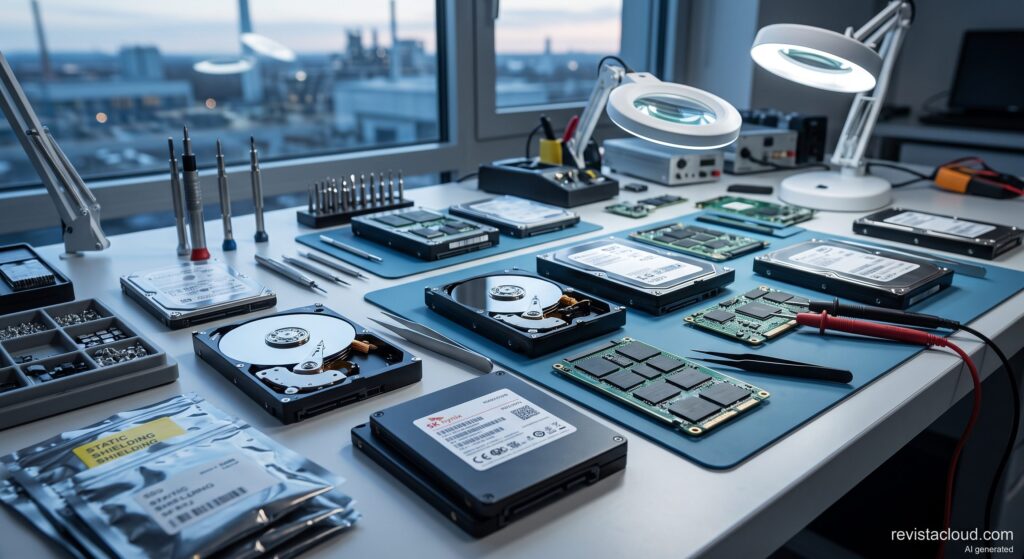
The stress in the memory market is starting to have a less obvious impact on consumers: obtaining a new SSD through warranty claim can become problematic. A recent widely shared case shows SK hynix offering to refund the originally paid amount for a malfunctioning unit due to stock shortages for replacements. This warranty option is available but especially unfavorable when buying an equivalent SSD now costs significantly more.
The key points of SK hynix RMA process in 20 seconds
- A user reports SK hynix has no stock to replace their faulty SSD and offers a refund.
- The company’s official warranty allows this possibility.
- The refund amount can be the lesser of the original purchase price and the current market value.
- The issue arises when SSDs have increased in price since purchase.
- This situation shows how memory shortages are starting to impact after-sales service as well.
The case should be interpreted with caution. One user’s experience does not prove that SK hynix has stopped generally replacing warranty units. However, it highlights a clause explicitly included in the company’s official conditions, which becomes particularly significant in a rising-price market.
SK hynix offers a limited five-year warranty for its consumer SSDs. Within this period, if a product is deemed faulty, they can repair or replace it, or alternatively, provide a refund calculated as the lesser of the original purchase price and its fair market value.
The problem isn’t getting the money back, but how much a new SSD costs now
On paper, this approach may seem reasonable. For decades, computer components have tended to offer more capacity and features for the same or lower prices over time.
A SSD bought for 150 euros could fail after four years when an equivalent unit cost 80 euros. Receiving a monetary compensation would make it easy to acquire a replacement.
But in a strained market, this logic can reverse.
Suppose a consumer bought a SSD for 100 euros during a period of low prices, and now an equivalent unit costs 200 euros. If the manufacturer lacks a replacement unit and only refunds the original 100 euros, formally the buyer gets back what they paid, but they need an additional 100 euros to get a comparable product.
That is precisely why these cases are causing frustration among some users.
SK hynix’s documentation is quite clear. Considered defective, products can be repaired or replaced according to company policy and discretion. Instead of doing so, the original purchaser may be offered a refund based on the lesser of the original price paid and current market value.
This leads to an interesting outcome.
If the SSD has depreciated, the compensation may be adjusted to its lower current value. But if the storage has increased in price, the limit becomes what the consumer initially paid.
This clause thus protects the manufacturer from price movements in either direction.
Five years of warranty doesn’t necessarily mean five years with an equivalent SSD
There’s another noteworthy detail in the terms.
When SK hynix performs a replacement within the five-year period, the countdown does not restart from zero. The replaced unit retains the remaining time based on the original purchase date.
Documentation also states that, when a product is exchanged through an authorized distributor and remains under warranty, a functionally equivalent replacement should be provided at no additional cost and according to SK hynix specifications.
The scenario changes when no product is available, and the refund option is used instead.
This makes warranty stock management much more critical. In a normal market, replacing a relatively old SSD can be straightforward because newer models with equal or greater capacity are often available at lower prices.
When prices rise and certain capacities become scarce, maintaining those equivalents becomes more difficult and costly.
RMA issues are starting to appear with other manufacturers too
SK hynix is not the only company with recent complaints related to replacements.
Users of Crucial products have shared similar experiences. In one recent case, a user with a DDR5 kit said Crucial told them they could no longer provide replacement products, offering only a refund of the original purchase price.
Another case involves Micron and Crucial, illustrating how these situations can become complex. A company described the warranty process for several NVMe SSDs, noting that initially they received inferior alternatives due to stock shortages. After further claims, they eventually received a unit of the same model.
These experiences remain individual reports and do not establish a general industry policy to avoid replacements.
However, they reveal an interesting issue: a prolonged component shortage can extend from retail shelves to warranty departments.
Manufacturer’s commercial warranty isn’t the whole story
There’s also an important distinction to keep in mind, especially for European buyers.
The commercial warranty conditions offered by a manufacturer do not necessarily replace the legal rights a consumer may have against the seller based on local laws.
Therefore, just because SK hynix’s international warranty provides a certain compensation mechanism does not automatically mean it’s the only option available to all buyers and in every jurisdiction.
This is particularly relevant in Europe, where specific rules regulate the conformity of goods sold to consumers.
It also depends on where the SSD was purchased, when, from whom, and which legislation is applicable. A voluntary RMA with the manufacturer and a legal warranty claim against the seller are not necessarily the same.
Thus, concluding that all SK hynix SSD owners will only get their money back in case of failure is an oversimplification.
What is clear is that SK hynix’s own conditions allow opting for a refund instead of repair or replacement, and that this refund is limited to the lesser of the original price and current market value.
Rising prices alter the true value of a warranty
Finally, the situation raises a significant question for an industry that competes by offering five-year warranties.
The number of years is important, but it doesn’t by itself predict what will happen if the product fails.
It also depends on whether the manufacturer retains stock for RMAs, provides equivalent models when a generation’s stock runs out, and how it calculates any eventual compensation.
While prices decreased with each generation, these differences may have gone unnoticed. When replacing a component today costs significantly more than it did years ago, the fine print conditions start to matter much more.
For buyers planning to purchase storage during a period of shortages, it’s no longer enough to compare capacity, performance, TBW, or warranty years. It may also be wise to check exactly what the manufacturer promises when an equivalent unit cannot be delivered.
Frequently Asked Questions
How many years of warranty does SK hynix offer for its SSDs?
SK hynix provides a limited five-year warranty for its consumer SSDs, subject to its specific conditions and requirements.
Can SK hynix refund the money instead of replacing an SSD?
Yes. Their conditions specify that, instead of repairing or replacing a faulty unit, a refund based on the lesser of the original price and the fair market value can be offered.
Why might this system now be disadvantageous to consumers?
Because if the SSD was purchased when storage was cheaper, and now an equivalent model costs much more, recovering only the original price may not be enough to buy a comparable unit.
Does the manufacturer’s warranty replace the legal rights of the seller?
Not necessarily. Consumer rights depend on jurisdiction, the seller, purchase date, and other factors. The manufacturer’s commercial warranty can coexist with other legal rights.
