
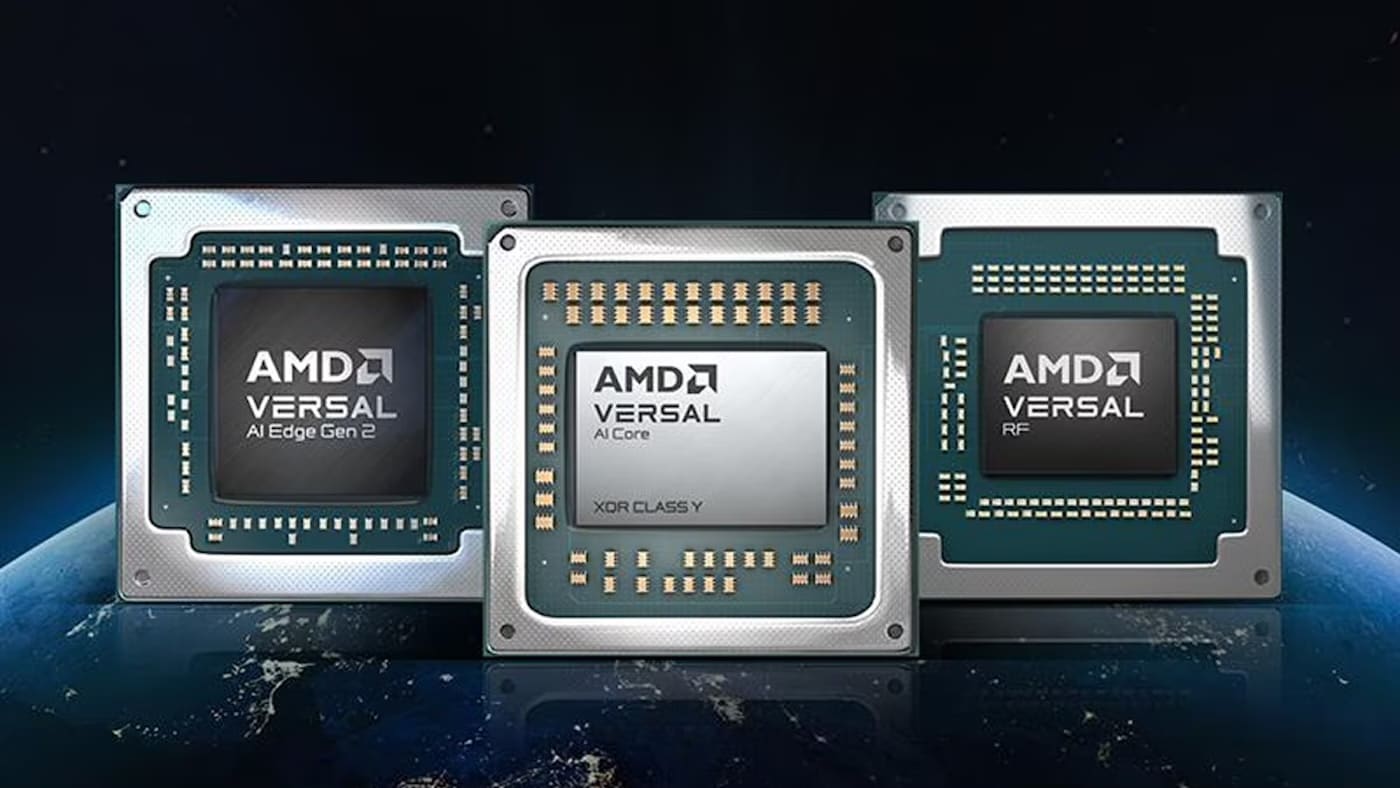
AMD might end up turning to Intel for part of its advanced manufacturing supply chain. A recent note from UBS includes AMD among potential clients of Intel Foundry for EMIB-T, the new generation of advanced packaging from the American manufacturer, alongside names like Google, Apple, and SpaceX. This forecast comes as another analysis from Goldman Sachs portrays a still significant gap between AMD and Nvidia in full AI systems: estimates project 50,000 Nvidia racks versus 5,000 AMD racks in 2026, with the disparity remaining considerable until 2028.
The key points about AMD, Intel, and the AI rack race in 30 seconds
- UBS anticipates future agreements of Intel Foundry with Google, Apple, AMD, and SpaceX, although there is no publicly confirmed contract with AMD.
- Intel states that customer interest in EMIB-T is high and is preparing volume increases for 2027.
- Goldman Sachs estimates 50,000 Nvidia racks versus 5,000 AMD racks in 2026.
- The forecast increases to 148,000 Nvidia racks and 15,000 AMD racks in 2028.
- AMD continues expanding Helios and its manufacturing ecosystem to compete at rack scale, not only through GPUs.
The idea of AMD using Intel manufacturing technology is striking considering decades of direct competition in x86 processors. However, the current semiconductor industry makes this apparent contradiction much less significant than it would have been years ago.
A company can design a processor, have its various dies fabricated by an external foundry, source memory from another supplier, and rely on a third company for advanced packaging. Product competition doesn’t necessarily prevent a customer-provider relationship at another layer of the supply chain.
That is precisely what Intel aims to achieve with Foundry.
Nevertheless, it is important to maintain a key distinction: UBS is making a forecast, not announcing a confirmed agreement between AMD and Intel. The analysis firm’s note expects financial commitments or upfront payments associated with upcoming foundry contracts with Google for EMIB-T, Apple for M-series processors, AMD, SpaceX, and possibly other clients.
Intel has not publicly identified AMD as a client for EMIB-T.
EMIB-T could become an alternative to packaging bottlenecks
Intel describes EMIB, Embedded Multi-die Interconnect Bridge, as a 2.5D encapsulation technology that uses small silicon bridges embedded in the substrate to connect different dies with high bandwidth.
EMIB-T adds TSVs, or through-silicon vias, to the bridge itself, enabling vertical connections in addition to lateral communications between chiplets. Intel presents this technology for logic-logic and logic-HBM integrations, precisely the kind of setup needed in advanced AI accelerators.
Intel introduced EMIB-T in 2025 and stated in its annual report that it expected to begin scaling adoption during 2026.
Since then, the timeline has advanced.
In Intel’s Q2 2026 results, the company reported that customer interest in EMIB-T remains “very high,” that order pipelines are growing, and that performance and reliability levels are meeting expectations. Intel is working to bring this technology to high volume for production increases among customers in 2027.
This provides some industrial backing to UBS’s thesis, although it does not confirm AMD as one of those customers.
The opportunity exists because advanced packaging has become one of the most critical components of modern accelerators.
It is no longer enough to just produce a GPU.
Current systems integrate multiple dies, large amounts of HBM memory, and high-bandwidth connections within the same package. Techniques like TSMC’s CoWoS or Intel’s EMIB make it possible to build these systems when a monolithic chip becomes impractical.
And this capability is increasingly in demand due to the expansion of AI.
AMD needs to ramp up Helios manufacturing
AMD’s situation helps explain why it would make sense to diversify suppliers if the right opportunity arose.
The company is shifting from mainly selling individual Instinct accelerators to offering Helios, a rack-scale AI architecture integrating GPU, EPYC CPU, networking, and ROCm software.
AMD confirms that Helios will use EPYC “Venice” processors and Instinct MI450X accelerators, and expects to start deploying multiple gigawatts during the second half of 2026.
To reach that volume, AMD needs more than just competitive chips.
It needs HBM.
Packaging.
Substrates.
Networking.
ODM manufacturing.
Cooling solutions.
Power management.
And a supply chain capable of delivering complete systems in much larger quantities than previous generations.
In May, AMD announced over $10 billion in investments within the Taiwanese ecosystem to expand capabilities related to AI infrastructure manufacturing and packaging. It also identified firms like Sanmina, Wiwynn, Wistron, and Inventec as manufacturers helping bring Helios to volume production.
Therefore, using Intel Foundry services wouldn’t necessarily mean replacing TSMC as the primary manufacturer.
It could be part of a diversification strategy for a specific phase of production.
Goldman Sachs continues to see a huge gap compared to Nvidia
While UBS looks at manufacturing, Goldman Sachs analyzes the end result: the AI racks that could hit the market.
The chart circulated by Goldman Sachs Global Investment Research projects:
| Year | Nvidia Racks | AMD Racks | Approximate Ratio |
|---|---|---|---|
| 2025 | 19,000 | – | – |
| 2026E | 50,000 | 5,000 | 10 to 1 |
| 2027E | 92,000 | 13,000 | 7.1 to 1 |
| 2028E | 148,000 | 15,000 | 9.9 to 1 |
These are Goldman Sachs estimates, not confirmed orders or official production figures from Nvidia or AMD.
Nevertheless, they highlight the scale of the challenge for AMD.
It’s not enough to simply launch a GPU that reasonably competes with Nvidia in certain workloads. The battle is shifting to complete systems arriving at data centers almost as integrated infrastructure units.
Goldman Sachs has already highlighted how the density of current systems changes the physical economics of data centers. A single Nvidia NVL72 rack concentrates a level of computing that would have required much larger facilities just a few years ago.
In this scenario, success favors those who can coordinate the entire platform.
GPU.
CPU.
Interconnection.
Switches.
Software.
Manufacturing.
Cooling.
Deployment.
Nvidia has the advantage because it has been building this integration for years.
AMD aims to respond with an open platform
Helios represents AMD’s clearest answer.
The company has built the platform around the Open Rack Wide (ORW) from the Open Compute Project, with a double-width design prepared for high-density AI systems, liquid cooling, and large accelerator nodes.
This approach has a strategic difference compared to Nvidia’s: AMD emphasizes a more open architecture and a partner network capable of manufacturing and integrating the system.
It has also expanded Helios through agreements with other companies.
In July, AMD announced a collaboration with Cerebras to combine Helios with Cerebras’ wafer-scale compute technology in a hybrid architecture for low-latency inference. AMD plans to utilize different hardware types for different phases of the process rather than requiring everything to run on the same accelerator.
This kind of integration shows that AMD is trying to compete in a broader scope than just GPU benchmarking.
However, Goldman Sachs’s figures suggest that transforming that technology into tens of thousands of racks will be a much more challenging task.
Intel needs external clients right now
The other side of the story is Intel’s perspective.
The company recently completed a capital increase of $20 billion, after initially planning to raise $15 billion. Intel issued 210,526,315 shares at $95 each.
The funds will be used for general corporate purposes, including capital expenditures and working capital. This move comes as Intel needs to fund both product development and its foundry operations — which require substantial investments over several years.
UBS interprets this capital raise as a sufficient financial bridge to navigate 2027 and 2028, and considers that future foundry agreements might provide upfront payments and additional commitments.
The firm maintains an optimistic outlook on Intel’s 14A process, though it expresses less confidence in the company’s current product roadmap.
Intel, on its part, has already decided to move towards volume production of 14A during 2028, after a risk production phase planned for the second half of 2027.
EMIB-T might become even more crucial in the short term because it can attract clients who may not yet be willing to manufacture their main dies on an Intel node.
A chip can be fabricated at TSMC and encapsulated using Intel’s technology.
This lowers the barrier to becoming a foundry client.
An AMD-Intel relationship in packaging wouldn’t be so strange anymore
The term “rival” greatly simplifies the current semiconductor landscape.
AMD and Intel compete directly in CPUs.
They are also beginning to compete in AI accelerators.
But this doesn’t prevent Intel from selling AMD an encapsulation technology if it’s economically attractive and meets technical requirements.
Similar situations occur elsewhere in the sector.
Apple indirectly competes with other manufacturers that are also TSMC clients. Nvidia and AMD use the same manufacturer for some of their chips. Companies competing in servers can share providers of memory, substrates, or networking.
Modern semiconductor industry is too complex for each company to control the entire supply chain.
That’s why an eventual AMD-Intel relationship in packaging would be interesting, though not illogical.
What would be more significant is what it would mean for Intel Foundry.
Getting a major competitor to trust it with advanced products would be a considerable validation of Intel’s strategy to become an open foundry for external customers.
For now, that remains a UBS forecast.
Intel confirms that there’s a growing portfolio for EMIB-T and that it’s preparing to supply customers in 2027. AMD confirms it needs to scale Helios and is increasing packaging capacity through numerous partners.
The name that would connect both stories has yet to be confirmed by either company.
Frequently Asked Questions
Has AMD already signed a deal with Intel Foundry?
No public contract has been announced. UBS expects AMD to be among future Intel Foundry customers, but until then, this remains an analyst forecast.
What is Intel EMIB-T?
It’s an evolution of Intel’s EMIB technology. It uses silicon bridges embedded in the substrate and adds TSVs to enable vertical connections, also integrating different dies and high-bandwidth HBM memory.
How many AI racks does Goldman Sachs expect AMD to sell?
Goldman Sachs estimates 5,000 AMD racks in 2026, 13,000 in 2027, and 15,000 in 2028. For Nvidia, projections are approximately 50,000, 92,000, and 148,000 units respectively. These are Goldman Sachs estimates, not official manufacturer figures.
Why might AMD need more packaging suppliers?
Helios and future AI platforms require large quantities of accelerators, HBM memory, and advanced packaging. Diversifying capacity can help AMD increase volume and reduce reliance on a single supply chain point.
via: wccftech
