
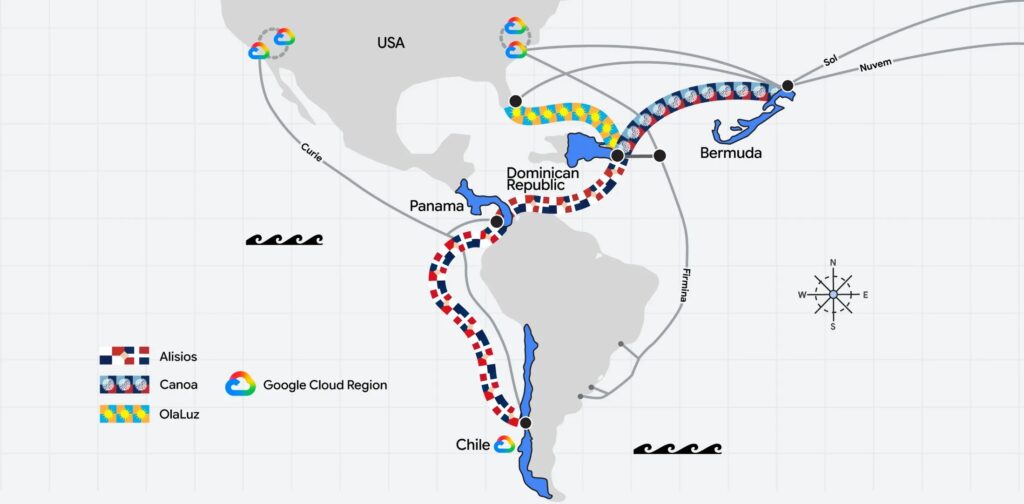
Google has announced Alisios, Canoa, and OlaLuz, three new submarine cable systems that will expand its infrastructure across South America, Central America, the Caribbean, and the United States. Along with a new branch of Firmina and the previously announced Curie, Nuvem, and Sol systems, they will form Americas Connect, an architecture in which the Dominican Republic will play a particularly important role as a connection point, also extending routes to Europe via Madrid.
The key points of Google’s new submarine cables in 30 seconds
- Alisios will connect Chile, Panama, and the Dominican Republic via routes through the Pacific and the Caribbean.
- Canoa will link the Dominican Republic with Bermuda and connect with Nuvem and Sol to extend connectivity to the United States and Europe.
- OlaLuz will create a direct route between the Dominican Republic and Florida.
- Google will also add a new branch of Firmina with a landing in the Dominican Republic.
- Americas Connect will link different routes with Google Cloud regions in Chile, the United States, and Madrid, aiming for greater diversity and fault tolerance.
Announced on August 11, 2026, this development is notable for more than just adding three names to the global map of cables. Google is designing an interconnected infrastructure of routes and rings so that traffic can have alternative paths between geographically separated cloud regions.
This design reflects a less visible reality for internet users. While satellites, 5G, and wireless networks are often discussed, the vast majority of intercontinental traffic still travels via fiber-optic cables laid on the ocean floors. TeleGeography confirms that cables carry over 99% of data traffic between continents, though they warn that there isn’t precise enough data to determine an exact global percentage compared to satellite traffic.
Its 2026 map includes 694 submarine systems in service or planned and 1,893 landing stations. Google’s expansion should be understood within this physical infrastructure, which underpins cloud services, streaming, financial transactions, and increasingly, artificial intelligence services.
Alisios, Canoa, and OlaLuz: what each cable will connect
The system with the broadest regional reach will be Alisios.
Google envisions a connection between Chile and Panama across the Pacific, and another from Panama to the Dominican Republic through the Caribbean. Its name derives from the trade winds that historically aided navigation between continents.
On the Pacific coast, Americas Connect will use Alisios to form a submarine ring with redundant routes between Chile and Panama, plus a third link from Panama to the west coast of the U.S.
This architecture will provide connectivity with Google Cloud regions located in Chile, Los Angeles, and Las Vegas.
Canoa will cover another part of the map.
The new system will connect directly the Dominican Republic and Bermuda. Here, two recent Google investments—Nuvem and Sol—become significant.
Nuvem is designed to connect Portugal, Bermuda, and the U.S., while Sol establishes another transatlantic route between the U.S. and Europe. By combining these systems with Canoa, Google will be able to build pathways from Latin America and the Caribbean to North America and Europe.
Madrid is precisely on this segment of the architecture.
Google explains that the Dominican Republic-Bermuda link can interconnect with Nuvem and Sol via rings to the U.S. and Europe, providing connectivity to its cloud regions in South Carolina and Virginia, as well as to Google Cloud Madrid.
The third system, OlaLuz, has a more geographically direct function: it will connect the Dominican Republic with Florida.
Google intends to use this route to increase capacity and diversity between the Caribbean and the U.S. East Coast.
The name combines “wave” and “light,” a literal reference to the optical pulses used to carry data through underwater fibers.
The Dominican Republic becomes the central hub of Americas Connect
Looking at the new routes together reveals an obvious detail: all three systems pass through the Dominican Republic.
Alisios arrives from Panama.
Canoa heads toward Bermuda.
OlaLuz reaches Florida.
Additionally, Google will add a new branch of Firmina with a direct landing in the country.
Firmina was originally conceived to connect North and South America. The new branch will extend this high-capacity infrastructure into the Caribbean and provide an additional route within Americas Connect.
This positions the Dominican Republic as more than just a cable destination—it can become a node for interconnection among routes originating from the Pacific, Caribbean, U.S., and North Atlantic.
Dominican President Luis Abinader has linked the project to the country’s goal of strengthening its position in regional telecommunications and developing opportunities related to the digital economy. Panama has also tied its investment to its Digital Hub initiative and its national digital infrastructure strategy.
Bermuda plays a similar role in the Atlantic.
According to the Bermudian government, Canoa will be the first submarine system directly connecting Bermuda to the Dominican Republic. Bermuda is already included in the designs for Nuvem and Sol, so this new route will increase its capacity as a key transit point for transatlantic networks.
Google no longer just acquires connectivity: it builds its own network
This announcement also signals a shift that has been unfolding over many years in the internet ecosystem.
Major content and cloud providers have transitioned from being large consumers of telecom networks to actively participating in building international infrastructure.
Google is one of the most prominent examples.
Firmina, Curie, Nuvem, and Sol will now integrate with Alisios, Canoa, and OlaLuz within a broader architecture. The company is also developing Pacific Connect, its submarine connectivity program in the Pacific.
It’s not just about achieving higher data capacities per second.
For a cloud provider, controlling where traffic flows, which regions are connected directly, and what alternatives exist when a route fails is especially valuable.
Resilience is fundamentally built through diversity.
If two data centers are connected by different cables following the same physical route, both could be affected by the same incident. Having geographically diverse routes minimizes that risk.
Americas Connect attempts to apply this principle on a continental scale.
In the Pacific, there will be a ring connecting Chile and Panama with continuity to the U.S.
In the Caribbean, Panama and the Dominican Republic will connect via routes to the U.S. East Coast.
And in the Atlantic, Canoa can be combined with Nuvem and Sol to offer various paths to the U.S. and Europe.
Resilience becomes increasingly important as reliance on the cloud grows
Submarine cables are highly capable but not indestructible.
Fishing, anchors, seabed movements, earthquakes, and other activities can cause cuts. Growing political concern over potential sabotage and attacks on submarine infrastructure has also emerged in recent years.
TeleGeography precisely distinguishes between physical, logical, and geopolitical threats around these networks. Coastal areas and landing stations are especially vulnerable because they concentrate critical infrastructure in accessible points.
The practical solution isn’t to produce an unbreakable cable.
It also involves having alternative paths for traffic when one route fails.
This explains why Google emphasizes concepts like route diversity, rings, and geographically separated cloud regions.
Artificial intelligence adds another factor.
Data centers dedicated to training and inference need to move increasing amounts of information between regions. An application can run in Madrid while querying services, storage, or resources located elsewhere. Multinational companies need to replicate data across continents, and platforms distribute content and computing capacity among multiple centers.
The network connecting those facilities is becoming as important as the servers themselves.
Madrid enters a new route between Europe and Latin America
For Spain, the most interesting detail of Americas Connect is at the Atlantic.
Google explicitly states that Canoa, combined with Nuvem and Sol, will provide connectivity to its Google Cloud region in Madrid.
That doesn’t mean Canoa physically runs from the Dominican Republic to Spain; its announced route ends in Bermuda.
The key is in the interconnection.
Bermuda will serve as a hub linking to other systems capable of continuing toward Europe, creating a chain from the Dominican Republic through Bermuda to Europe, with alternative routes via the U.S.
This distinction is important to avoid interpreting Americas Connect as a single transatlantic cable.
It’s a network of different systems that Google aims to operate in a coordinated manner.
This architecture also aligns with Madrid’s evolution as a data center and connectivity hub for southern Europe. The Iberian Peninsula’s geographic position is favorable for Atlantic cables and can also serve as an entry point to Europe for traffic from Latin America and Africa.
For Google, directly connecting this infrastructure to its cloud regions reduces dependence on intermediate routes and increases options when facing disruptions.
For countries where cables land, potential benefits extend beyond access to Google Cloud. A higher density of international infrastructure may foster data centers, traffic exchanges, and operators—though these effects will depend on how capacity is later commercialized and connected.
Cables remain the invisible infrastructure of AI
The tech industry continually discusses GPUs, large models, AI factories, and data centers of hundreds of megawatts.
All require connectivity.
A data center full of accelerators loses much of its utility if it cannot move data with sufficient capacity and redundancy to other centers, users, and networks.
That’s why the global race for AI infrastructure isn’t just about Nvidia, TSMC, or power companies.
It also extends to the ocean floor.
Modern cables can carry dozens or hundreds of terabits per second using fibers protected within a bundle roughly the diameter of a garden hose. According to TeleGeography’s 2025 analysis, over 570 systems already cross the seabed, with nearly 700 planned by 2026, including projects in progress.
Alisios, Canoa, and OlaLuz will add new routes to this infrastructure.
Google has yet to publicly specify the total length, capacity, fiber pairs, manufacturers, or commissioning dates for these three systems. As a result, detailed technical comparisons with major transatlantic and transpacific cables are premature.
What is clear is the map.
Chile, Panama, and the Dominican Republic will be connected via Alisios. The Dominican Republic will have direct connections to Florida via OlaLuz and Bermuda via Canoa. Firmina will add another Caribbean entry point, while Nuvem and Sol extend the architecture toward the U.S. and Europe.
More than three isolated cables, Google is building a network of alternative routes around the Americas.
And Madrid appears at one of its European endpoints.
Frequently Asked Questions
What are Alisios, Canoa, and OlaLuz?
They are three newly announced submarine cable systems by Google on August 11, 2026. They will become part of Americas Connect along with Firmina, Curie, Nuvem, and Sol.
Which countries will the Alisios cable connect?
Alisios will connect Chile, Panama, and the Dominican Republic. Google plans routes through the Pacific between Chile and Panama, and through the Caribbean between Panama and the Dominican Republic.
How will Americas Connect reach Madrid?
Canoa will connect the Dominican Republic with Bermuda, from where it can interconnect with Nuvem and Sol. Google states that this architecture will provide connectivity to its cloud regions on the U.S. East Coast and in Madrid.
When will Google’s new cables be operational?
Google has not specified a firm commissioning date for Alisios, Canoa, and OlaLuz, nor have they published full technical capacities yet.
