
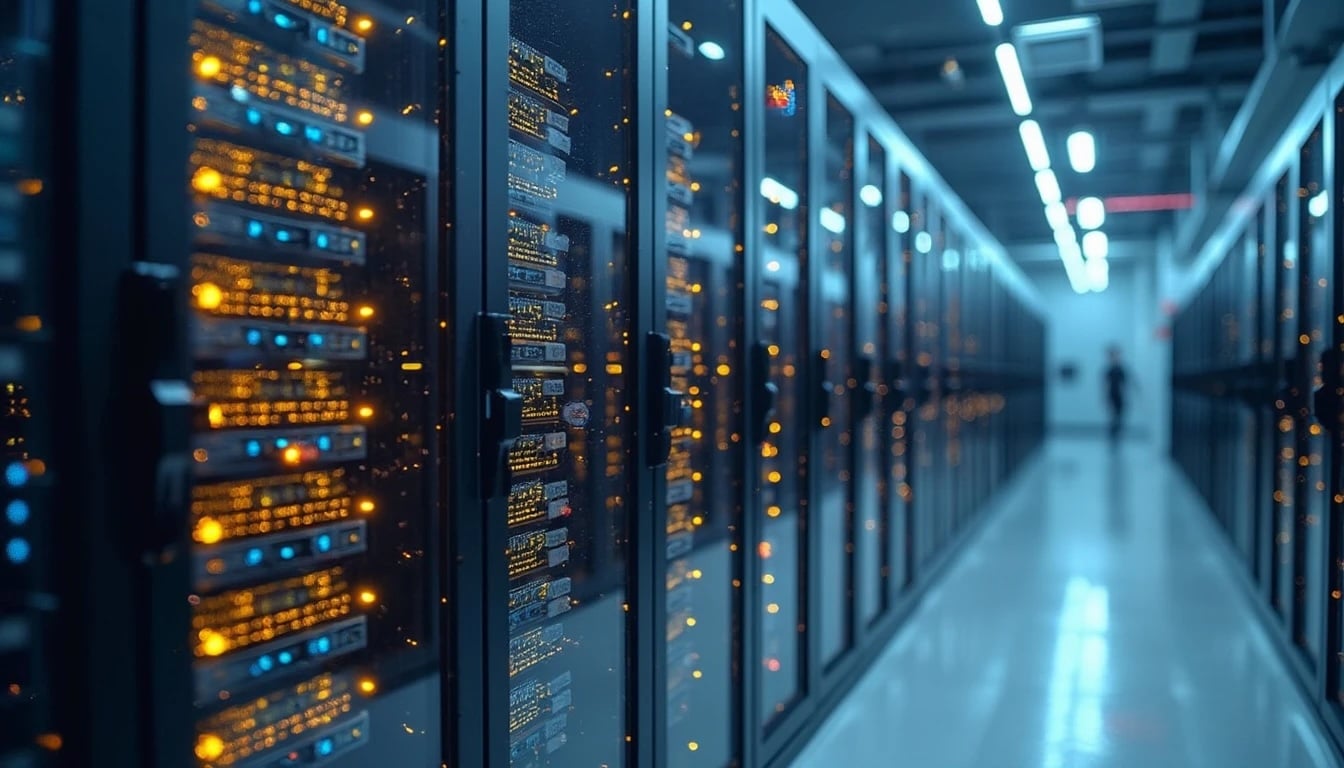
Data centers have ceased to be a specialized investment reserved for tech operators. Infrastructure funds, insurance companies, pension funds, real estate vehicles, private equity, and sovereign wealth funds are increasing their exposure to the sector through acquisitions, joint ventures, capital raises, and financing of new campuses. The interest is not solely driven by the AI boom; it reflects expectations that demand for computing, storage, and connectivity will continue to grow for decades.
Key points for investing in data centers in 30 seconds
- In 2025, 95% of the investors surveyed by CBRE expected to increase their sector exposure.
- JLL estimates that approximately $3 trillion will be needed to add nearly 100 GW of global capacity by 2030.
- AI accelerates demand, but growth also stems from cloud services, enterprise digitalization, and data usage.
- Major funds prefer platforms with land, energy, clients, and expansion capacity.
- The risk is no longer just raising capital—it also involves securing electricity, permits, equipment, and contracts that justify increasing investments.
The language used by investors reflects this shift—they no longer see data centers solely as technical real estate but as a combination of digital infrastructure, energy assets, and operational platforms. While the building remains important, its value increasingly depends on available power, grid connection, fiber optics, licenses, and the ability to incorporate new generations of hardware.
A capital need difficult to cover solely with operators
The projected scale explains much of the influx of institutional capital. JLL estimates the global data center capacity could nearly double to around 200 GW by 2030. Achieving this growth would require around $3 trillion in investment, generate about $1.2 trillion in new real estate assets, and need approximately $870 billion in new debt financing.
Construction costs are also rising. From 2020 to 2025, the global average cost per megawatt shifted from $7.7 million to $10.7 million, according to JLL. By 2026, an additional 6% increase is expected, reaching about $11.3 million per MW. These figures are averages and vary widely depending on the country, land, energy, cooling, and installation type, but they explain why a large campus can require several billion dollars before generating income.
Specialized operators alone cannot fund all this expansion. Therefore, they rely on funds, energy partners, structured debt, and joint vehicles. Investors provide patient capital and financial capacity; operators contribute technical expertise, clients, and daily management.
The relationship might not always involve buying a full company. It can also take the form of a minority stake, a joint venture to develop multiple campuses, or recapitalizations allowing the original owner to recover part of their investment and continue growing.
Demand driven by factors broader than AI trends
While AI commands many headlines, it alone doesn’t explain the financial appeal of data centers.
Public and private cloud, e-commerce, video platforms, cybersecurity, enterprise applications, the Internet of Things, and the digitization of governments and industries were already driving demand before the explosive growth of generative AI. GPU clusters have accelerated the process by introducing loads with much higher energy density and network needs.
The International Energy Agency estimates that the worldwide data center electricity consumption could rise from about 485 TWh in 2025 to nearly 950 TWh in 2030. Facilities focused on AI could grow faster and potentially triple their consumption during this period.
For investors, these forecasts point to a structural demand. It’s not just about a particular application succeeding but about increasing activity requiring digital capacity across economic sectors.
Occupancy data supports this thesis, albeit with variations across markets. CBRE observed that the weighted average vacancy in major global markets fell to 6.6% in Q1 2025, while areas like Northern Virginia dropped below 1%. In 2026, the firm continued to record lows in several markets despite substantial inventory growth.
Investors are now seeking platforms, not just buildings
An isolated data center can generate rental income, but an operational platform offers greater opportunities.
Large funds particularly value companies with a presence in multiple markets, management teams, electrical agreements, land for expansion, and relationships with enterprise or hyperscale clients. Once the initial investment is made, capital can be deployed in new phases without building each project from scratch.
The advantages of scale include:
- standardizing designs and procurement;
- negotiating better with suppliers;
- sharing corporate costs;
- entering new regions;
- merging clients and contractual maturities;
- financing additional acquisitions;
- developing capacity as commercial commitments are signed.
This approach underpins operations like AirTrunk’s acquisition by a consortium led by Blackstone, valued at over AUD 24 billion, or Brookfield’s large programs announced for AI infrastructure.
Blackstone also committed over $25 billion toward digital and energy infrastructure in Pennsylvania, with plans to mobilize another $60 billion. In 2025, Brookfield launched a program capable of acquiring up to $100 billion in AI infrastructure assets.
These amounts are not solely for data halls full of servers. They include land, substations, power generation, energy storage, networks, and supply contracts. The line between investing in data centers and energy assets is becoming increasingly blurred.
The appeal of contracted revenues and large clients
Institutional investors often seek relatively predictable cash flows. Data centers can provide these through multi-year contracts, capacity commitments, and high transfer costs.
Migrating a critical load isn’t as simple as leaving an office. It involves migrating applications, networks, security, storage, and operational procedures. This complexity fosters long-term relationships between operators and clients.
Large pre-committed reserves also enable financing of new developments with greater certainty. For example, Digital Realty announced in the first quarter of 2026 that its bookings total over $707 million in annualized rent, including its largest hyperscale contract in history.
However, stability is not guaranteed. Contracts vary in length, guarantees, minimum consumption, indexation, and energy responsibilities. Over-reliance on a few hyperscalers may also increase risk due to concentration.
A very large client provides volume but also bargaining power. Delays in deployment, architectural changes, or choosing to develop their own infrastructure can significantly impact the operator.
Geographic diversification also matters
Funds are not only expanding their portfolios to add megawatts but also to spread risk.
A portfolio with assets in the U.S., Europe, Asia-Pacific, and Latin America exposes investors to markets with different cycles, regulations, and electricity availability. It also allows combining mature facilities with projects still under development.
CBRE’s 2025 global survey showed that 95% of participants expected to increase their investments in data centers, with 41% planning to allocate at least $500 million, up from 30% the previous year. The preferred segment was turn-key hyperscale.
In the US survey of 2026, over half of investors expected to boost their allocations, and 55% projected increasing their purchasing activity by more than 10%. For the third consecutive year, energy availability remained the top obstacle.
Expanding into secondary markets partly addresses this challenge. When established cities cannot meet power needs in time, capital seeks locations with available land, grids, and permits—even if far from traditional hubs.
Financial structures are becoming more complex
The need to mobilize large amounts of capital is broadening the tools used for financing the sector.
Alongside traditional bank loans, there are bonds, asset-backed securitizations, project financing, private debt, and specialized funds. JLL projects that capital raised for core data center funds could surpass $50 billion in 2026, with combined ABS and CMBS issuances related to the sector potentially reaching similar levels.
Joint ventures also allow for role separation. One partner can finance and own the property, another provides energy, and a third operates the infrastructure. This division reduces individual exposure but increases contracts, dependencies, and governance complexity.
Recapitalizations have also gained ground. A fund may acquire part of a developed platform, with the seller using proceeds to fund the next phase. This approach recycles capital without necessarily relinquishing operational control.
Energy may be the biggest asset, not the building
Electricity availability has become the most critical factor influencing project value.
A large, well-connected site might be of little use if the grid cannot deliver hundreds of megawatts within a reasonable time. Conversely, a secondary location with secure power access can quickly attract contracts and capital.
This dynamic is bringing data center investors and energy companies closer. In July 2026, Brookfield and NextEra announced a project in Kentucky worth up to $100 billion that would combine a large campus with generation and storage. The planned development exceeds a gigawatt and shows how digital and energy investments are increasingly coordinated.
However, these opportunities also entail risks. Connections can face delays, costs may rise, and social opposition can slow projects. Water use, noise, emissions, and the impact on local tariffs are gaining political attention.
Therefore, a portfolio cannot be valued solely by the megawatts announced. It’s essential to distinguish between operational capacity, under construction, contracted, permitted, or merely planned.
Investment risks that shouldn’t be hidden
Enthusiasm among capital does not eliminate uncertainties.
Financing costs remain significant, especially for projects taking years to complete. Rapid hardware evolution can render designs obsolete if they aren’t prepared for higher densities or liquid cooling. Limitations of transformers, turbines, generators, and electrical equipment also extend timelines.
Overbuilding is another risk. If AI demand grows less than expected or model efficiencies improve substantially, some projects could take longer to fill.
High valuations require selectivity. CBRE Investment Management acknowledges that abundant capital and projected growth coexist with doubts about asset prices and the credibility of some capacity plans.
Operator quality becomes as important as the asset itself. Timely execution, energy procurement, cost control, and maintaining availability are capabilities that cannot be bought solely with money.
Why capital will continue to flow
Global capital continues to expand its portfolios because data centers combine several rare characteristics: structural demand, enormous investment needs, long-term contracts, and phased growth opportunities.
They also fit the horizons of pension funds, insurers, and sovereign funds, which can hold assets for decades and finance successive expansions.
The opportunity is no longer just buying occupied buildings and collecting rent; it involves building platforms capable of ensuring energy, obtaining permits, operating critical infrastructure, and serving clients across multiple regions.
This trend explains why competition is shifting from acquiring existing assets to controlling the conditions necessary for development. Land, fiber, power, and permits matter. But the real value increasingly resides in usable power, solid contracts, and the capacity to grow without disrupting operations.
Frequently Asked Questions
Why are pension funds investing in data centers?
Because they seek long-term assets with relatively predictable cash flows. Multi-year contracts and growing demand for digital infrastructure align with their investment horizons.
How much capital will the sector need through 2030?
JLL estimates that adding around 100 GW of new global capacity may require about $3 trillion, including approximately $870 billion in new debt financing.
Is AI the only driver of growth?
No. While AI accelerates demand, other factors like cloud, enterprise digitalization, video, e-commerce, cybersecurity, and overall data traffic growth also play significant roles.
What is the main risk for new projects?
Energy availability is one of the biggest obstacles, along with permits, construction costs, financing, client concentration, and the potential gap between announced capacity and actual demand.
