
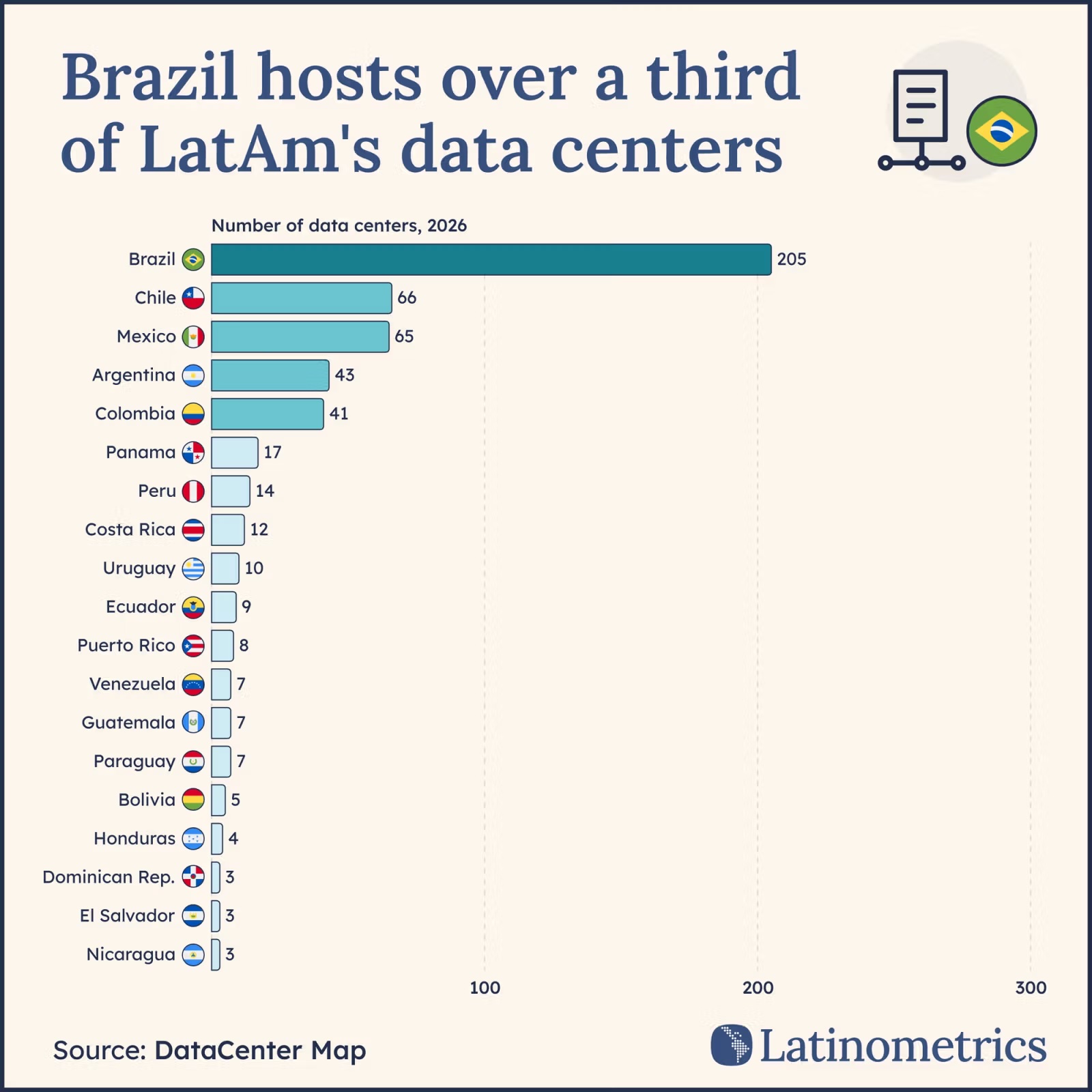
Brazil has become the main hub of Latin America’s digital infrastructure. According to the count shared by Latinometrics based on data from DataCenterMap, the country has 205 data centers in 2026, representing 38.8% of the 529 identified across the 19 markets included in the comparison. The gap with the rest is significant: Chile ranks second with 66 facilities, and Mexico third with 65.
The key facts about Brazil’s data centers in 30 seconds
- Brazil hosts 205 data centers, accounting for 38.8% of the total in the Latin American comparison.
- Chile has 66, Mexico 65, Argentina 43, and Colombia 41.
- São Paulo is also the largest regional market by capacity, with 536.7 MW of wholesale inventory in the first quarter of 2026.
- Cloud, artificial intelligence, international connectivity, and enterprise demand are accelerating new investments.
- Energy and water are beginning to influence where large facilities can be built.
The snapshot is interesting, though care must be taken when interpreting the number of facilities. Counting data centers does not equal measuring computational capacity. A small enterprise site and a hyperscale campus with hundreds of megawatts can appear as two facilities in a directory, despite having radically different capacities.
When comparing in megawatts, Brazil continues to hold a dominant position. CBRE ranks São Paulo as Latin America’s largest data center market, with 536.7 MW of wholesale inventory in the first quarter of 2026, an 8.9% increase from the previous year.
The combined capacity of the four major markets analyzed by CBRE—São Paulo, Querétaro, Santiago, and Bogotá—reached 1,045 MW, after a 41.3% year-on-year increase. This shows that Latin America is no longer a peripheral market within the global cloud infrastructure.
Brazil has size, demand, and connectivity to attract large data centers
Brazil’s advantage cannot be explained solely by land, water, or electricity availability. The size of its digital economy and population creates a local demand that’s hard to match elsewhere in Latin America.
Financial services, e-commerce, streaming, telecommunications, enterprise software, and cloud generate significant traffic clusters that benefit from processing close to users. The surge in AI workloads now adds another source of demand.
São Paulo hosts much of this activity.
CBRE reports that the city absorbed approximately 39.2 MW of new capacity during the first quarter of 2026, with hyperscale providers continuing to expand their presence in Brazil. Its available inventory stood at 51.5 MW, with a 9.6% availability rate.
Another advantage not visible by counting buildings is international connectivity.
Brazil is connected via numerous submarine cable systems to North America, Europe, and Africa. This infrastructure reduces latency, expands available routes, and makes the country a natural hub for platforms serving both the Brazilian market and the region.
JLL agrees that Brazil, Mexico, Chile, and Colombia are currently the four markets with Latin America’s highest demand. Their 2025 year-end report estimates that regional colocation inventory grew 20% that year alone.
Clearly, this isn’t just about the number of installed facilities listed in directories.
Artificial intelligence increases pressure on infrastructure
This new wave has a different characteristic. Traditional data centers could grow gradually by adding servers. AI-focused clusters require much higher concentrations of power.
Thousands of GPUs operating simultaneously mandate tens or hundreds of megawatts, high-capacity networks, and cooling systems capable of dissipating increasingly dense thermal loads.
Hence, available megawatts are becoming a more representative measure than the number of buildings.
The Latin American data center construction market could jump from about $5.59 billion in 2025 to $6.05 billion in 2026, according to Mordor Intelligence estimates cited by Research and Markets. Brazil would account for around 40% of regional investment in 2024.
Operators are also increasing commitments. Equinix announced in May that its investments, executed or planned for 2025–2026, surpassed $419 million in Latin America, with $270 million allocated to Brazil, $81 million to Mexico, $42 million to Chile, and $28 million to Colombia.
Brazil doesn’t want to limit itself to hosting traditional cloud services. Developing capacity for AI has become both an industrial and political issue—local infrastructure enables running models and storing data domestically, reducing reliance on centers in the US, Europe, or Asia.
Electricity is one key advantage.
Brazil’s energy matrix is heavily dominated by renewables, especially hydropower, wind, and solar. For an industry where energy availability increasingly influences where new campuses are built, this characteristic has growing economic value.
However, describing it merely as “cheap hydropower” would oversimplify the issue. Developers need available capacity at specific sites, grid connections, substations, permits, and long-term contracts. Abundance of renewable generation nationwide does not automatically mean hundreds of megawatts in any given parcel.
Chile and Mexico show that country size isn’t everything
Chile’s second-place ranking is arguably one of the most interesting data points from DataCenterMap.
The country has 66 data centers, one more than Mexico despite its considerably smaller population and economy.
Small markets like Panama (17 facilities), Costa Rica (12), and Uruguay (10) also rank fairly well.
The explanation lies in that digital infrastructure follows a different geography than the population. International connectivity, grid stability, regulation, business concentration, and land availability can weigh just as heavily as market size.
Mexico is accelerating especially rapidly.
CBRE estimates Querétaro reached 298.2 MW of inventory in the first quarter of 2026, after an extraordinary 450.2% year-on-year growth driven by hyperscale and AI deployments. Santiago had 165.8 MW, and Bogotá 44.3 MW.
Chile is also preparing larger-scale projects. The availability of solar energy and storage is prompting developers to consider large campuses specifically targeting AI workloads.
This means Brazil’s lead in the number of data centers doesn’t necessarily ensure it will maintain the same margin when considering new capacity expected in the coming years.
Water isn’t an automatic advantage
Another point to clarify in the original comparison is that a country with abundant water resources doesn’t automatically solve the water consumption of its data centers.
Impact depends on location and, especially, the cooling system used.
A data center cooled with evaporative systems may have a completely different profile from one using closed-loop or dry cooling. Even within the same company, architectures can vary.
Brazil has attempted to incorporate this issue into its industrial policy. The proposed REDATA regime aimed to incentivize data centers by including environmental requirements such as using clean or renewable energy and achieving specific water efficiency standards.
The first temporary REDATA measure expired on February 25, 2026, when its approval process was not completed. On the same day, the Chamber of Deputies approved a new bill to revive the regime, offering tax incentives for five years on certain equipment and regulations related to the use of clean energy.
The debate is significant because large AI campuses can become electricity consumers comparable to industrial facilities.
Furthermore, Brazil is already discussing who should bear the costs of expanding power grids, how incentives should be granted, and what economic benefits truly stay in the communities where these projects are built.
Over 500 facilities, but the next leap will be measured in megawatts
The DataCenterMap-based count totals 529 data centers across the included countries. Brazil accounts for 205; Chile and Mexico add another 131, together roughly 63.5% of the total.
Argentina has 43 facilities, and Colombia 41. Beyond that, the numbers drop significantly: Panama has 17, Peru 14, Costa Rica 12, and Uruguay 10.
The concentration will likely continue, but the key indicator to track in the coming years will be another.
A region can add dozens of smaller data centers without significantly changing its computing capacity. A single 500 MW AI campus can impact the electricity market, investment climate, and available capacity much more than numerous traditional facilities.
Brazil has an advantage in scale, demand, connectivity, and renewable energy availability. Mexico is experiencing rapid growth around Querétaro, and Chile aims to turn its renewable capacity into an advantage for the next generation of AI-focused centers.
Latin America’s data center race is no longer just about accumulating buildings. The real competition is now about who can reliably deliver hundreds of megawatts of electricity, connectivity, and cooling at a cost that supports operating thousands of accelerators around the clock.
Frequently Asked Questions
How many data centers does Brazil have in 2026?
Latinometrics’ count, based on DataCenterMap, registers 205 data centers in Brazil, representing 38.8% of the 529 facilities recorded across Latin American countries included.
Which countries have the most data centers in Latin America?
After Brazil, the top are Chile with 66, Mexico with 65, Argentina with 43, and Colombia with 41. Together, these five countries hold the majority of the facilities in the comparison.
What is Latin America’s largest data center market?
According to wholesale capacity analyzed by CBRE, São Paulo remains the largest market, with 536.7 MW of inventory in the first quarter of 2026. Querétaro reached 298.2 MW, and Santiago 165.8 MW.
Why is Brazil attracting so many data centers?
Factors include the size of its digital market, the concentration of financial and enterprise services, connectivity through fiber and submarine cables, and a power grid with a high share of renewables. However, the actual availability of energy, water, land, and electrical connections continues to influence each project’s location.
Image and source: latinometrics
