

Security cameras are ceasing to be simple devices that record images and are becoming small computing systems capable of analyzing what happens in front of them. A report by Future Market Insights estimates that the worldwide market for artificial intelligence applied to video surveillance reached about $7 billion in 2025 and could grow to $58.6 billion by 2035, although other consulting firms have different projections. Behind this growth are advances in machine vision, edge processing, and a new generation of real-time video analysis.
The key points of AI-powered video surveillance in 20 seconds
- Future Market Insights projects growth from $7 billion in 2025 to $58.6 billion by 2035.
- Hardware accounts for 39.7% of the estimated market in 2025.
- Leading providers include Hikvision, Dahua, Avigilon, and Milestone.
- Technological evolution focuses on Edge AI, computer vision, real-time analysis, and cloud.
The $58.6 billion figure comes from a specific forecast and should be interpreted as such. Future Market Insights calculates a compound annual growth rate (CAGR) of 23.1% between 2025 and 2035. Other firms present similarly expansive markets but with different figures: Fortune Business Insights estimates $6.26 billion in 2025 and $26.9 billion in 2034, with an 18.2% CAGR.
This variation illustrates the difficulty in defining this market. Depending on the study, it may include cameras with integrated processing, servers, analysis software, cloud storage, services, or various combinations of these components.
What is clearer is the technological direction: intelligence is beginning to shift from the room where recordings are stored and viewed to the cameras themselves and edge systems in the network.
From recording video to understanding what appears in the images
Traditional video surveillance was relatively straightforward. Cameras captured images sent to a recorder or server, and often a person would review the footage to identify incidents.
The addition of artificial vision changes this model.
A modern system can automatically analyze objects, people, or vehicles, detect movements and specific behaviors, perform searches on recordings, or generate alerts when a designated situation occurs.
Use cases listed by Future Market Insights include object detection and tracking, perimeter protection, license plate recognition, traffic analysis, smoke and fire detection, people search, and false alarm filtering.
Artificial intelligence does not necessarily mean facial recognition. In fact, many applications can function without identifying individuals.
A camera installed in a factory could detect unauthorized entry into a restricted area. Another might identify a stopped vehicle in a dangerous location. In retail, analysis could be used to study occupancy or movements, while in critical infrastructures, it might help detect unauthorized objects or access.
Advances in vision models also enable more complex analysis beyond traditional motion detection.
However, this automation has limits. False positives and negatives remain a problem, and an alert generated by an algorithm does not necessarily mean an actual incident has occurred. The Future Market Insights report itself mentions perceptions of reliability as a factor that could hinder adoption.
Edge AI: processing video without sending everything to the cloud
One of the most significant changes is happening within the cameras themselves.
Processing video requires substantial computation. A setup with hundreds or thousands of cameras can generate enormous data volumes if it constantly transmits all footage to central servers.
Edge AI aims to perform part of this processing close to where the data is generated.
New cameras can incorporate specialized processors capable of running computer vision algorithms locally. Instead of constantly sending all footage for analysis in a data center, the device can identify specific events and transmit only relevant images, metadata, or alerts.
This offers several advantages:
- Reduces bandwidth use, decreases latency, and maintains some functions even with limited connectivity to the central platform.
- Can lower the amount of video that needs remote processing.
This model explains why hardware accounted for 39.7% of the estimated market in 2025, according to Future Market Insights. The firm also anticipates this segment will grow at an annual rate of 23.4% through 2035.
Cameras are beginning to resemble specialized edge devices: image sensors, connectivity, and computing power working together.
This does not mean that the cloud will disappear.
The evolving model combines local processing with central servers and cloud services. A camera can perform initial detection, while a remote platform stores events, manages devices, correlates information from different locations, or runs more demanding analyses.
Hikvision and Dahua lead an industry with a strong Chinese presence
The market includes camera manufacturers, software providers, and companies specializing in artificial intelligence.
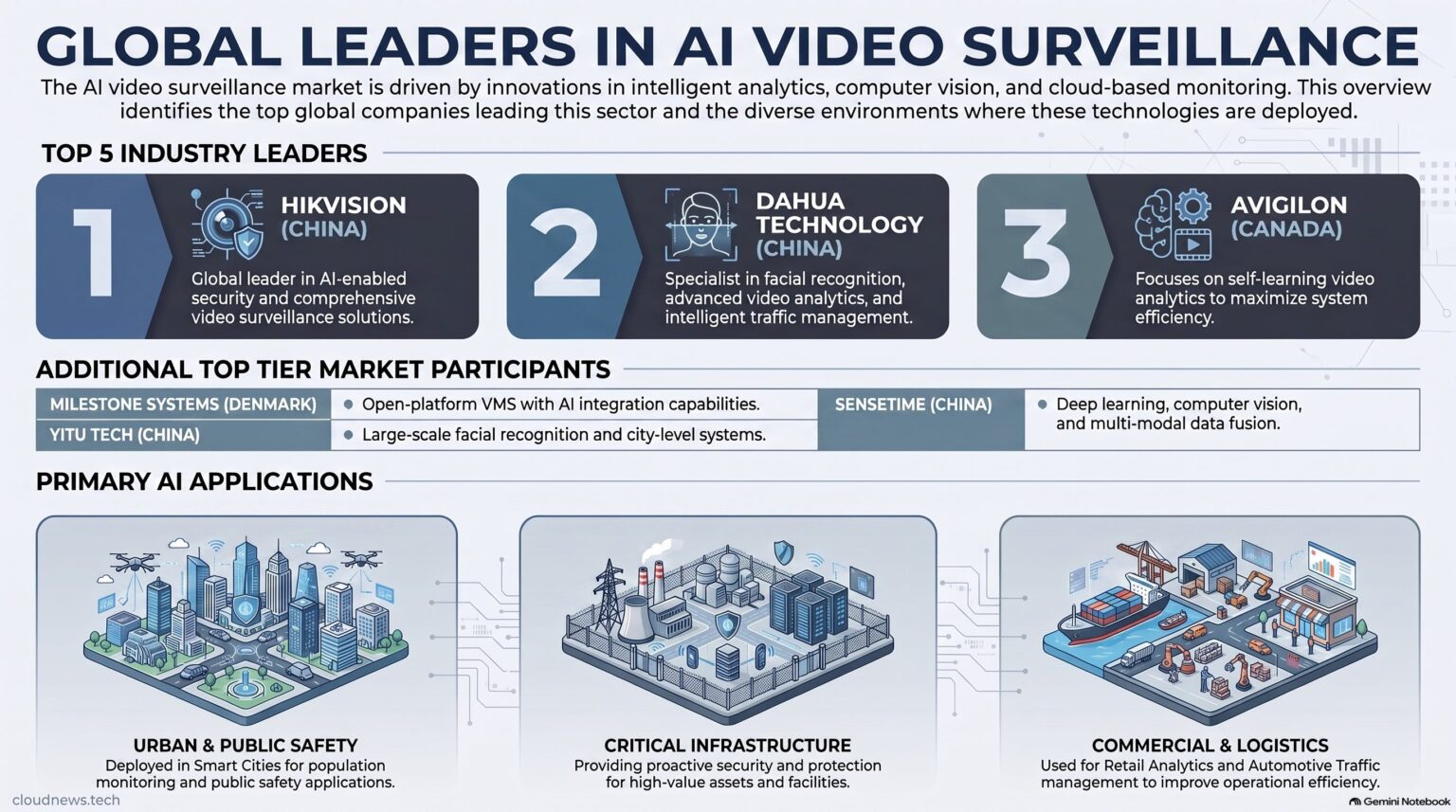
Future Market Insights lists major players such as Hikvision, Dahua Technology, Avigilon, Milestone Systems, YITU Tech, SenseTime, and Agent Video Intelligence.
Hikvision and Dahua exemplify China’s significant role in the global manufacturing of cameras and surveillance systems. Avigilon, part of Motorola Solutions, combines cameras with video analysis, while Milestone has historically focused on VMS (Video Management Software) with an open platform that integrates various devices and applications.
The accompanying image often used in discussions about this market should be viewed with caution. It shows a supposed ranking of ten companies, but the lower positions contain generic names such as “[Generic Company A]”, “[Generic Company B]”, or “[Indicative Company C]”. This is not a reliable ranking of the top ten global manufacturers, although some identified providers do appear in the Future Market Insights report.
Furthermore, stating a “leader” depends on the segment. The manufacturer that sells the most cameras may hold a different position in VMS software, video analysis, facial recognition, or cloud platforms.
A market with differing billion-dollar forecasts
Estimates for the future size of this industry vary significantly.
Future Market Insights starts with $7 billion in 2025 and projects $58.6 billion by 2035, with a CAGR of 23.1%.
SNS Insider’s March 2026 estimate placed the 2025 market at $6.41 billion and predicted $49.02 billion in 2035, with an 22.56% annual growth rate.
Fortune Business Insights is more conservative. Its July 2026 update estimates the market at $6.26 billion in 2025, $7.04 billion in 2026, and $26.9 billion by 2034.
| Source | Starting market | Forecast | Annual growth |
|---|---|---|---|
| Future Market Insights | $7B (2025) | $58.6B (2035) | 23.1% |
| SNS Insider | $6.41B (2025) | $49.02B (2035) | 22.56% |
| Fortune Business Insights | $6.26B (2025) | $26.9B (2034) | 18.2% |
The discrepancies advise against presenting any figure as the definitive size of the industry. These are forecasts based on different methodologies and definitions.
All foresee significant growth in the coming years.
Privacy will be as crucial as algorithm accuracy
Turning millions of cameras into sensors capable of automatically interpreting what they observe raises issues beyond technology.
Using artificial vision to detect smoke in a factory differs markedly from facial recognition used to identify people in public spaces.
The more these systems analyze images, associate them with identities, and maintain histories, the greater the privacy, data protection, and misuse concerns.
The expansion of these systems will have to coexist, especially in Europe, with legal requirements concerning personal data processing and the use of certain biometric systems.
Cybersecurity is also a concern. A connected camera is another device on the network and can process sensitive information. Manufacturers and operators must protect credentials, communications, firmware, remote access, and stored video itself.
Therefore, the next generation of video surveillance will not depend solely on who develops the most accurate recognition algorithms.
Competition will also focus on how much analysis can be performed at the edge, bandwidth requirements for each camera, data protection measures, software integration capabilities, and how organizations control their data.
The cameras that only used to record 24/7 are giving way to systems that select, classify, and interpret images even before a human viewing them. If growth forecasts come true, this evolution will turn video surveillance into another major Edge AI market over the next decade.
Frequently Asked Questions
How much will the AI surveillance market grow?
Future Market Insights estimates it will grow from $7 billion in 2025 to $58.6 billion by 2035, though other firms have lower projections.
What is Edge AI applied to security cameras?
It involves executing part of the AI algorithms directly on the camera or nearby devices. This allows for lower latency image analysis and reduces the need to transmit all footage to a data center.
Which companies are leading in AI-enabled video surveillance?
Future Market Insights includes Hikvision, Dahua, Avigilon, Milestone Systems, YITU Tech, SenseTime, and Agent Video Intelligence among the notable players in this market.
Does AI video surveillance always use facial recognition?
No. AI can detect objects, vehicles, license plates, fires, intrusions, movements, or anomalies without necessarily biometric identification of individuals.
