
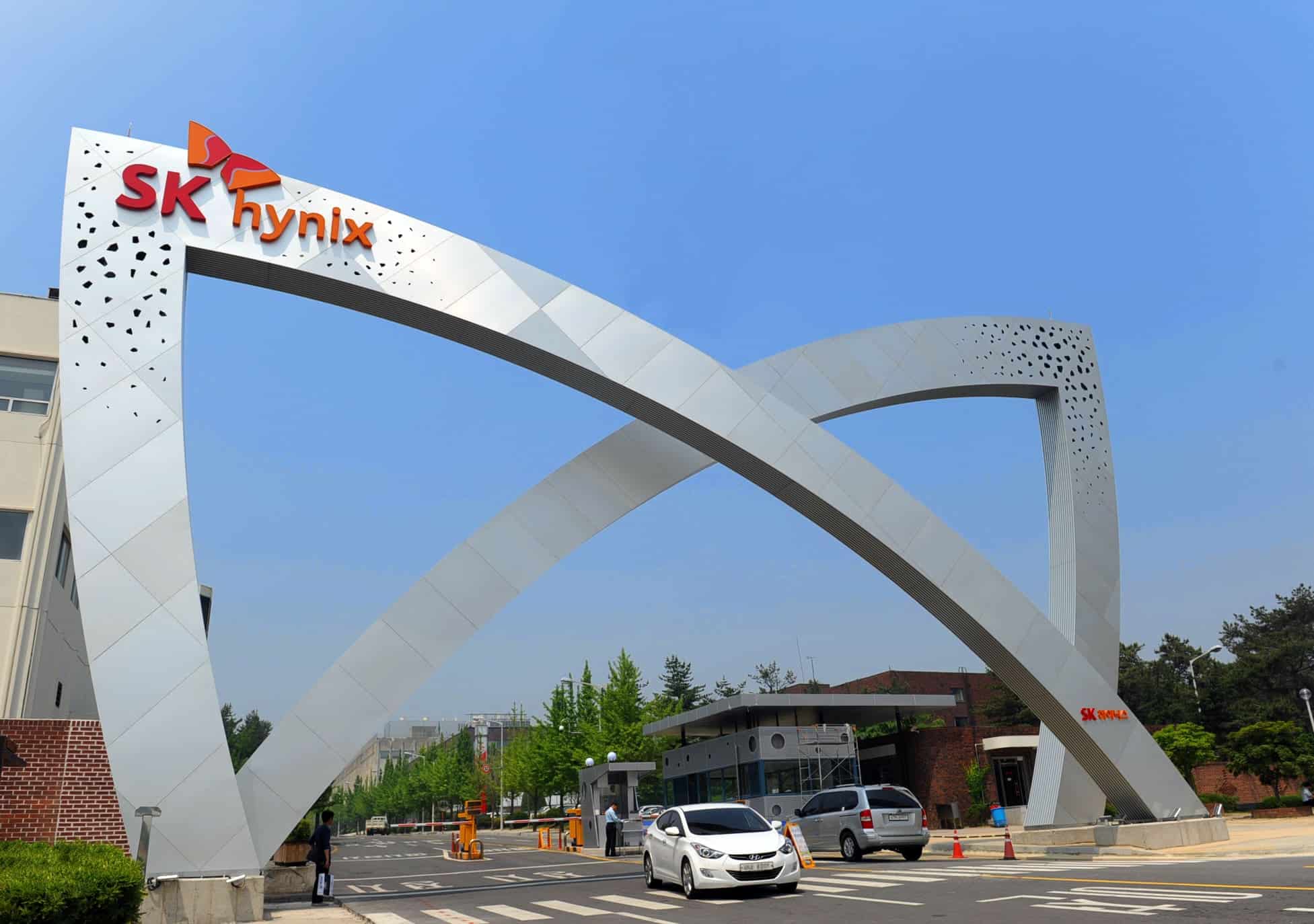
SK hynix has approved an investment of approximately 54 trillion South Korean won to build two new memory factories in South Korea, one primarily dedicated to DRAM and HBM, and another focused on NAND Flash. The company will allocate 35.2 trillion won to the Y2 plant in the Yongin cluster and another 19.1 trillion to the future M17 facility in Cheongju, marking one of its largest industrial moves in response to the growing demand for memory associated with artificial intelligence.
The key points of SK hynix’s investment in 20 seconds
- SK hynix will invest around 54 trillion won in two new factories.
- Y2, in Yongin, will produce next-generation HBM and DRAM.
- M17, in Cheongju, will increase NAND Flash capacity, especially for enterprise SSDs.
- The first cleanrooms will open in December 2028 and June 2029.
- The company expects demand for DRAM and NAND to grow at a compound annual rate of 19% until 2030.
The decision comes at a time when memory has ceased to be a secondary component in the race for artificial intelligence. Accelerators need HBM to fuel GPUs with large amounts of data, servers incorporate increasing amounts of DRAM, and inference is further boosting demand for high-performance NAND storage.
For SK hynix, this shift is not just a temporal cycle. The company considers that memory is becoming a core part of infrastructure that directly determines the performance of AI systems.
Yongin Y2: More capacity for HBM and DRAM
Most of the investment will go to Yongin Y2, the second of four planned factories within the Yongin Semiconductor Cluster.
SK hynix will allocate 35.2 trillion won to this facility, which will cover approximately 1.13 million square meters of built-up area. Construction will begin in July 2027, with the first cleanroom expected to be operational in June 2029.
Its purpose will be to produce:
- Next-generation HBM;
- Advanced DRAM;
- Other memory products mainly targeting high-performance systems.
The company is already building Y1, whose first cleanroom is scheduled for February 2027. Y2 will be the next step in a much larger project.
SK hynix has also decided to accelerate the entire Yongin plan. The original plan aimed to complete the four factories by 2045, but now aims to finish the entire set by 2033, twelve years earlier than initially planned.
The entire cluster covers approximately 4.16 million square meters, and its basic infrastructure for electricity and water for the initial phases was already 99% complete when the company announced the new investment.
Cheongju M17: AI also drives NAND demand
The second factory will be M17, located in Cheongju.
SK hynix will invest approximately 19.1 trillion won in this complex, which will cover a total area of around 680,000 square meters.
Construction will start in February 2027, with the first cleanroom expected by December 2028.
M17 will primarily focus on expanding NAND Flash production.
This part of the investment is particularly interesting because it demonstrates that the impact of artificial intelligence extends beyond HBM.
The growth of AI services is rapidly increasing demand for enterprise SSDs, used to fuel massive datasets and store information during training and inference processes.
TrendForce also notes that the proportion of SSDs within SK hynix’s NAND business has surged: from around 50% of NAND revenue in Q2 2025 to approximately 70% in Q2 2026.
KV Cache also beginning to change the storage market
SK hynix explicitly mentions another phenomenon driving NAND demand: the KV Cache.
During large language model inference, vectors of keys and values are generated that can be reused to avoid repeating certain calculations. The longer the conversation or the larger the context window, the more memory this cache requires.
Traditionally, much of the KV Cache resides in high-speed memory, but AI architectures are starting to use fast storage as an additional level as data volumes grow.
This opens up new opportunities for enterprise SSDs.
The emergence of AI agents, models with much larger contexts, and physical AI systems could further increase this demand in the coming years. SK hynix specifically cites the KV Cache as one of the reasons to expand NAND production.
A 54 trillion won investment within a much larger plan
The two recently approved projects are only part of an extraordinary industrial strategy.
SK hynix maintains a long-term investment plan of up to:
| Region | Long-term Plan |
|---|---|
| Yongin Semiconductor Cluster | 600 trillion won |
| Cheongju | 100 trillion won |
| New projects Y2 + M17 | 54.3 trillion won |
Yongin will become one of the world’s largest hubs for advanced memory production, while Cheongju will expand NAND capacity, leveraging existing facilities in factories M11, M12, and M15, along with existing electrical and water infrastructure.
This existing infrastructure was one of the reasons for choosing Cheongju for M17, as it allows faster ramp-up of new capacity.
Memory demand expected to grow by 19% annually until 2030
The data underpinning these investments comes from SK hynix’s forecasts.
According to Omdia, cited by the company, demand for both DRAM and NAND is expected to grow at a compound annual rate of 19% between 2025 and 2030.
This rate is exceptionally high for a mature industry like memory.
Artificial intelligence is also changing the composition of that demand.
In DRAM, priorities are shifting towards:
- HBM;
- Server DDR5 memory;
- Specialized solutions for accelerators.
In NAND, growth primarily comes from:
- Enterprise SSDs;
- Data center storage;
- Inference caches;
- New AI architectures.
TrendForce also notes that increased HBM consumption could put pressure on the supply of traditional DRAM, as manufacturers must decide how to allocate limited capacity among different products.
More factories do not mean immediate more memory
The investment will not immediately resolve current market tightness.
A semiconductor factory takes years to go from groundbreaking to commercial production.
Even after the first cleanroom is operational, machinery installation, process qualification, yield improvements, and gradual ramp-up are required.
SK hynix makes clear that factories will be built according to the planned schedule, but equipment installation and effective cleanroom expansion will proceed gradually based on customer demand.
This is why Y2 and M17 are primarily responses for the late 2020s.
In the short term, the market will continue to rely mainly on existing capacity and improvements to current production lines.
Memory becomes strategic infrastructure for AI
During the early years of the current AI boom, much of the discussion centered on GPUs.
Now, it’s becoming clear that accelerators are just one piece of the system.
An AI server needs:
GPU + HBM + DRAM + storage + network + power
If any of these layers becomes a bottleneck, system performance is limited.
SK hynix is in a particularly interesting position because it participates in several of these layers through HBM, conventional memory, and enterprise NAND.
The company believes that simply having the most advanced technology is no longer enough. It must also be able to supply the right volume precisely when customers need it.
The simultaneous approval of Y2 and M17 reflects this shift.
It’s not just about manufacturing more RAM or SSD chips. SK hynix is preparing industrial capacity for a scenario where AI data centers will consume significantly more memory than ever before.
And although the new factories won’t alleviate the market until 2028 and 2029, their construction indicates that manufacturers are already planning the memory infrastructure that AI will require by the end of this decade.
Frequently Asked Questions
How much will SK hynix invest in its new factories?
The company has approved approximately 54 trillion won, distributed as 35.2 trillion for Yongin Y2 and 19.1 trillion for Cheongju M17.
What will Y2 produce?
Y2 will focus on manufacturing next-generation HBM and DRAM. Its first cleanroom is scheduled for June 2029.
What will M17 produce?
M17 will mainly expand NAND Flash capacity, especially to meet the growth of enterprise SSDs used in AI infrastructure.
Will these new factories lead to lower prices for RAM and SSDs soon?
Not necessarily. The first cleanrooms will not be operational until late 2028 and mid-2029, and capacity will be added gradually. Therefore, their impact will be primarily medium- and long-term.
Sources:
