
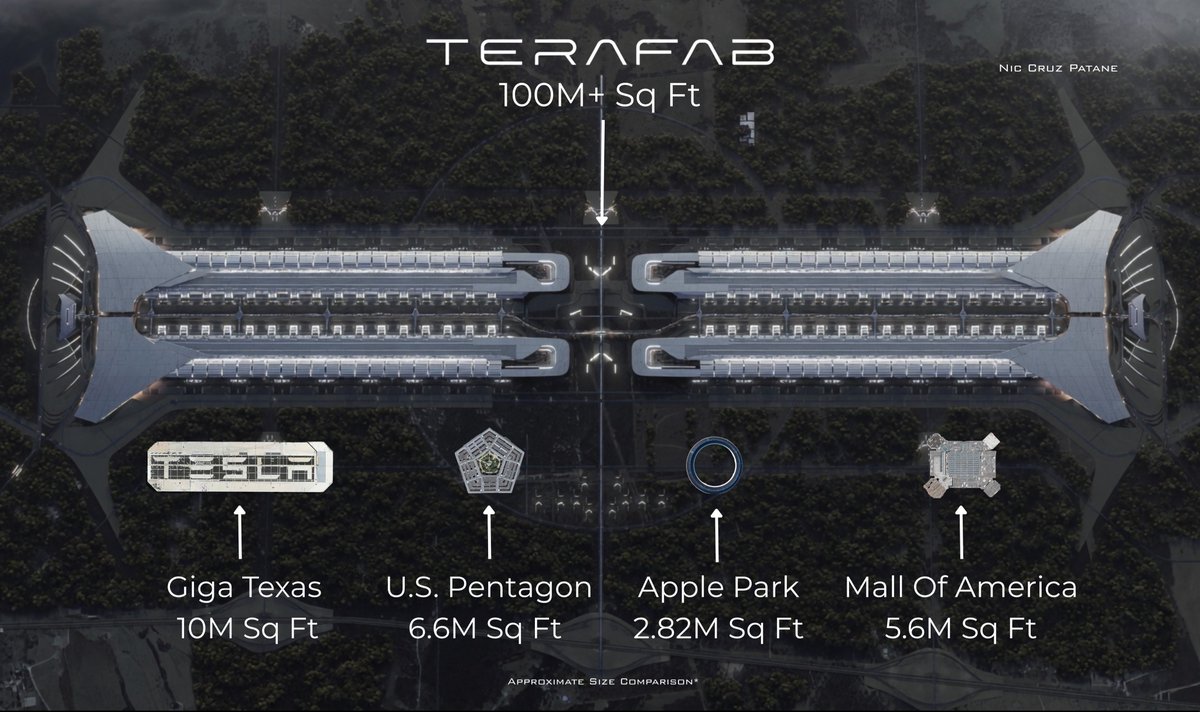
SpaceX and Tesla have chosen Grimes County, Texas, to build TeraFab, a massive semiconductor manufacturing complex for artificial intelligence with an initial investment of $16.8 billion (about 14.4 billion euros at current exchange rates). The project aims to exceed 100 million square feet, approximately 9.3 million square meters, upon full development and could mobilize up to $119 billion in successive phases.
Key facts about TeraFab in 30 seconds
- SpaceX and Tesla plan to initially invest $16.8 billion in TeraFab, located in Texas.
- The complex could reach 9.3 million m² of manufacturing space and create at least 3,000 jobs.
- It will manufacture, package, and test logic chips and memory within the same facility.
- Elon Musk has highlighted Intel 14A as the envisioned technology for future production.
- The chips will serve the demands of Tesla, SpaceX, and their AI, robotics, and space computing projects.
The announced scale warrants caution: the over 100 million square feet refers to full projected development, not an already built factory. The initial confirmed investment is significantly less than the $55 billion previously mentioned in documentation related to tax incentives and the maximum potential of $119 billion.
A factory to reduce reliance on major chip manufacturers
TeraFab addresses a challenge that Elon Musk has publicly emphasized for months: his companies anticipate needing far more semiconductors than they believe they can procure from current suppliers.
SpaceX states that the combined demand from its projects and Tesla could surpass 1 terawatt (TW) of computing capacity. While it recognizes the importance of its current suppliers and expects them to expand production, it considers there will remain a significant gap between supply and demand.
The project aims to partly bridge this gap through in-house manufacturing.
And it won’t be a conventional factory dedicated solely to wafer processing. The plan involves focusing on logic chips, memory, packaging, and testing within the same complex.
Vertical integration would allow Musk’s companies to control a much larger portion of their supply chain.
The intended use of these semiconductors also explains the project’s scale. Tesla will need chips for autonomous driving systems, its future Cybercabs, and humanoid robots like Optimus. SpaceX plans to utilize them in infrastructure for space-based computing and its related satellite data center projects.
Thus, initially, TeraFab is not envisioned as an external foundry competing with TSMC, Samsung, or Intel Foundry for outside clients. Its main purpose is to meet internal demand, which its supporters expect to grow dramatically.
Intel 14A included in TeraFab plans
One of the most interesting uncertainties is what technology a facility of this size will use.
Musk provided a significant hint during Tesla’s Q1 earnings presentation: TeraFab plans to use Intel 14A process technology.
This technology is still under development. Musk acknowledged in April that 14A is not yet fully finished but estimated that it should be sufficiently mature when TeraFab reaches large-scale production.
Intel announced its involvement in the project shortly thereafter.
The U.S. company stated that its capabilities in chip design, manufacturing, and packaging could contribute to TeraFab’s goal of reaching a computing capacity equivalent to 1 TW annually.
This relationship suggests a model different from simply contracting Intel Foundry to produce chips.
Musk has explained that Tesla would initially operate a pilot line, with SpaceX responsible for high-volume manufacturing. While details are still scarce, this indicates some form of technological collaboration with Intel, though the specifics of industrial structuring and which process segments each company will supply remain to be clarified.
This also means we should be cautious: Musk’s announcement of plans to use Intel 14A does not mean TeraFab currently has an operational 14A line.
A 9.3 million square meter factory
The scale announced is difficult to compare with conventional factories.
SpaceX mentions over 100 million square feet of manufacturing space, approximately 9.3 million square meters, once full development is completed.
Musk has publicly described TeraFab as potentially the largest and most valuable building on Earth, comparing it to about 50 times the size of the Pentagon.
These comparisons are from Musk himself and should be viewed as a depiction of the intended scale, not as the measurement of finished facilities.
Earlier estimates suggested a much lower figure, roughly equivalent to about 15 pentagons for 100 million square feet, depending on which part of the U.S. building is used as a reference. Therefore, the “50 times” comparison is not a precise technical measure.
What truly matters is the absolute scale: 9.3 million square meters of industrial space would be extraordinary even among the world’s largest chip complexes.
The full installation would comprise multiple large buildings, integrating various production stages.
From $16.8 billion to potentially $119 billion
The figures related to TeraFab have changed significantly since Musk publicly announced the project in November 2025.
Initial estimates were around $20 billion. Later, documentation submitted for Texas tax incentives indicated a figure of $55 billion for one project phase, with a total potential development cost of up to $119 billion.
The August announcement now specifies an initial investment of $16.8 billion. Reuters reports that the project could reach $119 billion if all planned expansions are realized.
These figures are not necessarily contradictory; they correspond to different phases and scenarios.
| Concept | Announced or estimated investment |
|---|---|
| Initial announced investment | $16.8 billion |
| Earlier figure for one phase | $55 billion |
| Potential full development | Up to $119 billion |
| Final announced surface area | Over 9.3 million m² |
| Expected direct employment | At least 3,000 people |
Grimes County has also approved tax incentives to facilitate the project. TeraFab will additionally receive a $30 million grant from the Texas Enterprise Fund, according to information released after the announcement.
Water will be one of the major challenges
Semiconductor manufacturing requires vast amounts of ultrapure water during industrial processes.
The projected scale of TeraFab has raised concerns among local residents regarding resource consumption, environmental impact, and public incentives granted to the project.
SpaceX and Tesla state they will avoid using local groundwater for industrial operations.
The plan involves sourcing water from Gibbons Creek Reservoir, as well as building proprietary facilities to treat wastewater and develop reuse and conservation systems.
Chemical management, industrial waste, and hazardous materials will also be handled in accordance with applicable regulations.
These are meaningful commitments, though the ultimate impact depends on the actual size the complex attains and its production capacity.
A new front in the race to control AI infrastructure
TeraFab demonstrates how artificial intelligence is reshaping industrial decisions among major tech giants.
In recent years, the bottleneck has been primarily in GPUs. However, large-scale AI deployments also demand CPUs, HBM memory, DRAM, storage, high-speed networks, advanced packaging, and increasing power supplies.
Tesla and SpaceX aim to push this integration even further.
If the project proceeds as planned, Musk’s enterprise group would gradually control an entire chain—from design and manufacturing of specific chips to autonomous vehicles, robots, rockets, satellites, and potentially space computing infrastructure.
But there’s a significant gap between announcing a 100-million-square-foot factory and operating a semiconductor complex of that scale.
Advanced manufacturing demands highly specialized equipment, high yields, extensive supply chains, and thousands of skilled professionals. Also, how collaboration with Intel will materialize and when the 14A technology will be integrated remains to be seen.
For now, the tangible measure is the $16.8 billion committed for its initial phase in Grimes County. The rest delineates the ambitious scope Tesla and SpaceX envision for a factory that, if all phases come to fruition, would be unparalleled in today’s global semiconductor industry.
Frequently Asked Questions
What is TeraFab?
TeraFab is SpaceX and Tesla’s project to build a massive complex in Texas dedicated to manufacturing, packaging, and testing advanced semiconductors mainly for their needs in AI, robotics, vehicles, and space computing.
How much will SpaceX and Tesla invest in TeraFab?
The announced initial investment amounts to $16.8 billion. Earlier documents suggest full development could cost up to $119 billion.
What technology will TeraFab use?
Elon Musk indicated Intel 14A as the planned process technology for advanced manufacturing once TeraFab scales up. Intel is involved in the project, though details of the final industrial model are still emerging.
Where will TeraFab be built?
The large complex will be located in Grimes County, Texas, near College Station. It is expected to generate at least 3,000 jobs.
