
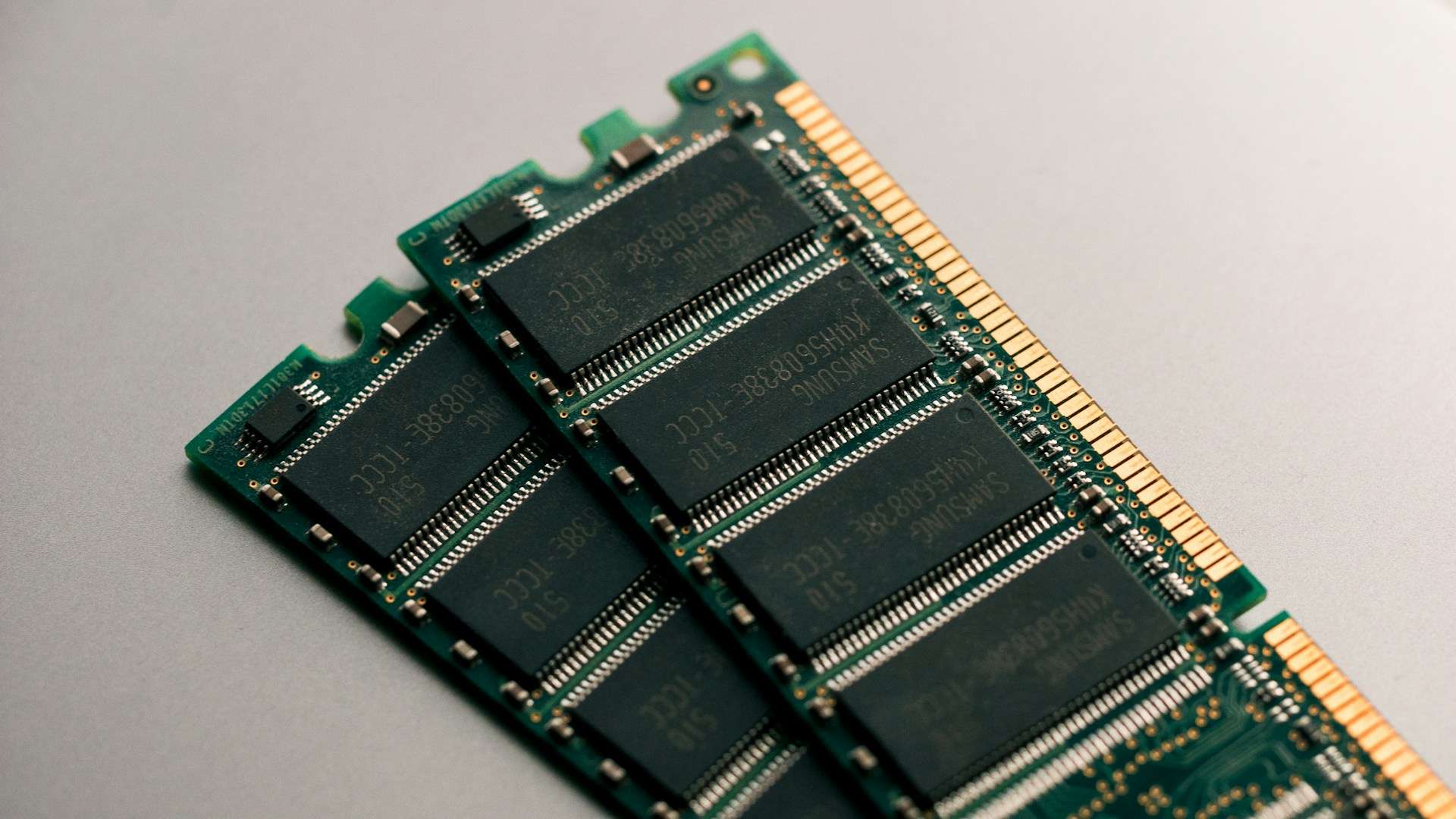
The price of RAM memory is experiencing an anomaly rarely seen in the history of computing. After decades in which storing each gigabyte became progressively cheaper, the sharp increase in DRAM during 2026 has brought the cost per GB back to levels that, adjusted for inflation, are close to those of the early 2010s. Without adjusting for inflation, the comparison even extends to 2007-2008. The main driver behind this change is the enormous demand for memory associated with artificial intelligence infrastructure.
The key points of the RAM price surge in 20 seconds
- The cheapest consumer DDR5 has surpassed $11 per GB in some instances.
- In nominal dollars, these prices are comparable to those observed around 2007-2008.
- The demand for HBM for AI accelerators is absorbing capacity that is also needed for conventional DRAM.
- TrendForce expects the supply-demand tension to continue through 2027.
The comparison comes from historical data compiled by the DAM project at Stanford University, which continues the well-known memory price records of John C. McCallum and has been combining this data since mid-2024 with retail prices obtained via Keepa. This series reveals a phenomenon that until recently seemed improbable: the declining curve has reversed direction.
This doesn’t mean that memory manufacturing technology has regressed twenty years. Nor does it mean all DDR5 modules cost the same as DDR2 did back then. The comparison focuses on the cheapest retail price found per gigabyte, a crucial distinction for correctly interpreting the data.
Decades of decreasing memory costs—almost a year to reverse the trend
The historical evolution of computer memory has been extraordinary.
In the earliest computer systems, storing just a few kilobytes could account for a significant portion of the total cost. Semiconductor manufacturing advancements, increased density, and successive generations of DRAM led to a nearly continuous decline in cost per capacity unit.
Generations like DDR, DDR2, DDR3, DDR4, and later DDR5 followed this general trend.
Each new generation might start relatively expensive, but growing production volumes quickly drove down the cost per gigabyte.
Data collected by Stanford allows us to observe this evolution from the late 1950s. Because the scale spans many orders of magnitude, a logarithmic representation is necessary.
During 2024 and much of 2025, consumer DDR5 memory in the US could still be found at around $2-3 per GB among the most affordable options.
However, the situation began to change rapidly in the second half of 2025.
In 2026, prices accelerated, with some retail references seeing DDR5 more affordable modules exceed $10 per GB, reaching around $11-13 per GB.
Visually, this is striking: after decades of decline, the curve has nearly started to ascend in the opposite direction.
Researcher Daniel Lemire has highlighted this historical anomaly by comparing current prices to those over the past few decades. Nominally, the price per unit of memory is roughly at levels seen around 2007.
But inflation must be factored in.
Is RAM really the same price as in 2007?
Not exactly.
Stanford’s database allows toggling between nominal dollars and constant 2024 dollars using the US Consumer Price Index (CPI-U).
A simple comparison of dollars paid per gigabyte shows current prices of $11-13 can be found in periods close to 2007–2008.
However, $12 in 2008 had considerably more purchasing power than $12 today.
Once adjusted for inflation, the comparison shifts several years forward, aligning the current prices closer to those observed around the early 2010s, when DDR3 was dominant.
Thus, it’s more accurate to speak of two different comparisons: nominal dollars, memory prices have regressed nearly two decades; in real terms, the retreat is about 15 years, depending on the exact point used.
Another caution is necessary.
Stanford doesn’t calculate the average price of all RAM sold globally. Its DRAM indicator uses the cheapest new consumer DIMM available per GB each month on Amazon, via Keepa’s historical data. From 1957 until mid-2024, it relies on McCallum’s historical series.
The project’s creators warn that retail prices can lag behind wholesale contracts, and the most affordable options might be older, clearance modules.
In other words, while the chart excellently illustrates the long-term trend, it shouldn’t be considered an official index of average global DRAM prices.
HBM for AI shifts prioritization
The underlying reason for the price increase relates to a different type of memory: High Bandwidth Memory (HBM).
HBM stacks DRAM chips vertically, connected via extremely wide interfaces, to provide the enormous bandwidth required by GPUs and AI accelerators.
NVIDIA, AMD, and other accelerator designers need increasing amounts of this memory.
Manufacturing HBM competes for some of the same industrial resources as conventional DRAM production.
At the start of 2026, S&P Global Market Intelligence reported that Samsung, SK Hynix, and Micron were shifting capacity toward HBM to meet AI data center demands, resulting in a more limited supply of traditional DRAM for servers, PCs, and consumer electronics.
Economic incentives are clear.
HBM is a higher-value product with more attractive margins for manufacturers. When capacity is constrained, dedicating wafers and new investments to AI-related products can be more profitable than rapidly increasing production for consumer markets.
But HBM isn’t the only issue.
AI servers also require vast amounts of conventional DRAM alongside integrated memory with accelerators. Building data centers thus increases pressure from multiple fronts.
TrendForce warned on July 22 that contract prices for server-grade DRAM would rise sharply in Q3 2026. Its 2027 outlook predicts a tense market because demand growth linked to AI will outpace capacity expansion by Samsung, SK Hynix, and Micron.
Specifically, the report states that HBM and newer technologies like SOCAMM are consuming a growing share of available capacity, limiting RDIMM module supply for servers.
Building factories doesn’t solve the problem immediately
The industry is responding.
Samsung, SK Hynix, and Micron have major capacity expansion projects underway. For example, SK Hynix has recently approved multi-billion-dollar investments in new facilities dedicated to DRAM, HBM, and NAND.
The challenge is timing.
An advanced semiconductor fab takes years to build and begin producing memory. It requires highly complex facilities, specialized machinery, process ramp-up, and reaching optimal yields.
As a result, much of the new capacity will only be fully available after several years.
In the meantime, manufacturers can also increase output by migrating to more advanced nodes, which allow more bits per wafer. Still, these improvements are not unlimited.
Recently, Elon Musk summarized this imbalance during a SpaceX earnings presentation. He estimated that memory production could grow around 20% annually, while demand from the new tech cycle might grow much faster—up to 200%. This is an entrepreneur’s projection, not an independent market forecast, but it highlights the speed gap that worries large buyers.
The problem extends far beyond data centers
The battle for AI memory might seem initially limited to NVIDIA, AMD, hyperscalers, or big data centers.
But its effects reach much farther.
A conventional server needs DRAM. So do laptops, smartphones, gaming consoles, workstations, and graphics cards.
Manufacturers of these devices may absorb some of the rising costs, reduce installed memory, or pass it on to consumers.
The situation is even more delicate in enterprise infrastructure. A server with 512 GB, 1 TB, or several terabytes of RAM amplifies any price increases. In large virtualization and cloud platforms—where memory often dictates how many VMs can run per physical node—the cost of DRAM is regaining importance after years of decline.
Memory was headed to become a plentiful, inexpensive component. AI has interrupted that trajectory—at least temporarily.
How long this lasts remains uncertain.
TrendForce forecasts that demand related to AI will keep outpacing supply growth in 2027. Manufacturers are expanding capacity and developing new memory generations, while the industry also works on techniques like quantization, compression, more efficient architectures, and new memory management methods to reduce needs.
After nearly seventy years of a one-way decline in price per gigabyte, 2026 demonstrates that even one of computing’s most constant trends can reverse when demand becomes sufficiently large.
Frequently Asked Questions
How much does 1 GB of DDR5 memory cost currently?
Stanford’s DAM project data places some of the most affordable consumer DDR5 references around $11-13 per GB during 2026. These are retail prices of the cheapest options detected, not the global average price of DRAM.
Is RAM really the same price as in 2007?
In nominal dollars, prices per GB can be similar to those recorded around 2007–2008. Corrected for inflation, the comparison more closely approximates early 2010s prices.
Why is AI making RAM more expensive?
AI accelerators consume large amounts of HBM, while the supporting servers also require conventional DRAM. Companies like Samsung, SK Hynix, and Micron are allocating a growing share of their resources to AI-related products, reducing capacity available for other segments.
Will RAM prices drop in 2027?
There is no certainty. TrendForce predicts that in 2027, the demand driven by AI will continue to outpace the supply expansion by major manufacturers, keeping the market tight.
