
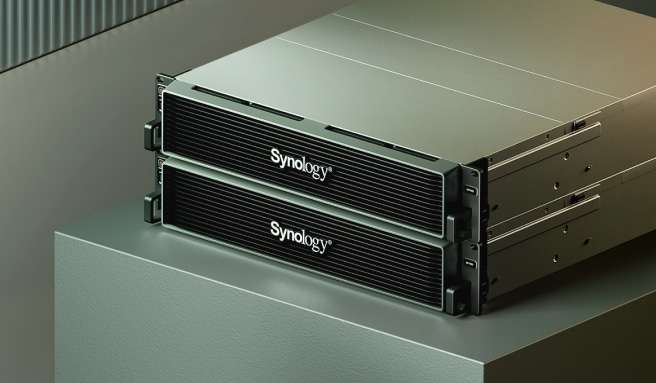
Synology has announced the new RackStation RS1226+ and RS1226RP+, two rack-mounted NAS systems with 2U and eight bays designed for small to medium-sized businesses that require centralized storage in remote offices, branch locations, or edge environments where space is often limited. The new generation features 2.5 GbE connectivity as standard, M.2 NVMe slots to enhance performance with SSD cache, and expansion options in both capacity and network speed.
The key features of the new RackStation RS1226+ and RS1226RP+ in 20 seconds
- Synology introduces two 2U, 8-bay NAS units for remote offices and edge environments.
- They include 2.5 GbE built-in, M.2 NVMe slots, and support for up to 12 drives.
- Both are compatible with VMware, Hyper-V, Citrix, and OpenStack, as well as containers and virtual machines.
- The RS1226RP+ model offers redundant power supplies to increase uptime.
This announcement comes at a time when many organizations are strengthening their distributed infrastructure. The expansion of hybrid work models, growth of edge computing, and the need to process data close to the source have driven demand for compact solutions that provide storage, backup, and virtualization services without relying solely on traditional data centers.
Designed for remote offices and communications closets
One primary goal of this new series is to meet the needs of companies with multiple sites that require a system easy to deploy and manage from a central location.
The low-profile chassis facilitates installation in communications closets where space is limited. Additionally, the design aims to minimize downtime during maintenance, featuring hot-swappable drive trays and online volume management.
For the RS1226RP+, Synology also includes redundant power supplies, a common feature in critical infrastructure where service continuity is prioritized.
Enhanced connectivity and performance
The new generation brings significant improvements over previous models.
For the first time in this lineup, Synology incorporates 2.5 GbE ports as standard, a speed increasingly recognized as a new norm in many enterprise networks. The M.2 NVMe slots allow the use of SSDs as cache to accelerate data access, ideal for workloads with high read/write demands.
According to the manufacturer, the devices can deliver sequential read speeds over 2,300 MB/s and write speeds over 1,500 MB/s. Final performance depends on system configuration and deployment environment.
Organizations requiring higher bandwidth can install optional 10 GbE or 25 GbE network cards, further expanding their network capabilities.
Both models support expansion from 8 to 12 bays through the RX426 expansion unit, allowing storage capacity to grow as business needs evolve.
Virtualization, private cloud, and containers
Beyond hardware, a key strength of the RackStation series is the DiskStation Manager (DSM) software ecosystem.
Included applications like Synology Drive turn the NAS into a private cloud for file sharing across sites and synchronization between distributed teams.
The platform also features Virtual Machine Manager and Container Manager, enabling hosting of virtual machines and containers directly on the storage system. Synology states these functions are certified for platforms like VMware, Microsoft Hyper-V, Citrix, and OpenStack, ensuring compatibility with existing infrastructure.
While these NAS units are not intended to replace dedicated virtualization clusters, they can be useful for labs, testing environments, disaster recovery, or small virtual workloads.
Smart storage for managing data growth
Another notable update is the enhancement of storage optimization features in DSM 7.4.
Synology introduces improvements in Synology Tiering, a technology that automatically migrates data between different storage tiers based on access frequency. Frequently used data remains on high-performance drives, while less active data can be moved to higher-capacity units.
Synology also assures that the new storage efficiency features can achieve data reduction ratios between 1.5:1 and 3.5:1 in certain internal scenarios, though results depend on workload and data patterns.
A commitment to enterprise edge deployment
The launch of the RS1226+ and RS1226RP+ reflects a growing market trend: the expansion of distributed infrastructure where local storage remains vital.
Even as cloud services expand, many companies need to keep some data close to applications due to latency, availability, sovereignty, or business continuity reasons. In this landscape, business NAS solutions evolve to offer not just storage, but also virtualization, site synchronization, data protection, and centralized management.
With this new lineup, Synology aims to strengthen its position in this segment, providing a compact platform suitable for remote offices, branch offices, and edge deployments where physical space and ease of management are critical factors.
Frequently Asked Questions
Who are the Synology RS1226+ and RS1226RP+ designed for?
Primarily intended for small and medium-sized businesses that need centralized storage in remote offices, branch locations, or edge environments.
What are the main differences between the two models?
The main difference is that the RS1226RP+ includes redundant power supplies, aimed at improving system availability.
Can these be used for virtualization?
Yes. Synology offers Virtual Machine Manager and Container Manager, with certified compatibility for VMware, Hyper-V, Citrix, and OpenStack.
Can storage capacity be expanded?
Yes. Both models can be expanded from eight to twelve bays using the RX426 expansion unit.
via: synology
