
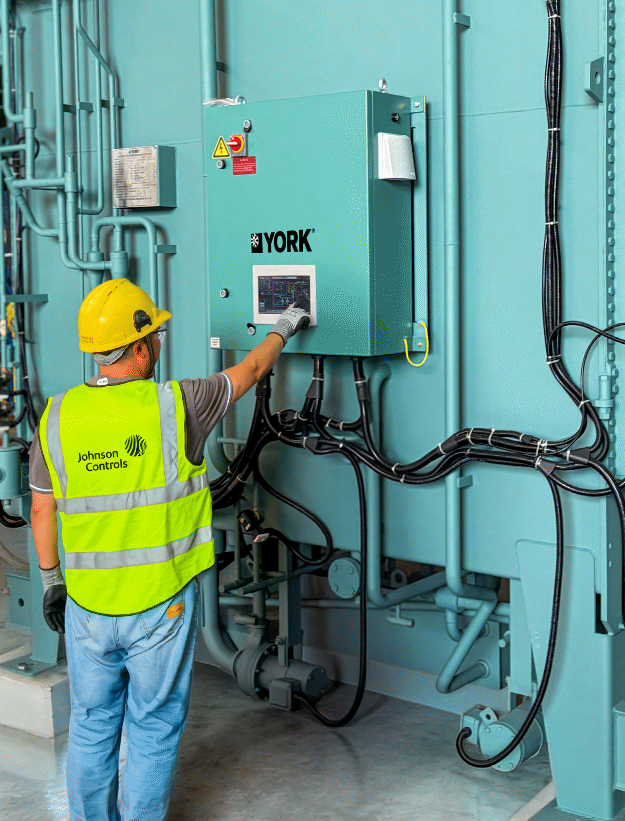
Data centers consume increasingly larger amounts of electricity to power artificial intelligence loads, but a significant portion of that energy is dissipated as heat. Johnson Controls believes that this heat can be turned into an opportunity and has introduced a technical guide proposing its reuse through absorption chillers to generate cooling, thereby reducing electricity consumption for climate control and freeing up more power for servers and AI accelerators.
Key points of absorption cooling in 20 seconds
- Johnson Controls presents a design guide to reuse residual heat from data centers.
- The proposal could reduce up to 44% of the cooling-related electricity consumption.
- In a 1 GW installation, it could free up to 97 MW for AI workloads.
- The company estimates that this architecture can achieve a PUE of 1.23 and reduce cooling system emissions by up to 43%.
The initiative arrives at a time when major cloud operators and infrastructure providers are seeking efficiency improvements that allow them to increase computing capacity without relying on new electrical connections or expanding energy generation.
Turning heat into computing capacity
Traditionally, heat generated by servers and power systems is considered waste that must be eliminated as quickly as possible to maintain stable operating temperatures.
Johnson Controls proposes a different approach: harnessing this residual heat to feed absorption chillers, a technology that uses thermal energy instead of electricity to produce chilled water for climate control systems.
According to the company, approximately 57% of the energy used for onsite power generation ends up as heat dissipation. Recovering part of this energy could significantly reduce the electrical demand of cooling systems.
This would result in greater power availability to add more servers dedicated to artificial intelligence without increasing the energy generation capacity.
Up to 97 MW additional for AI
The example used by Johnson Controls pertains to a 1 GW “AI Factory.”
In that scenario, reclaiming residual heat could provide up to 97 MW additional for AI computing loads.
The company estimates that this extra capacity could translate into up to $18 billion in additional revenue over the lifespan of a typical U.S. facility, although this is a projection based on a theoretical model developed by the company itself and will depend on various factors such as data center utilization, workload types, and market evolution.
Reducing cooling electricity consumption
One of the main goals of the report is to decrease the electricity used by climate control systems.
According to Johnson Controls, using absorption chillers could cut up to 44% of the electrical demand dedicated solely to cooling.
Furthermore, the proposed design aims for additional efficiency objectives:
- Achieve a PUE (Power Usage Effectiveness) of up to 1.23.
- Reduce CO₂ emissions associated with cooling by up to 43%.
- Operate without in-situ water consumption in certain configurations.
Although these figures depend on the specific design of each installation, they reflect the growing importance of thermal management within next-generation data centers.
Cooling gains prominence in the AI era
Until a few years ago, discussions about data centers mainly focused on processors, GPUs, and storage.
The expansion of artificial intelligence is shifting some of that focus to another critical element: cooling.
New AI clusters host thousands of accelerators operating simultaneously with electrical consumption reaching several hundred megawatts per facility. Maintaining these infrastructures within suitable thermal margins has become one of the primary challenges for operators, manufacturers, and infrastructure providers.
In this context, technologies like liquid cooling, heat recovery, absorption systems, and energy optimization are becoming as vital as the computing hardware itself.
A scalable architecture for growth
Johnson Controls explains that the presented design has a modular approach, allowing adaptation to campuses of approximately 100 MW as well as future installations of several gigawatts without a complete redesign of the infrastructure.
The company also points out that the technology leverages decades of experience with its YORK chillers, used in industrial sectors and high-demand applications.
This proposal reflects an increasingly visible trend in the sector: AI growth is no longer solely dependent on manufacturing more chips. It also requires better utilization of each available megawatt, reducing auxiliary system energy consumption, and transforming elements previously considered waste, like residual heat, into a useful resource to boost computing capacity.
Frequently Asked Questions
What is an absorption chiller?
It’s a cooling system that uses thermal energy, such as residual heat, instead of electricity to produce chilled water for building climate control or industrial facilities.
Why is it interesting for data centers?
It allows utilizing part of the heat generated by the facility itself to produce cooling, thereby reducing electricity consumption for climate control.
What does it mean to free up 97 MW for AI?
According to Johnson Controls’ model, a 1 GW facility could allocate up to 97 MW more to AI servers and accelerators by reducing the energy needed for cooling.
Is this a new technology?
No. Absorption chillers have been used for decades in industrial and cogeneration applications. The novelty lies in their integration into new data center infrastructures designed for AI workloads.
