
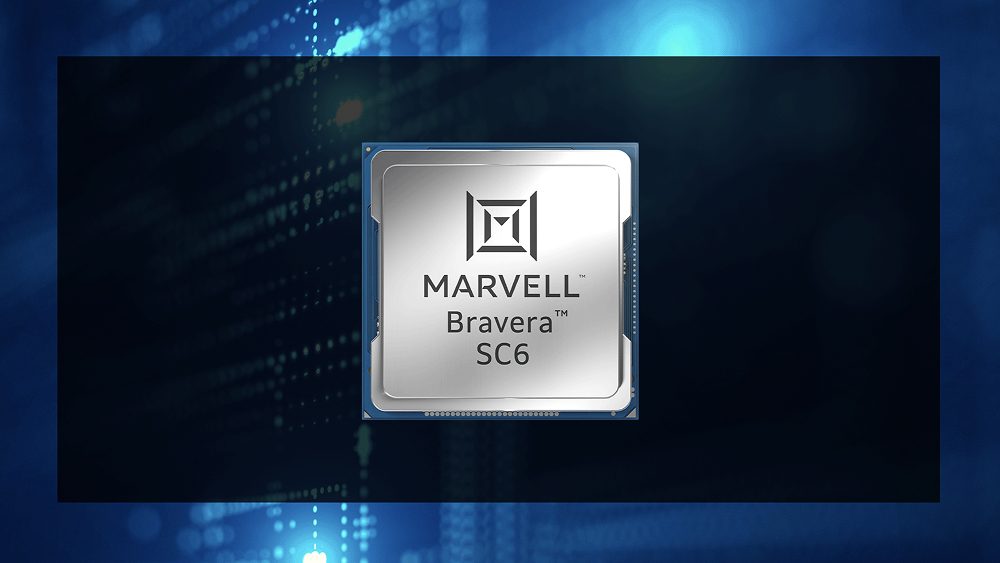
The next generation of SSDs for data centers is no longer measured solely by bandwidth. Artificial intelligence is transforming how servers, GPUs, and storage work together, prompting a redesign of the core components of NVMe drives: the controller. With this in mind, Marvell has introduced Bravera SC6 (MV-SF1410), a new PCIe Gen6 controller for enterprise SSDs that is expected to become a key part of AI infrastructure in the coming years.
Although the controller won’t be available to manufacturers until Q4 2026, its architecture clearly indicates the direction in which AI storage is heading: SSDs that transition from simple storage devices to an extension of accelerator memory.
Key features of Bravera SC6 in 20 seconds
- Marvell introduces Bravera SC6, its new enterprise PCIe Gen6 SSD controller.
- Designed for AI, cloud, and hyperscale infrastructures.
- Supports the latest NAND TLC and QLC with speeds up to 3,600 MT/s.
- Integrates 16 ARM cores, hardware encryption, and advanced error correction technologies.
- First samples are scheduled for release in Q4 2026.
AI is transforming the role of SSDs
For years, NVMe storage has served as a distinct layer separate from main memory. However, the growth of AI models is changing that architecture.
GPUs feature extremely fast HBM memory, but it is also very costly and limited in capacity. As model sizes grow, context windows expand, and the number of simultaneous agents increases, it becomes impractical to keep all data solely in HBM or even in DRAM.
Therefore, data centers are adopting hierarchical memory architectures where NVMe SSDs act as a high-capacity layer capable of storing tens or hundreds of terabytes at a much lower cost per gigabyte.
This trend is further supported by recent NVIDIA initiatives like Storage-Next and the open-source software cuFile, which aim to enable GPUs to access NVMe storage directly without relying continuously on the CPU.
PCIe Gen6 and NVMe 2.2 for the next-generation SSDs
Bravera SC6 features PCI Express 6.0 x4 interface, while maintaining full backward compatibility with previous PCIe generations.
The controller also complies with NVMe 2.2, including end-to-end data protection to ensure integrity throughout the data transfer process.
Its NAND interface supports both ONFI and Toggle standards, operating at 1.2 volts and reaching speeds up to 3,600 MT/s, which are essential for powering future high-performance NAND memories.
The architecture includes:
- 16 NAND channels.
- Up to 8 Chip Enables per channel.
- Compatibility with SLC, MLC, TLC, and QLC memories.
This allows the design of enterprise SSDs with large capacities without sacrificing performance.
A controller with integrated CPU power
Modern SSD controllers do much more than move data between NAND and the PCIe bus.
They handle address translation (FTL), wear leveling, garbage collection, caching, encryption, error recovery, and multiple background processes.
Marvell has integrated a processing platform consisting of:
- 12 ARM Cortex-R82 cores, distributed across two clusters.
- 3 Cortex-M7 cores dedicated to specific tasks.
- 1 Cortex-M3 secure core for cryptographic functions.
Altogether, the controller features 16 embedded processors capable of executing multiple storage management tasks simultaneously without performance penalties.
Security built for data centers
Security is also a major focus.
The secure Cortex-M3 core includes hardware accelerators for:
- AES encryption
- SHA hashing
- RSA encryption
- Elliptic Curve Cryptography (ECC)
This enables compliance with Trusted Computing Group (TCG) standards for encryption, authentication, and secure cryptographic key management without impacting SSD performance.
Error correction for increasingly dense memories
One of the main challenges with current NAND memories is maintaining reliability as the number of bits stored per cell increases.
To address this, Bravera SC6 incorporates Marvell’s sixth-generation NANDEdge, a proprietary platform for managing flash memory.
It includes advanced error correction engines LDPC (Low Density Parity Check) alongside hardware-based RAID, enhancing fault tolerance and extending the lifespan of enterprise drives.
Prepared for AI-powered SSDs
Marvell emphasizes that this controller has been designed with major cloud providers and enterprise SSD manufacturers in mind.
In addition to supporting NAND from multiple vendors, it allows OEMs to maintain a common platform regardless of the memory supplier—particularly important as the NAND market continues to face supply pressures driven by AI demand.
Although Bravera SC6 will still take a few months to reach initial manufacturers, it exemplifies the evolution of enterprise storage: SSDs are transitioning from simple data repositories to critical components within AI memory hierarchies.
Frequently Asked Questions
What is Marvell Bravera SC6?
It is a new enterprise PCIe Gen6 SSD controller designed for data centers, cloud environments, and AI infrastructure.
What are the advantages of PCIe Gen6?
It doubles the bandwidth compared to PCIe Gen5 and enables SSDs capable of handling much more intensive workloads, especially in AI and databases.
What types of NAND memory does it support?
Supports SLC, MLC, TLC, and QLC NAND memories, using up to 16 NAND channels and speeds of 3,600 MT/s.
When will it be available?
Marvell expects to begin shipping samples to manufacturers during Q4 2026.
