
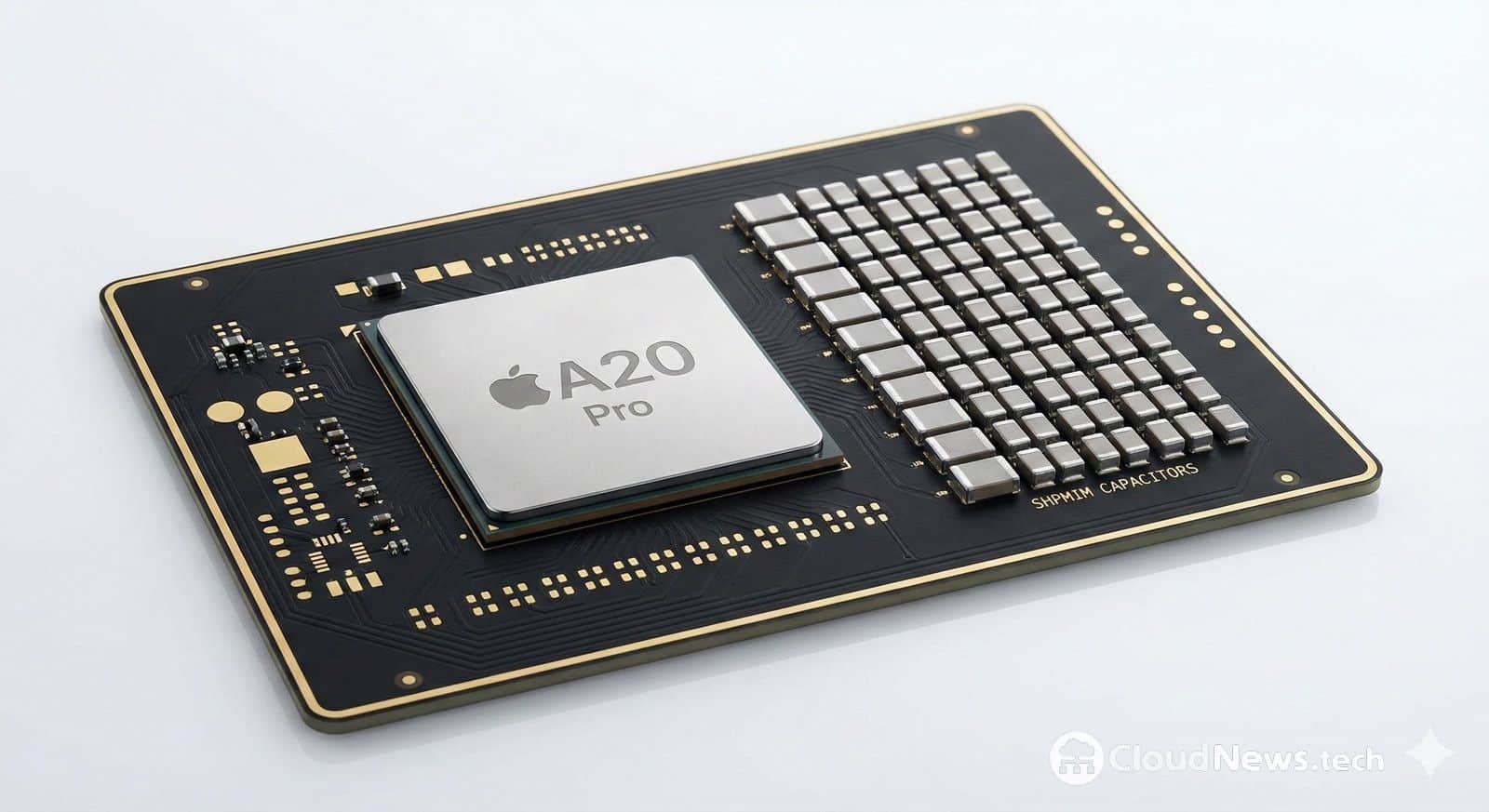
Apple’s supply chain could face a new hurdle ahead of the next-generation iPhone. According to information published by the industry-focused site Wccftech, TSMC is stockpiling Apple A20 Pro chips worth approximately $1 billion that cannot move to the next manufacturing phase due to a lack of DRAM memory supply. If confirmed, the bottleneck would no longer be in processor manufacturing capacity but in memory availability, one of the components most strained by the rise of artificial intelligence.
The key points of the DRAM shortage in 20 seconds
- TSMC is estimated to have accumulated about $1 billion in pending A20 Pro chips awaiting completion.
- The lack of DRAM memory is slowing down the next production phase.
- Apple is competing with large AI clients for LPDDR5X memory supplies.
- The information hints at possible delays in some products, although Apple has not confirmed this.
Sources within the industry, cited by Culpium and reported by Wccftech, suggest that the situation could affect the production schedule of upcoming iPhone 18 Pro models. However, neither Apple nor TSMC has made public statements about these potential supply issues at this time.
It’s no longer about chips; it’s about memory
In recent years, industry conversations around semiconductors have focused on the manufacturing capacity of advanced nodes. However, the landscape is shifting.
TSMC continues to increase its 2-nanometer production, with projections to reach nearly 100,000 wafers per month by the end of 2026, driven by strong demand from major AI clients and Apple.
According to published information, fabrication of the A20 Pro processors is proceeding normally. The problem arises in subsequent assembly stages, where sufficient DRAM memory is crucial to complete final device assembly.
This situation marks a significant industry shift: manufacturing processors is no longer the primary bottleneck; the bottleneck is now memory availability.
AI is absorbing much of global production
The pressure on the memory market is not new.
Manufacturers such as Samsung, SK hynix, and Micron have been prioritizing products for data centers and AI accelerators for months, especially HBM and LPDDR5X memories, which are much more profitable than traditional DRAM used in computers and smartphones.
As a result, supply for other segments has decreased, and prices have risen significantly.
This phenomenon has already forced many PC manufacturers to reduce installed memory in their devices and is also affecting the NAND storage market.
Apple now competes with major AI clients
The published information indicates that Apple has attempted to secure additional supplies through negotiations with its usual suppliers and even explored deals with Chinese manufacturer CXMT.
However, these efforts have not yielded the desired results, and the company may have to accept higher prices to access the necessary memory for its upcoming devices.
While Apple has traditionally been one of the most influential negotiators in the industry, the AI boom is shifting the market balance. Large data center operators and AI model developers are placing massive memory orders, increasing competition for components whose production cannot be immediately scaled up.
Could the iPhone 18 be delayed?
Wccftech suggests that this could lead to delays in the launch or initial availability of the iPhone 18 Pro and iPhone 18 Pro Max.
However, it’s important to emphasize that this possibility has not been officially confirmed by Apple, TSMC, or any of their suppliers.
In recent years, Apple has demonstrated a high capacity to reorganize its supply chain when production issues arise, so it’s still too soon to conclude that there will be a direct impact on the release schedule of its upcoming devices.
Memory: the new strategic resource
Beyond the specific case of Apple, the information reflects a profound shift in the semiconductor industry.
For decades, the main challenge was manufacturing more advanced processors. Now, with the explosion of AI, memory has become one of the most critical components in the entire tech supply chain.
Major manufacturers are allocating increasing capacity to AI-related products, while companies in traditional sectors—including smartphone and PC makers—must compete for increasingly limited resources.
If this trend continues into 2027, the shortage of DRAM and NAND could continue to influence both the price and availability of numerous electronic devices.
Frequently Asked Questions
What’s happening with Apple’s A20 Pro chips?
According to information from Wccftech, TSMC has already manufactured A20 Pro processors that cannot proceed to the next stage due to a lack of DRAM memory. This information has not been officially confirmed.
Is the iPhone 18 delayed?
No. Some industry sources suggest this possibility, but Apple has not announced any changes to its release schedule.
Why is DRAM memory in short supply?
Demand for memory for AI and data centers is absorbing a large portion of global production, reducing the supply available for other markets.
Who are the main producers of this memory?
The leading DRAM manufacturers continue to be Samsung, SK Hynix, and Micron. Companies like CXMT are increasing production but still hold a much smaller market share.
via: wccftech
