
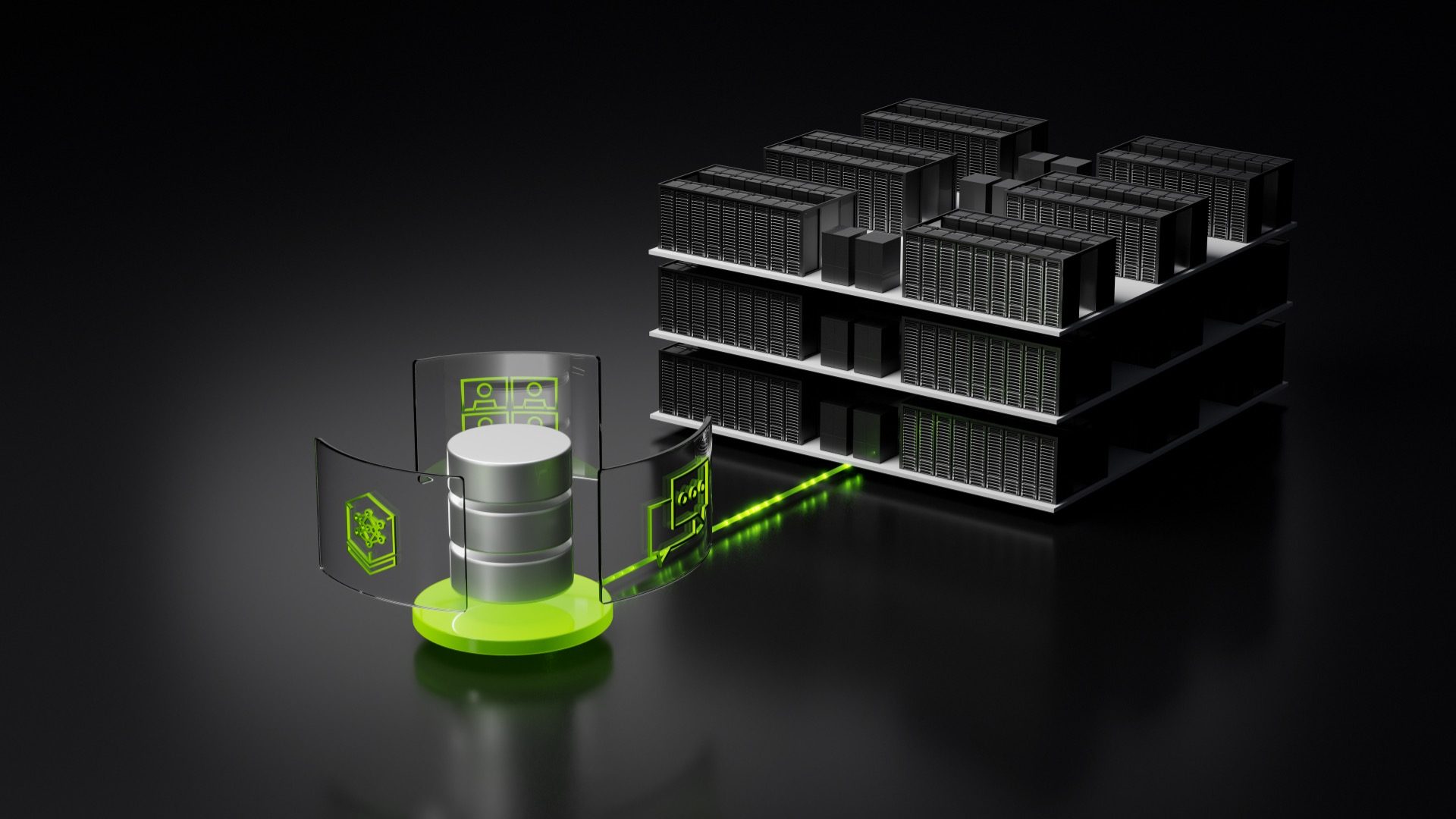
NVIDIA believes that the next major bottleneck in artificial intelligence will no longer be computing power, but available memory. Therefore, the company has introduced at Future of Memory and Storage (FMS) 2026 a new strategy that allows GPUs to access SSD units directly without going through the CPU, aiming to expand the effective memory capacity for ever-larger AI models and agents working simultaneously.
Key points of Storage-Next in 30 seconds
- NVIDIA will open source cuFile, the technology that enables GPUs to access storage directly.
- GPUs will be able to launch thousands of simultaneous requests to SSDs without relying on the CPU.
- The Storage-Next initiative involves over 40 companies, including Google, Intel, Meta, Micron, Kioxia, and DDN.
- The goal is to use NAND Flash as a new memory layer for AI when HBM proves insufficient.
- NVIDIA clarifies that an SSD will not replace HBM but will allow for storing large contexts, caches, and persistent memory with microsecond latencies.
This proposal comes at a time when HBM memory has become one of the most scarce and expensive components in AI infrastructure. Models with larger context windows, inference with thousands of agents, and large knowledge bases are increasing pressure on GPU memory.
GPU aims to stop relying on CPU for data access
Currently, when a GPU needs information stored on an SSD, the process usually involves several steps.
Data passes through the CPU, traverses various layers of the operating system, and makes multiple copies before finally reaching GPU memory.
NVIDIA wants to eliminate much of this process.
To do this, it will open source cuFile, the interface used by GPUDirect Storage, allowing GPUs to initiate direct read/write operations on storage.
According to the company, this will enable managing thousands of concurrent requests by leveraging the hundreds of thousands of threads available on modern GPUs.
The project will be developed within XIO-SIG, a new initiative whose first maintainers will be Google, Intel, Meta, and NVIDIA, with the aim of creating an interoperable layer that works across different hardware and software platforms.
NAND becomes part of the memory hierarchy
The approach is not about replacing HBM memory with SSDs.
The differences in latency and bandwidth remain significant.
What NVIDIA proposes is to utilize the vast capacity available in enterprise SSDs as an additional layer within the memory hierarchy.
Instead of keeping all information in HBM, applications will be able to store on SSDs elements such as:
- Large-sized contexts.
- KV caches for language models.
- Persistent memory for AI agents.
- Vector databases.
- Partially used datasets.
GPUs will retrieve only the necessary blocks at each moment, reducing pressure on main memory.
NVIDIA states that this access will occur on microsecond scales, a significant difference compared to traditional storage models.
SCADA: direct access with isolation
Allowing a GPU to write directly to storage also presents new security challenges.
To address these, NVIDIA has introduced SCADA (Scaled Accelerated Data Access).
This framework clearly separates two components.
On one hand, the application needing quick access to storage remains outside the system’s trust boundary.
On the other, a privileged component pre-configures which storage regions each workload can use, maintaining typical Linux kernel protection mechanisms.
The company claims this design prevents applications from freely accessing storage contents or interfering with other processes.
Storage-Next aims to define the future of AI storage
All these technologies are part of Storage-Next, an initiative driven by NVIDIA along with more than 40 storage, Flash memory, and infrastructure platform manufacturers, including DDN, Kioxia, and Micron.
The goal is to establish open standards for a new generation of storage specifically designed for GPU-accelerated workloads.
Within this ecosystem, NVIDIA Vera BlueField-4 STX will also play a significant role, combining the new Vera processors, BlueField-4 DPUs, and the DOCA security stack to create native AI storage platforms.
Rising SSD demand… and potential market pressure
Although NVIDIA does not specify the commercial impact of this strategy, the move could have consequences for the storage industry.
If SSDs become much more active components within AI infrastructure, their demand could increase in parallel with the growth of data centers dedicated to generative models.
Manufacturers like Kioxia, Micron, Samsung, SK Hynix, and Solidigm have been increasing investments in high-capacity NAND over recent months, precisely due to the strong growth in the AI market.
However, it is still too early to predict a direct impact on prices. The evolution will depend on the actual adoption of these architectures and the balance of supply and demand for Flash memory in the coming years.
What seems clear is that NVIDIA no longer considers storage merely as a data repository. In the next generation of AI infrastructure, SSDs will become part of the execution path of models, reducing dependence on HBM memory, whose capacity remains one of the sector’s main limitations.
Frequently Asked Questions
What does NVIDIA aim to do with SSDs?
They want GPUs to access storage directly, using SSDs as an additional memory layer dedicated to AI applications.
Will SSDs replace HBM memory?
No. NVIDIA explains that there will still be significant performance and latency differences. The idea is to complement HBM, not replace it.
What is Storage-Next?
It is an initiative led by NVIDIA and over 40 companies to develop open standards for storage optimized for GPU-accelerated workloads.
What is SCADA?
It is a framework developed by NVIDIA to enable direct GPU access to storage while maintaining isolation and security mechanisms compatible with Linux.
