
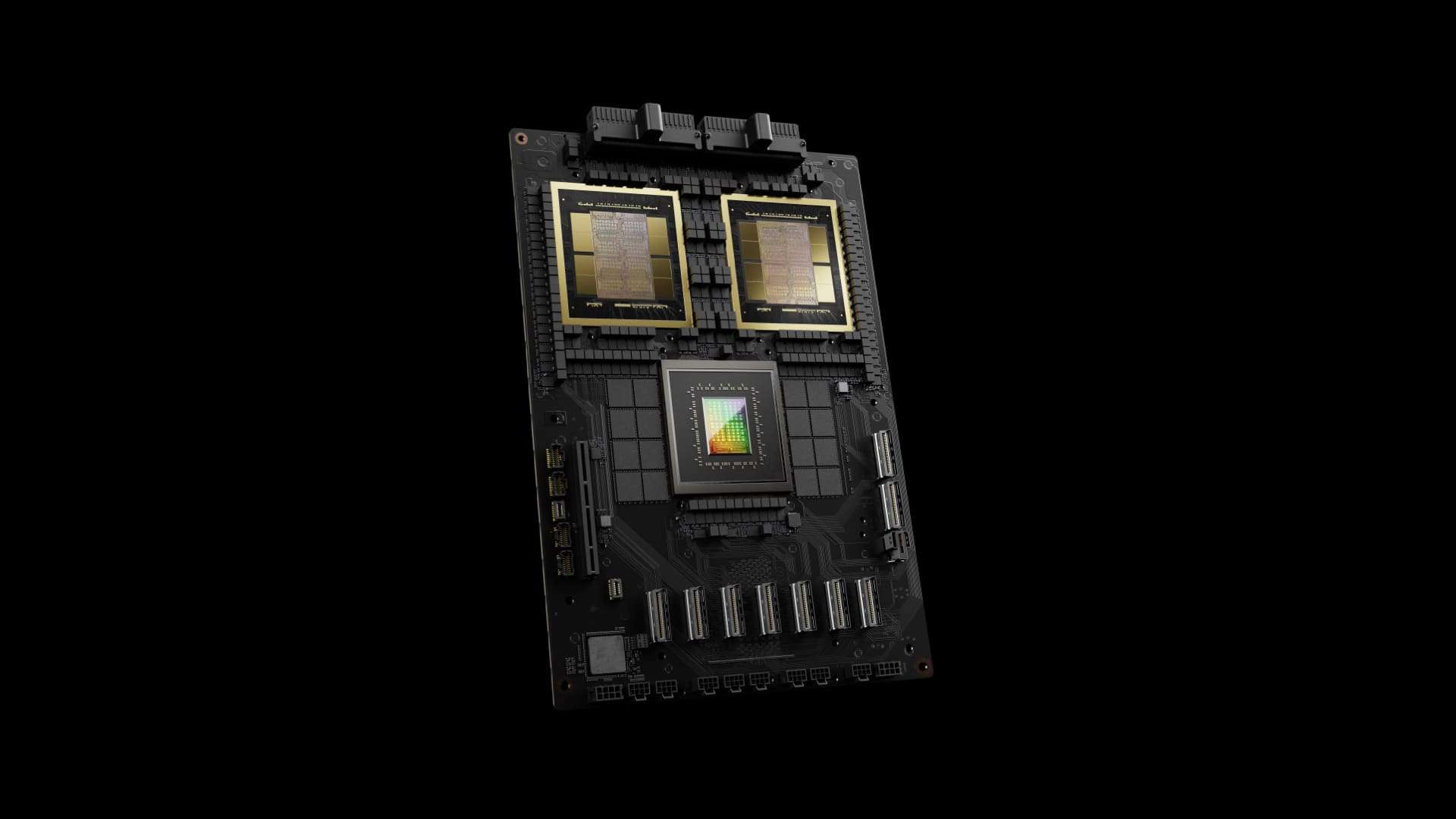
China is once again attempting to change the rules of the artificial intelligence chip market. Instead of directly competing with NVIDIA in the race for the most advanced manufacturing processes, the Chinese startup Dongfang Suanxin (DFSX) promotes a completely different strategy: reducing the memory bottleneck. Its future platform TY64 SuperNode, based on the DF2000 accelerators using 14-nanometer technology, promises up to 960 TB/s of memory bandwidth, well above the 576 TB/s offered by the NVIDIA GB200 NVL72 system, according to figures published by the company itself.
The key points of DFSX and its focus on memory in 20 seconds
- DFSX is betting on 3D architecture and encapsulation instead of competing in manufacturing nodes.
- The upcoming DF2000 will maintain a 14 nm process but will increase bandwidth to 15 TB/s per chip.
- A TY64 SuperNode would reach an aggregated bandwidth of 960 TB/s, according to the company.
- The proposal aims to reduce Chinese dependence on HBM and on technologies subject to U.S. restrictions.
- These figures have not yet been independently verified.
The proposal comes at a time when the industry is beginning to recognize that simply increasing computational power is no longer enough to improve AI model performance. For workloads such as training large language models or large-scale inference, moving data from memory to compute units has become one of the main performance bottlenecks.
The “Memory Wall,” the new enemy of artificial intelligence
For years, the semiconductor race has revolved around two indicators: manufacturing node size and FLOPS (operations per second).
However, the explosion of artificial intelligence has raised another long-standing issue: the memory wall.
Current GPUs can perform enormous amounts of mathematical operations but are often partially idle waiting for data to arrive from memory. This dead time reduces hardware utilization and limits the efficiency of systems that cost millions of dollars.
DFSX argues that this is where the real opportunity lies.
Instead of chasing processes at 3 or 2 nanometers, the company has designed an architecture where memory and compute logic are physically much closer.
A 14-nanometer chip that avoids dependence on HBM
The company’s first accelerator, the DF1000, already drew attention by utilizing a mature 14 nm process combined with a near-memory computing architecture.
Its design eliminates traditional microbump usage through hybrid bonding at the wafer level, directly connecting logic with memory via millions of vertical interconnections. According to DFSX, this enables reaching 6.4 TB/s bandwidth using their own memory instead of relying on restricted commercial HBM memories.
The next generation, called DF2000, will go a step further.
Instead of stacking a single layer of memory over the logic, it will utilize multiple memory and compute towers grouped via an architecture called 3.5D Infinity Chiplet.
According to the roadmap presented by the company:
| Platform | Memory Bandwidth |
|---|---|
| DF2000 | 15 TB/s per chip |
| TY64 SuperNode (64 DF2000 chips) | 960 TB/s |
| NVIDIA GB200 NVL72 | 576 TB/s |
These figures come from DFSX itself and have not yet been validated by independent third parties.
More memory but significantly less compute power
This strategy has a notable trade-off.
While the bandwidth is extremely high, the computational power remains clearly behind NVIDIA’s platform.
According to data provided by DFSX:
- TY64 with DF2000: 64 PFLOPS BF16
- NVIDIA GB200 NVL72: 360 PFLOPS BF16
The difference is still substantial.
DFSX’s main hypothesis is that many current AI models do not fully utilize these FLOPS because they are waiting for data from memory.
If this hypothesis proves correct, an architecture with lower raw compute but much faster memory access could achieve greater efficiency in certain inference scenarios.
China’s response to U.S. restrictions
Beyond technology, the project reflects the transformation underway in China’s semiconductor industry.
U.S. restrictions limit access to advanced lithography and the latest generation HBM memories. As a result, several Chinese companies are attempting to compete with new architectures instead of following the same technological path as NVIDIA, AMD, or TSMC.
DFSX employs a fully domestic supply chain and has already presented a roadmap that includes:
- DF1000, ready to begin deliveries before the end of 2026.
- DF2000, scheduled for Q4 2026.
- DF3000, expected to arrive by the end of 2027 with a target of 20 TB/s per chip.
Software and manufacturing remain big uncertainties
The figures published by DFSX are impressive, but many open questions remain.
First, the company has yet to demonstrate the performance of its platforms on real workloads comparable to NVIDIA’s.
Additionally, commercial success will depend on factors such as:
- The maturity of the software ecosystem.
- Compilers and AI libraries.
- Scalability across hundreds or thousands of accelerators.
- Manufacturing yields.
- Energy efficiency.
The company itself acknowledges that 3D stacking also poses industrial challenges and that increasing the number of layers could negatively impact manufacturing yields.
What is increasingly clear is that the next generation of AI accelerators won’t be decided solely by who can manufacture the smallest node. Memory, advanced packaging, and the ability to move data faster are becoming factors as important as FLOPS itself.
Frequently Asked Questions
What is DFSX?
Dongfang Suanxin (DFSX) is a Chinese startup specializing in AI accelerators that advocates for near-memory architectures and a predominantly domestic supply chain.
Why use a 14-nanometer process?
The company prioritizes a different architecture based on 3D encapsulation and integrated memory to reduce reliance on advanced nodes and HBM memory.
Does this mean the DF2000 will be faster than NVIDIA?
Not necessarily. DFSX claims it will offer higher memory bandwidth but acknowledges that its BF16 compute power is lower than that of the NVIDIA GB200 NVL72 system.
Are these figures verified?
No. The data published about the DF2000 and the TY64 SuperNode come from the company itself and have not yet been confirmed through independent testing.
via: wccftech
