
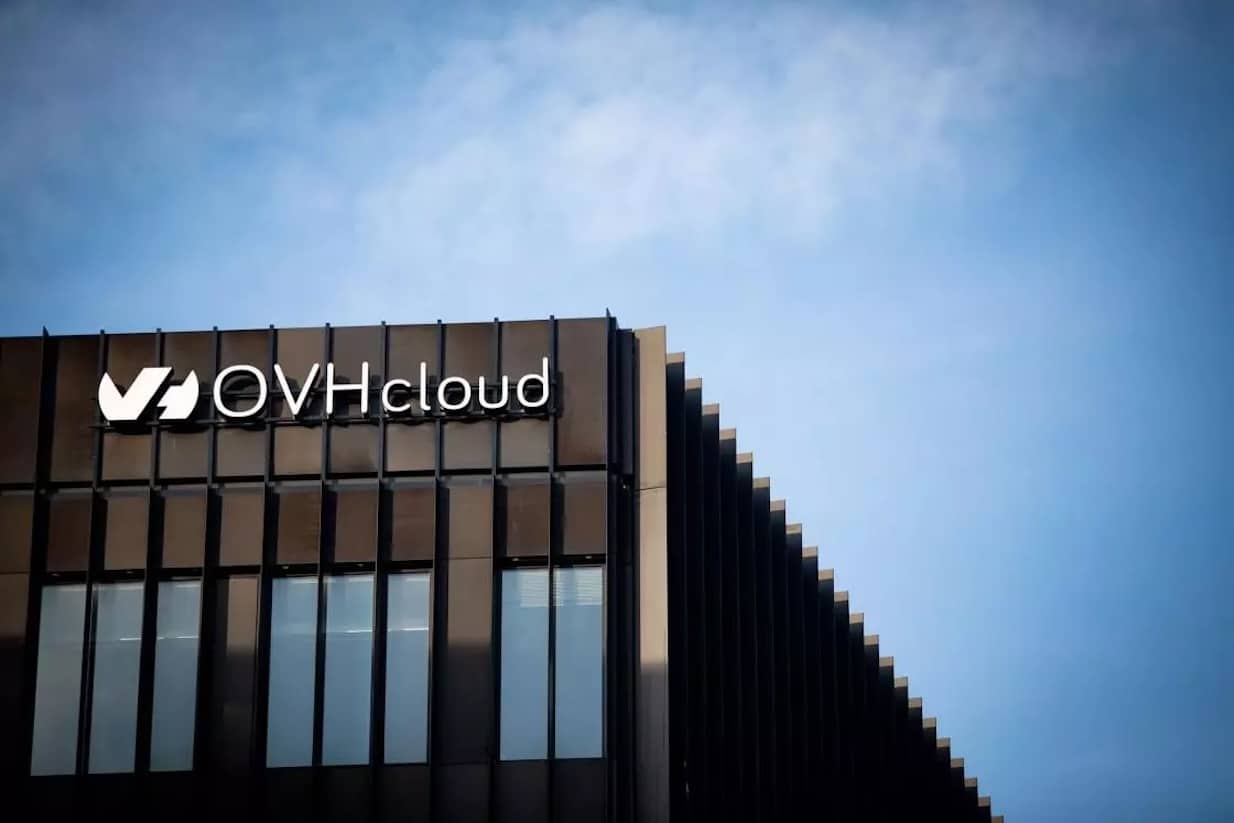
OVHcloud has become one of the leading European alternatives to Amazon Web Services, Microsoft Azure, and Google Cloud. The French group operates over 500,000 servers across 46 data centers, serves 1.6 million clients, and combines public cloud, private cloud, dedicated servers, and web hosting with a focus on sovereignty, reversibility, and infrastructure control.
The key points of OVHcloud and European sovereignty in 20 seconds
- OVHcloud was founded in Roubaix in 1999 and has been listed on Euronext Paris since 2021.
- It manages 46 data centers and more than 500,000 servers.
- The company manufactures some of its equipment and operates its own network and infrastructure.
- Some of its solutions are certified with France’s SecNumCloud qualification.
- Being European reduces certain legal risks, but sovereignty depends on the service contracted and its configuration.
The importance of OVHcloud isn’t just in its nationality. In a market dominated by U.S. providers, the company maintains control over much of the technical chain: designing and assembling servers, managing data centers, operating an international network, and developing infrastructure and platform services.
This integration allows OVHcloud to advocate a different model from the major hyperscalers. The company emphasizes the freedom to move data, reduced or no costs for outbound traffic on certain services, and the ability to combine physical servers, private clouds, and public services.
A French company with international reach
Octave Klaba founded OVH in 1999 in Roubaix, northern France. The company initially offered web hosting and servers but gradually expanded into private cloud, public platforms, storage, and managed services.
Currently, the group employs around 3,000 people, operates 46 data centers across four continents, and has a presence in over 140 countries. Its fiscal year 2025 revenue is projected at 1.085 billion euros, with an adjusted gross operating profit of 438 million euros.
OVHcloud went public on October 15, 2021. The IPO price was 18.50 euros per share, with an initial capitalization of approximately 3.48 billion euros. The offering raised 400 million euros, with the founding family maintaining a controlling stake.
The company positions itself as the leading European provider solely dedicated to cloud services. This focus is significant because, while Europe has large telecom and tech groups, few regional operators have developed comparable infrastructure and global deployment capabilities.
Major locations include Roubaix, Gravelines, and Strasbourg in France, Beauharnois in Canada, and Limburg in Germany. The network is supplemented with data centers and local zones in other markets.
What does it really mean for a cloud to be sovereign?
Digital sovereignty is often reduced to the physical location of servers, but this is just part of the issue.
Other factors include the provider’s nationality, shareholding structure, involved companies, applicable laws, access by technical personnel, management of encryption keys, and the actual ability to migrate workloads to another platform.
OVHcloud is a French company primarily subject to European legal frameworks within the European Union. This lessens direct exposure that can occur when the parent company is a U.S. entity subject to laws like the CLOUD Act.
However, it’s not accurate to assume that all data hosted with OVHcloud products are automatically outside the reach of foreign legislation. The situation depends on the service, the chosen region, involved entities, the contract, and how the infrastructure is managed.
The company differentiates between its general services and offerings deployed within trusted zones with specific sovereignty requirements. Therefore, using a standard instance and deploying a qualified platform for sensitive data are not equivalent decisions.
Sovereignty also does not replace security. A European provider can experience incidents, misconfigurations, or outages just like a U.S. company. Choosing jurisdiction and location helps with legal control, but data encryption, backups, access restrictions, and continuity plans remain essential.
SecNumCloud does not certify OVHcloud’s entire catalog
One common argument in favor of OVHcloud is its relationship with SecNumCloud, the qualification established by France’s National Agency for the Security of Information Systems (ANSSI).
SecNumCloud assesses technical, operational, organizational, and legal aspects of a cloud service. It is aimed at government agencies, critical operators, and organizations handling sensitive or strategic information.
The key point is that this qualification is granted to specific services and perimeters, not to the entire company or any product listed in its catalog.
For example, OVHcloud offers VMware-based Hosted Private Cloud with SecNumCloud 3.2 and obtained qualification for Bare Metal Pod in 2025. This combines dedicated physical servers, network isolation, encryption, access control, and traceability within a defined environment.
OVH is also working on qualifying SNC Cloud Platform, which aims to bring managed infrastructure and platform services up to the same standards. The ANSSI includes it among ongoing evaluation projects, so it’s not yet a fully qualified offering.
This distinction helps clarify that having certified services doesn’t mean all servers, regions, or products automatically inherit that certification.
Own infrastructure, reversibility, and reduced dependency
OVHcloud manufactures and assembles some of its servers, reuses components, and has developed proprietary liquid cooling systems over the years. It also operates its own fiber network and data centers, reducing reliance on third parties in certain layers.
This approach enables cost control and hardware customization for its services. At the same time, it requires ongoing investments in buildings, power, processors, storage, and connectivity, especially with the growth of AI workloads.
The company highlights reversibility as a core principle. The idea is that customers can retrieve their data and migrate it elsewhere without being locked into closed formats or facing exorbitant exit costs.
Absolute dependence should be evaluated per service. Applications built on virtual machines and open tools tend to be easier to migrate than those heavily reliant on multiple databases, functions, and proprietary managed services.
OVHcloud offers widely used technologies such as OpenStack, Kubernetes, VMware, and bare-metal servers. This combination can ease hybrid architectures and strategies where a company keeps part of its systems on private infrastructure and moves other workloads to the cloud.
Europe needs own providers, but also greater scale
OVHcloud is a significant component of European technological autonomy, though its size is still far below the three major U.S. giants.
AWS, Microsoft, and Google invest billions annually in data centers, networks, chips, and AI services. They also have larger catalogs and challenging global footprints to match.
The European alternative doesn’t necessarily mean replicating every service of hyperscalers. It can focus on areas where jurisdiction, location, portability, close support, or hardware control matter more than having hundreds of different products.
Public sector entities, healthcare, industry, defense, banking, and organizations managing sensitive intellectual property are some of the environments where this difference could be critical.
There’s also an economic dimension: contracting European providers keeps a greater share of technological spending, jobs, and infrastructure investments within the region. While this doesn’t automatically make a solution the best choice for every project, it introduces a relevant criterion many organizations are now considering.
OVHcloud demonstrates that Europe can sustain a cloud provider with own infrastructure, international presence, and qualified services. Its existence doesn’t eliminate the continent’s technological dependency, but it offers a real alternative for companies seeking greater control over data location, legal protections, and future recovery options.
Frequently Asked Questions
Is OVHcloud a French company?
Yes. Founded in 1999 in Roubaix, its parent company, OVH Groupe, has been listed on Euronext Paris since October 2021.
How many data centers does OVHcloud have?
The company reports 46 data centers across four continents, with over 500,000 servers and 1.6 million clients.
Is all OVHcloud certified with SecNumCloud?
No. SecNumCloud applies to specific services and environments, such as certain Hosted Private Cloud offerings and Bare Metal Pod. Other products may be in qualification processes or not covered by this certification.
Does using OVHcloud completely avoid the U.S. CLOUD Act?
Not necessarily for all contracts. French ownership and European services reduce direct exposure, but legal protection depends on the service, region, contractual terms, involved entities, and data management practices.
