
Meta has once again placed artificial intelligence at the core of its business strategy. The company reported record revenues of $60.8 billion in Q2 2026, a 28% increase compared to the previous year. However, the substantial rise in investments in AI infrastructure significantly reduced its free cash flow and initially led to a negative market reaction. Despite this, CEO Mark Zuckerberg asserts that the spending is fully justified because it is already improving the company’s main business and will open new revenue streams.
The key points of Meta’s AI investment in 20 seconds
- Meta earned $60.8 billion in Q2 2026, up 28% year-over-year.
- Free cash flow dropped by 91%, to $784 million, due to increased investment levels.
- The company plans to allocate between $130 billion and $145 billion to AI infrastructure this year.
- Zuckerberg states that artificial intelligence is already driving growth in the advertising business.
- Meta is also exploring commercial AI services, enterprise agents, and even computing capacity offerings.
Meta’s evolution reflects a trend seen among other tech giants like Microsoft, Amazon, and Alphabet: the focus is no longer solely on developing AI models but on building the massive infrastructure needed to run them. Data centers, thousands of GPUs, and new electrical networks have become some of the most valuable assets in the tech sector.
Record revenues but far more spending
Quarterly results show that Meta’s business continues to grow at a solid pace. Most of its revenue still comes from advertising, which reached approximately $59 billion during the quarter.
However, the other side of the coin is in free cash flow. Meta closed the quarter with $784 million, compared to $8.55 billion a year earlier—a decline of nearly 91%.
Part of this decline is due to investments in Reality Labs, the division responsible for developing virtual and augmented reality devices. Nonetheless, the primary expenditure focus remains on building AI infrastructure.
During the analyst conference, both Mark Zuckerberg and CFO Susan Li emphasized that these investments are driven by strategic needs rather than one-time spending increases.
Zuckerberg: “AI is accelerating all our businesses”
Mark Zuckerberg explained that artificial intelligence is already delivering measurable improvements across Meta’s key business lines.
One example mentioned was the advertising system. According to the CEO, large language models (LLMs) enable analyzing a much broader context about user activity to select the most relevant ads.
This process improves the predictive capabilities of Facebook and Instagram’s ad platforms, increasing both ad relevance and conversion rates.
The executive asserted that, thanks to these improvements, Meta’s advertising business is growing faster than that of other industry competitors.
Besides advertising, Zuckerberg believes AI will create new business opportunities for companies. These include developing commercial APIs, intelligent agents for corporate clients, and the potential to commercialize computing capacity for AI-related workloads.
While the company has not yet detailed how these services will materialize or when they might launch, they are positioned as part of Meta’s medium-term growth strategy.
Data centers and GPUs: the new tech race
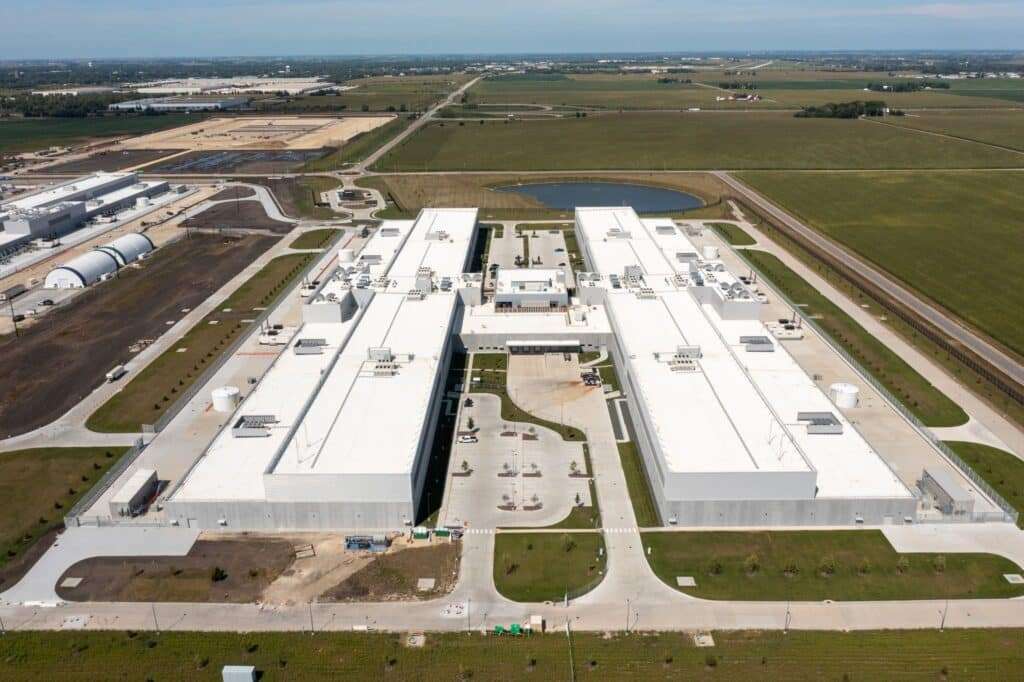
Meta maintains an aggressive investment policy in AI infrastructure.
The company plans to invest between $130 billion and $145 billion this year, mainly to expand its data center capacity and deploy new accelerated computing systems.
Susan Li explained that this strategy addresses a shared industry challenge: the available capacity is still insufficient to support the expected growth of AI.
According to the CFO, the sector has historically invested less than necessary to meet current demand, so owning its infrastructure provides a competitive advantage.
This approach aligns with the strategies of other major cloud providers. Microsoft, Google, Amazon, and Oracle are also spending tens of billions of dollars to expand their data centers for AI training and inference.
The difference is that Meta not only uses this infrastructure for its own services but is also exploring the possibility of turning part of capacity into an additional revenue source through enterprise services.
Investors monitor return on investments
Although Meta continues to grow, the high level of investment is causing some concern among investors.
After earnings were announced, the stock dropped about 10% in after-hours trading. This reaction echoes recent cases in the tech sector where companies with record profits saw their stock penalized due to increased AI-related spending.
Markets still reward growth, but they also demand clear signals that these massive data center investments will eventually generate sustainable profits.
Meta argues that this return has already begun to materialize in its advertising business and that the next phase will involve new AI-based business services.
Whether this strategy proves successful will largely depend on how quickly AI demand continues to grow and on the company’s ability to transform infrastructure into new revenue streams beyond Facebook, Instagram, and WhatsApp.
Frequently Asked Questions
How much did Meta earn in Q2 2026?
The company reported revenues of $60.8 billion, representing a 28% year-over-year increase.
Why did free cash flow decline?
Mainly due to the significant increase in investments in AI infrastructure and, to a lesser extent, spending on Reality Labs.
How much does Meta plan to invest in AI this year?
The company expects to allocate between $130 billion and $145 billion toward AI-related infrastructure.
How is Meta using AI?
Currently, it employs AI to improve ad targeting and relevance, boost conversions on Facebook and Instagram, and develop future enterprise solutions based on AI agents and computing services.
via: pcgamer
