
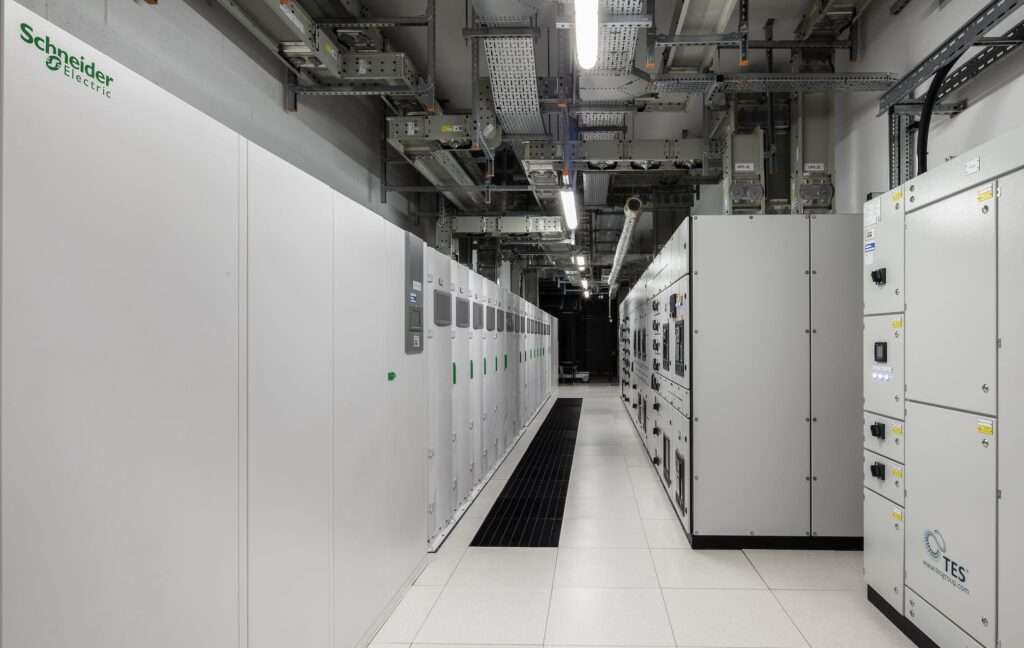
Schneider Electric and AMD have introduced the first validated reference design for the AMD Helios platform, an architecture developed jointly with the aim of facilitating the deployment of high-density AI-ready data centers. The goal is to reduce the design and integration time for the infrastructure needed for so-called AI factories, a concept gaining prominence among major cloud operators and companies training and deploying large-scale artificial intelligence models.
The key features of AMD Helios in 20 seconds
- Schneider Electric and AMD present the first reference design for the Helios platform.
- The architecture supports racks of up to 246 kW and modular clusters with 10.4 MW of IT load.
- It combines sixth-generation AMD EPYC processors, GPU Instinct MI455X, and Vulcano Pensando networks.
- The design integrates power supply, liquid cooling, digital twin, and infrastructure management.
- Both companies aim to reduce complexity and accelerate the deployment of AI data centers.
The rapid expansion of artificial intelligence is forcing a rethink of data center design. New accelerators consume several times more energy than previous generations and generate heat levels that make traditional air-based cooling insufficient.
In this context, hardware and infrastructure manufacturers are increasingly working together to provide pre-validated designs that reduce risks during the construction of high-density facilities.
A design crafted to accelerate AI infrastructure deployment
The new reference design has been specifically developed for AMD Helios, the rack-scale platform AMD introduced for future generations of AI infrastructure.
The architecture relies on several of the manufacturer’s latest components:
- AMD Instinct MI455X GPU.
- Sixth-generation AMD EPYC processors.
- Vulcano NICs from AMD Pensando.
- Open software platform ROCm.
The objective is to provide a comprehensive technical guide that enables architects, engineers, and operators to deploy AI infrastructures with less uncertainty during planning phases.
Instead of designing power, cooling, or physical layout from scratch, the document offers a pre-validated architecture that outlines how to integrate these elements effectively.
According to Schneider Electric, this approach can reduce planning times and project risks significantly.
246 kW racks and clusters over 10 MW
One of the most striking aspects of the design is its high power density.
The architecture supports:
- Up to 246 kW per rack for AI workloads.
- Modular clusters of up to 10.4 MW of IT load for new deployments.
These figures demonstrate how data center design for AI is changing.
While a typical rack a few years ago consumed between 5 and 15 kW, systems equipped with large GPUs now routinely exceed 100 kW, with each new hardware generation pushing these limits higher.
To support these densities, the design incorporates liquid cooling via Motivair’s CDU (Coolant Distribution Unit), part of Schneider Electric, along with hybrid air-liquid solutions.
Schneider Electric states that this system can dissipate up to 84% of the heat generated by the AI infrastructure.
Digital twins and real-time monitoring
The project extends beyond physical infrastructure.
It integrates various simulation and management tools developed by Schneider Electric:
- ETAP, used for modeling and analyzing electrical infrastructure.
- EcoStruxure IT Design CFD, focused on thermal and airflow simulation.
- AVEVA Unified Operations Center, for real-time operational monitoring.
The company also incorporates digital twin capabilities to virtually represent the data center’s electrical infrastructure.
These tools allow for simulations of changes before physical implementation, identifying potential bottlenecks, and optimizing system performance throughout its lifecycle.
Furthermore, Schneider Electric asserts that these platforms facilitate predictive maintenance, AI-augmented, and optimize power, cooling, and IT infrastructure holistically.
Energy efficiency and international expansion
Another goal of the design is improving energy efficiency in future facilities.
Schneider Electric claims that the architecture can achieve a PUE (Power Usage Effectiveness) close to 1.12 at full load.
The PUE metric is widely used to gauge data center efficiency; a value of 1 indicates nearly all energy goes directly to IT equipment with minimal cooling and power losses.
Initially validated against ANSI standards for deployment in the US, the architecture is also being adapted to meet IEC standards for easier international adoption, especially in Europe and other markets.
A step closer to AI factories
This announcement underscores a growing industry trend: vendors are no longer just selling servers or accelerators but offering complete platforms designed to build large-scale AI infrastructure.
AMD refers to this rack-scale architecture as Helios, while companies like NVIDIA run similar initiatives with their own designs for next-generation data centers.
The rising demand for computational power is prompting a holistic approach that considers processors, accelerators, networking, power, cooling, and management software from early project stages.
With this reference design, Schneider Electric and AMD aim to provide a common technical foundation that simplifies integration and speeds up the construction of AI-ready data centers for the next era of workloads.
Frequently Asked Questions
What is the AMD Helios reference design?
It is a jointly developed architecture by Schneider Electric and AMD that defines how to deploy high-density AI infrastructures by integrating power, cooling, networking, and management systems.
What power capacity does each rack support?
The design supports work loads of up to 246 kW per rack, well above typical data center standards.
What is the maximum cluster size?
The architecture enables modular deployments of up to 10.4 MW of IT load, suitable for large-scale AI infrastructures.
What components are included in the Helios platform?
It features AMD Instinct MI455X GPU, sixth-generation AMD EPYC processors, Vulcano Pensando NICs, the ROCm open software platform, and Schneider Electric’s power, cooling, and management solutions.
