
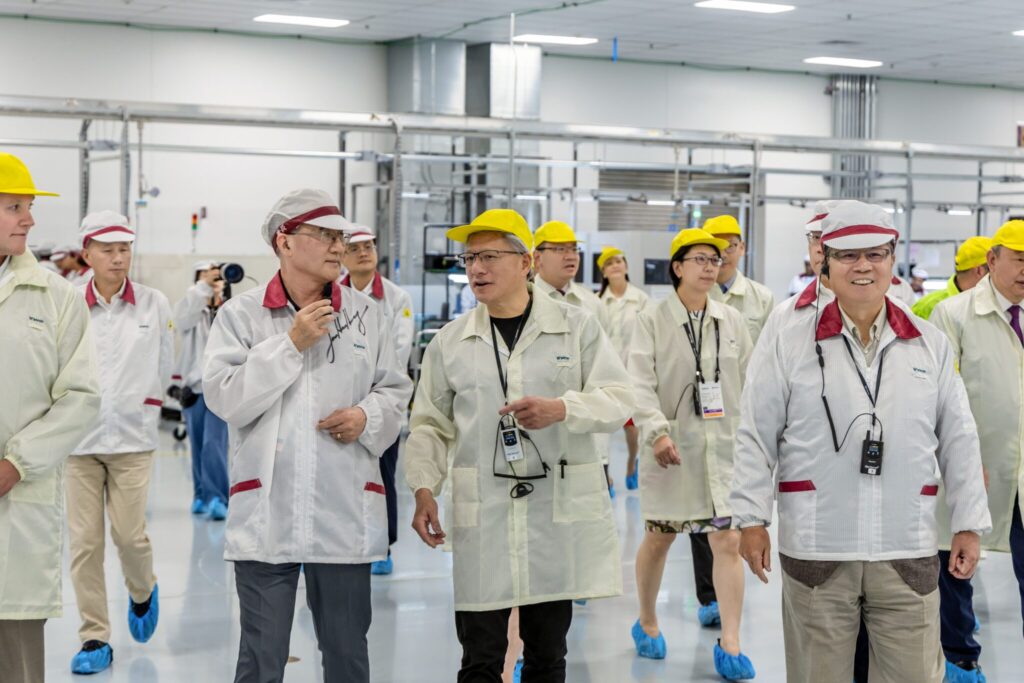
Wistron has opened its first factory in the United States in Fort Worth, Texas, a facility covering approximately 30,100 square meters designed to produce NVIDIA’s advanced artificial intelligence systems. The plant is already assembling the GB300 Grace Blackwell Ultra Superchip and is preparing a second line for Vera Rubin, the next-generation computing platform from the American company.
The key facts about the NVIDIA and Wistron factory in 20 seconds
- Wistron opens its first U.S. manufacturing plant in Texas.
- The facility represents a commitment of $700 million.
- It will produce GB300 Grace Blackwell Ultra and Vera Rubin systems.
- Its capacity will grow to tens of thousands of boards per month.
- The factory was first designed and tested using a digital twin.
The opening demonstrates how the rise of artificial intelligence is shifting some investment from chip design and data center construction toward the manufacturing of complete systems. Buying accelerators is no longer enough: new clusters require boards, racks, networks, cooling, power supplies, and industrial processes capable of integrating millions of components on tighter schedules.
Wistron, a Taiwanese manufacturer specializing in computers, servers, and enterprise systems, will play a significant role in this supply chain. The company does not produce NVIDIA wafers but is responsible for converting processors, memory, and other components into systems ready to be installed in what are called AI factories.
From chips to two-ton systems with 1.5 million parts
The facility, called D1, initially operates with two production cells. The first assembles boards based on the NVIDIA GB300 Grace Blackwell Ultra Superchip. The second will manufacture systems for the upcoming Vera Rubin architecture.
Wistron plans to expand activity through 2026, reaching production of tens of thousands of boards monthly, according to information released by NVIDIA. This figure reflects the industrial scale now required for AI infrastructure construction.
The GB300 combines Grace CPUs and Blackwell Ultra GPUs to perform training and inference of advanced models. These components are then integrated into much larger systems, such as GB300 NVL72 racks, which connect dozens of accelerators via high-speed networks.
Jensen Huang, NVIDIA’s founder and CEO, stated during the opening that one such system can contain around 1.5 million parts, weigh nearly two tons, and be valued at approximately $4 million. These figures are from NVIDIA and may vary depending on configuration, networking, storage, and embedded services.
This complexity explains why AI bottlenecks are no longer solely in processor manufacturing. It also affects board integration, encapsulation, optical connections, electrical and thermal testing, rack assembly, and validation before shipping to data centers.
| Element | Announced Data |
|---|---|
| Plant area | 324,000 square feet (~30,100 m²) |
| Financial commitment | $700 million |
| Initial employment | Over 500 jobs |
| Goal by end of 2026 | Up to 1,000 workers |
| Systems | GB300 Grace Blackwell Ultra and Vera Rubin |
| Expected production | Tens of thousands of boards per month |
A factory built first within a digital twin
One of the most unique aspects of this project is that Wistron designed and simulated the plant before completing its physical construction.
The company created a digital twin, a virtual representation of the building, assembly lines, and operational processes. This replica allowed testing equipment layouts, studying material movements, reviewing procedures, and training workers before launching the actual facility.
They utilized NVIDIA technologies such as Omniverse, the Metropolis vision libraries, PhysicsNeMo simulation environment, and models from the Nemotron and Cosmos families.
While the digital twin does not eliminate the need for physical testing, it enables problem detection before installing costly equipment or modifying an operational line. Engineers can experiment with different layouts, check for unnecessary routes, and anticipate bottlenecks in production.
Wistron has also developed AI tools applied to its own industrial operations. During 2026, the manufacturer introduced initiatives based on NVIDIA Cosmos and a platform of agents aimed at creating a kind of digital brain for the factory.
This combination makes the plant both a client and producer of AI. It uses models, simulation, and computer vision to improve the production of servers that will then run other AI workloads.
NVIDIA aims to manufacture platforms worth $500 billion in the U.S.
The opening is part of a broader NVIDIA plan to produce advanced AI platforms in the United States valued at up to $500 billion.
This figure does not represent an immediate direct investment by NVIDIA but indicates the potential value of systems the company intends to manufacture with its U.S. partners over several years.
Wistron is involved in assembly and testing in Texas, while other partners cover different parts of the supply chain. NVIDIA has also announced collaborations with manufacturers like Foxconn, TSMC, Amkor, and SPIL to expand chip fabrication, packaging, and system manufacturing domestically.
The strategy addresses two needs: increasing industrial capacity to meet the growing demand for AI infrastructure and reducing the geographic concentration of a supply chain heavily dependent on Taiwan and other Asian enclaves.
While the U.S. leads in accelerator design and much of the AI software, it still depends on external sources for manufacturing, packaging, and assembly of many advanced systems.
Bringing production to Texas does not eliminate that dependence. Processors, high-bandwidth memory, and many components will still be imported from international suppliers, but it brings a part of the final assembly, testing, and system integration closer to the U.S.
Over 500 jobs and a workforce that will continue to grow
NVIDIA presents the plant as part of a $700 million commitment to advanced manufacturing in the U.S. It has created over 500 jobs, and Wistron plans to expand the workforce to approximately 1,000 employees by the end of 2026.
The activity goes beyond assembly workers. Such a factory requires electrical and mechanical engineers, network specialists, cooling technicians, quality control staff, automation experts, and system testing personnel.
It also generates indirect jobs in construction, logistics, electrical installation, and maintenance. Fort Worth is part of a region already rich in projects related to semiconductors, telecommunications, aerospace, and data centers.
Finding qualified workers will be a challenge. Producing AI equipment does not function like a traditional consumer electronics line. Each rack involves high energy density and requires checks for networking, temperature, power, and stability before delivery.
Capacity increases must be accompanied by a logistics chain capable of sourcing components still in high demand—especially HBM memory, optical systems, switches, and cooling equipment.
Vera Rubin requires factory preparations before deployment
The decision to reserve a cell for Vera Rubin illustrates how manufacturers must adapt their facilities before a new platform reaches large-scale deployment.
Vera Rubin succeeds Blackwell and combines a new generation of GPUs, CPUs, interconnects, networks, and memory. NVIDIA designed its systems to retain some physical compatibility with current racks, which could simplify updates in data centers and manufacturing lines.
However, each generation alters power, cooling, assembly, and validation requirements. Wistron will need to prepare tools, procedures, and personnel before scaling up production volume.
The pace of this transition reflects the industry’s speed. While companies still deploy Blackwell-based systems, manufacturers are already adapting their plants for Rubin. Overlapping development involves early investments and leaves little room for supply chain delays.
The Fort Worth plant is thus more than just a new industrial building. It demonstrates that the competition in AI also hinges on the ability to transform advanced designs into tens of thousands of systems that can be installed, connected, and operated reliably.
Frequently Asked Questions
What will Wistron manufacture in Fort Worth?
Initially, the plant will produce systems based on NVIDIA GB300 Grace Blackwell Ultra, with a dedicated cell prepared for the upcoming Vera Rubin platform.
How much has been invested in the factory?
NVIDIA presents the project as part of a $700 million commitment to advanced manufacturing in the United States.
How many jobs will the Wistron plant create?
It has already created over 500 jobs, with plans to reach around 1,000 employees by the end of 2026.
What is the digital twin used by Wistron?
It is a virtual replica of the factory that allowed simulations of the assembly lines, process reviews, and worker training before physical production began.
