
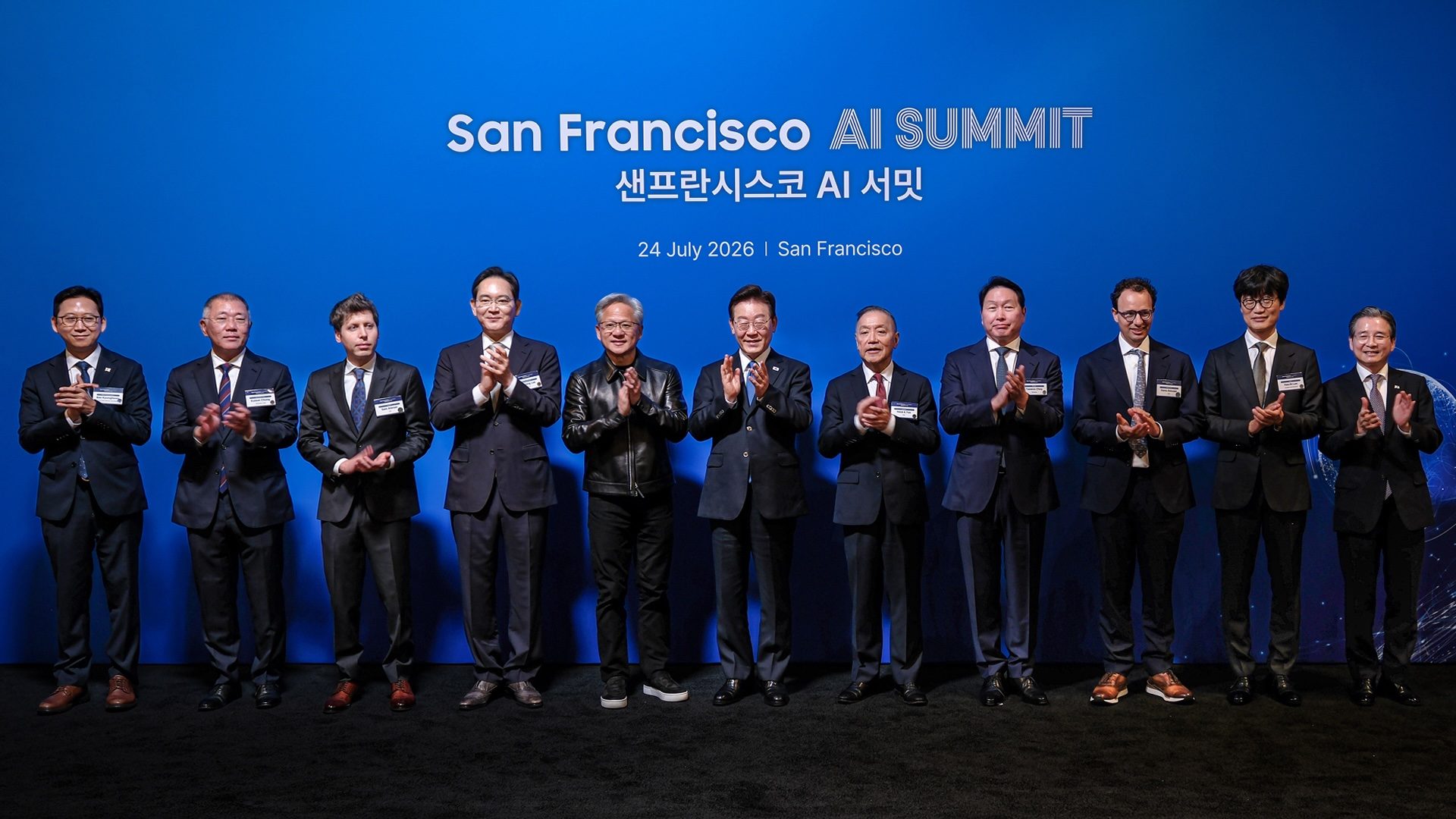
South Korea has announced an expansion of its agreements with NVIDIA to reinforce virtually every layer of its artificial intelligence industry: data centers, semiconductors, HBM4 memory, models in Korean, robotics, autonomous vehicles, and researcher training. The most visible project will be the expansion of NAVER’s AI factory in Sejong to 200 MW, with a capacity equivalent to about 100,000 next-generation GPUs.
The key points of the partnership between South Korea and NVIDIA in 30 seconds
- NAVER, Brookfield, and NVIDIA will expand the AI factory installed in the GAK Sejong data center to 200 MW.
- The infrastructure will utilize the Vera Rubin platform and could amount to roughly 100,000 GPUs.
- SK Group will deploy NVIDIA systems powered by SK hynix’s HBM4 memory.
- Hyundai will work on robotics, smart factories, and autonomous driving.
- NVIDIA and KAIST will create a joint laboratory to research AI agents tailored to the Korean language and industry.
The announcements were made during a summit held in San Francisco with the presence of South Korean President Lee Jae-myung, NVIDIA CEO Jensen Huang, and leaders of some of the main technology and industrial companies of both countries.
Participants included representatives from Samsung Electronics, SK Group, Hyundai Motor Group, and NAVER, as well as executives from OpenAI, Anthropic, and Broadcom. The event demonstrated how much South Korea intends to leverage its strengths in memory, electronics manufacturing, automotive, and telecommunications to position itself centrally in the global AI supply chain.
The plan is not limited to purchasing accelerators from NVIDIA. The country aims to build its own computing capacity, secure component supplies, develop language-specific models, and deploy AI across factories, vehicles, robots, and public services.
NAVER triples its project and prepares a 200 MW AI factory
NAVER, Brookfield, and NVIDIA will expand the so-called AI factory located at the GAK Sejong data center, one of South Korea’s major tech complexes.
The project will reach an approximate capacity of 200 MW, more than triple the initial deployment announced in June. NVIDIA estimates that this could house the equivalent of about 100,000 GPUs, though the final configuration will depend on rack design, system power consumption, and construction schedules.
The infrastructure will rely on NVIDIA Vera Rubin, the platform succeeding Blackwell that will combine new accelerators, processors, networks, and high-bandwidth memory.
Such a large installation should not be viewed as a conventional data center. These AI factories are designed to convert large amounts of electricity and data into training, fine-tuning, and inference of models.
In these facilities, GPUs are only part of the system. They also require low-latency networks, high-performance storage, advanced cooling, redundant electrical systems, and software capable of coordinating tens of thousands of accelerators.
NAVER will leverage this capacity for its models, search engines, cloud services, and enterprise applications. Simultaneously, the project aims to provide infrastructure for South Korean organizations unable to build such large clusters independently.
SK supplies HBM4 memory and expands its partnership with NVIDIA
SK Group also announced an expansion of its collaboration with NVIDIA to deploy infrastructure based on Vera Rubin and SK hynix’s HBM4 memory.
High-bandwidth memory, known by its acronym HBM, has become one of the most critical components for AI accelerators. These systems need to transfer enormous amounts of information between memory and processors, so access speed can limit performance even when there is enough compute capacity.
SK hynix is a key player in this market and already supplies several generations of HBM to NVIDIA and other accelerator manufacturers. The upcoming HBM4 will increase bandwidth and modify parts of the architecture connecting memory and processors.
NVIDIA described its relationship with SK as a partnership whose economic scope could exceed $500 billion. This figure, provided by the company, reflects the potential value of infrastructure and activities during the collaboration, not necessarily an immediate investment or signed contract of that amount.
The alliance encompasses more than memory supply. SK Telecom aims to develop computing capacity for companies, robotics, and physical AI, while other divisions could participate in energy, data centers, and connectivity.
This integration showcases one of South Korea’s advantages: it has memory manufacturers, telecom operators, industrial conglomerates, and internet companies capable of collaborating within a single deployment.
| South Korean Partner | Main Collaboration Area |
|---|---|
| NAVER | AI factories, cloud, and models |
| SK hynix | HBM4 Memory |
| SK Telecom | Computing infrastructure and AI services |
| Hyundai Motor Group | Robotics, factories, and autonomous driving |
| KAIST | Research on AI agents |
| Seoul National University | Foundational models, science, and physical AI |
Hyundai advances AI from data centers to factories and vehicles
Hyundai Motor Group unveiled a physical AI strategy — a term used to describe systems that perceive their environment, make decisions, and act via robots, vehicles, or industrial machinery.
The automotive group will work with NVIDIA on a reference platform for robots and will expand a deployment involving 50,000 Blackwell GPUs.
These capabilities will be used to train robotics models, develop digital twins, simulate factories, and enhance autonomous systems before testing them in real environments.
The collaboration also includes integrating NVIDIA DRIVE Hyperion with Hyundai’s vehicle platforms. DRIVE Hyperion combines in-vehicle computers, sensors, and the DriveOS operating system to develop automated driving functions.
The agreement doesn’t mean all Hyundai vehicles will immediately feature advanced autonomous driving. Instead, it provides a development platform for designing, training, and validating future systems.
For NVIDIA, automotive and robotics are a natural extension of its data center business. Models are trained on large clusters, tested in simulators, then run on computers installed inside vehicles or machinery.
KAIST and NVIDIA will study language-adapted agents
NVIDIA and Korea Advanced Institute of Science and Technology (KAIST) will establish a joint lab dedicated to AI agents.
Located at the Kim Jaechul Graduate School of AI in Seoul, it will focus on models and systems adapted for the Korean language and industrial needs.
AI agents aim to develop systems capable of planning tasks, using tools, consulting information, and executing multiple actions autonomously within limits. Their enterprise application involves solving challenges related to precision, permissions, security, and human oversight.
The lab will utilize NVIDIA’s open models NVIDIA Nemotron, company tools, and computing resources through NVIDIA AI Cloud partners. The collaboration also includes multi-year funding and programs to train Korean researchers.
KAIST and NVIDIA are also preparing a tech center focused on physical AI within the Department of Mechanical Engineering.
Meanwhile, Seoul National University is developing another collaboration center that will cover foundational models, accelerated computing, scientific AI, and training. Technologies like Nemotron and NVIDIA Cosmos — a family of models designed to understand and simulate the physical world — are included.
South Korea aims to cover the entire AI value chain
President Lee Jae-myung’s strategy seeks to position South Korea as a significant global provider of AI infrastructure.
The country already has two assets hard to replicate: Samsung Electronics and SK hynix. Both companies are involved in manufacturing memory and other essential components for servers, accelerators, and electronic devices.
However, South Korea’s ambition goes beyond just supplying chips to foreign companies. The government and large corporations aim to increase their capacity to operate models, offer cloud services, and develop proprietary industrial applications.
The plan can be divided into several layers:
- Semiconductors: HBM memory, manufacturing, and encapsulation.
- Computing: AI factories with tens of thousands of accelerators.
- Models: language- and sector-specific systems.
- Industry: robotics, automotive, and advanced manufacturing.
- Talent: university labs and specialized training.
NVIDIA appears as a common partner across most layers. The company provides GPUs, networks, software, and development platforms, while South Korea offers memory, industrial firms, energy, data centers, and manufacturing capacity.
This relationship also creates reliance. Much of the announced infrastructure will use NVIDIA’s proprietary technologies, so South Korea’s autonomy remains tied to a U.S. provider for critical components.
South Korea is trying to reduce this risk through its industrial capacity and the development of its own models and services. It does not aim to isolate from foreign platforms but to prevent its entire AI stance from being limited to just selling memory and components.
From chip manufacturer to global AI hub
For decades, South Korea has held a prominent position in electronics, displays, memory, and automobiles. The new strategy aims to transfer these capabilities to an industry where value is shifting toward computing, models, and AI-based services.
Success will depend on various factors. Building 200 MW of infrastructure requires reliable access to electricity, funding, cooling, and networks. There must also be sufficient enterprise demand to utilize the systems once installed.
Another challenge is turning research into market-ready products. Having GPUs and labs does not guarantee that South Korean models can compete with those from the U.S. or China.
Nonetheless, the combined strengths of NAVER, Samsung, SK, Hyundai, and leading universities provide a rare industrial foundation. South Korea can participate in AI from memory modules alongside processors to robots using those models inside factories.
The San Francisco announcements show that the country does not want to limit itself to supplying components for AI revolutions. Its goal is to build a larger part of the infrastructure, research, and applications that will define the market.
Frequently Asked Questions
How many GPUs will NAVER’s AI factory have?
NVIDIA estimates that expanding to 200 MW will be roughly equivalent to 100,000 GPUs. The final count will depend on infrastructure configuration and system power consumption.
What is NVIDIA Vera Rubin?
It is NVIDIA’s next-generation AI computing platform. It will integrate accelerators, CPUs, networks, and high-bandwidth memory for large data centers.
What will SK hynix contribute to the project?
SK hynix will supply HBM4 memory for Vera Rubin systems. This memory allows fast data transfer to accelerators and is a highly demanded component in AI infrastructure.
What will NVIDIA and KAIST research?
They will establish a joint lab focused on AI agents tailored for the Korean language and industry sectors, also training researchers and developing technologies for Korean companies.
