
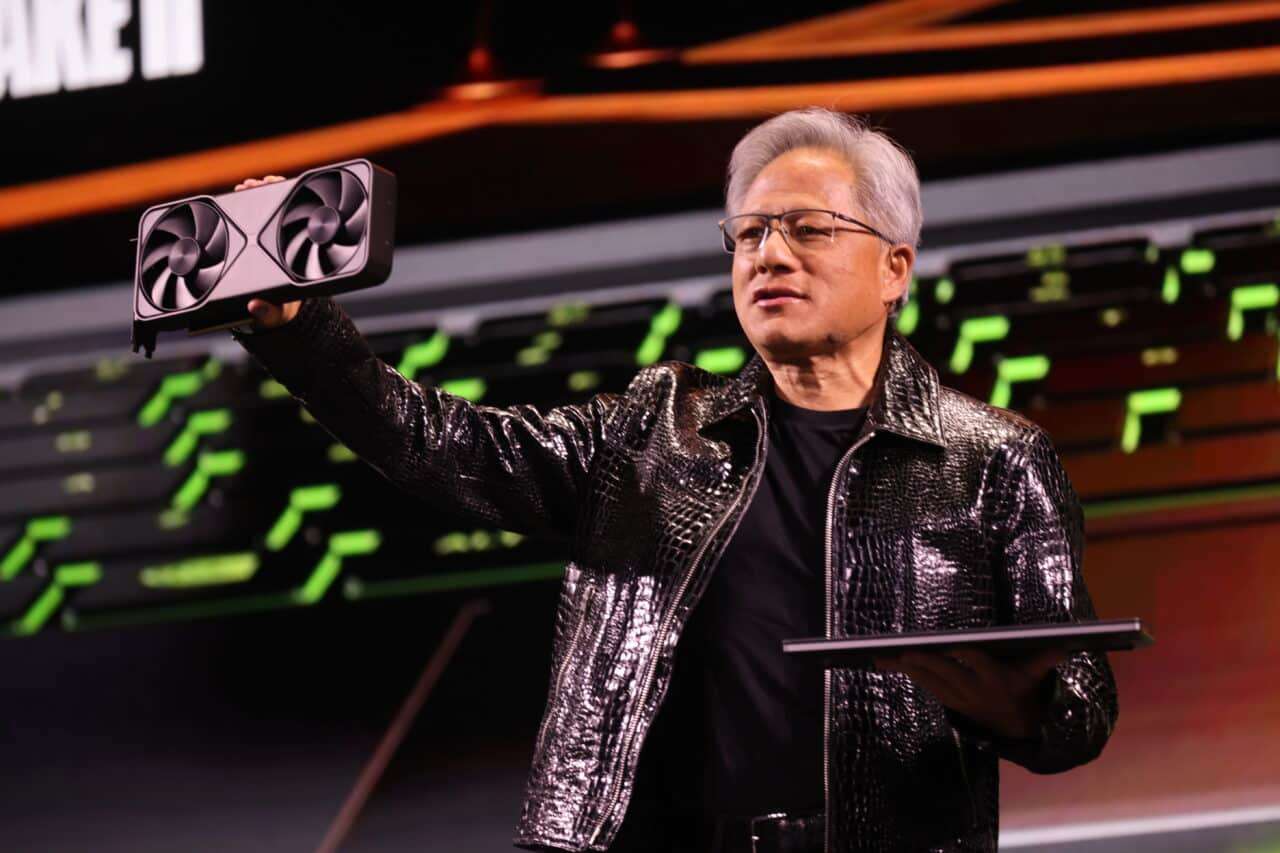
Jensen Huang, CEO of NVIDIA, has argued that U.S. companies should be allowed to use open-source AI models developed in China. The executive considers that systems like Kimi, DeepSeek, or Alibaba’s models can expand technology adoption and rejects the idea that their origin alone should prevent their use, although he admits organizations should assess their security before deploying them.
The key points of the Chinese models’ defense in 30 seconds
- Jensen Huang believes that China’s most advanced open-source models should be usable in the United States.
- He rejects the notion that downloading model weights automatically creates a hidden connection to China.
- The U.S. government is examining how to regulate their use due to potential security risks and technology dependence.
- Running models on private infrastructure offers more control over data but requires hardware, maintenance, and audits.
- NVIDIA benefits from increased adoption because these models also need GPUs and data centers.
These statements come as the U.S. administration considers possible restrictions on Chinese AI models. Among the proposed measures are requirements for security guarantees and additional responsibilities for companies choosing to use them, according to reports from Axios and Fortune.
Huang argues that this debate often stems from a misconception: that a downloadable model necessarily acts as a backdoor controlled by its developer. In an interview with Axios, he dismissed this interpretation as a misunderstanding and reminded that models with accessible weights can be installed on internal systems and their usage barriers can be customized.
That does not mean all Chinese models are inherently secure. The code, weights, dependencies, training data, and the tools needed to run them must be reviewed just like any other critical component. The ability to run models locally without sending every query to an external service reduces some privacy risks but does not eliminate vulnerabilities, hidden behaviors, or supply chain issues.
Huang advocates for both open and proprietary AI
NVIDIA’s CEO does not propose replacing GPT, Claude, or Gemini with Chinese models. His stance is that the market needs both proprietary systems and open alternatives.
“These Chinese models are excellent. Open-source models that are excellent should be used,” he said during the interview. Huang had previously stated at GTC 2026 that the future doesn’t necessarily pit open AI against closed, but that both modes will coexist and serve different needs.
Proprietary services often offer a simpler experience. The provider manages the infrastructure, updates the models, applies controls, and charges for usage via APIs or subscriptions.
Open models or weights available for download provide more control. A company can install them on its datacenter, private cloud, or public infrastructure under its own account. They can also adapt them with internal data and decide where queries are processed.
This freedom comes at a cost. Running large models requires GPUs, memory, storage, electricity, and skilled personnel for maintenance. Downloading a model does not mean its use is free. For organizations with low query volumes, it may be cheaper to use an API; for high volumes, owning infrastructure could offer better predictability and control.
Not all models labeled as “open source” commercially fit the traditional definition of open code. Some publish weights but apply licenses that limit certain uses, do not disclose training data, or do not allow full reproduction of their creation process. Therefore, it’s more accurate in many cases to refer to them as open weights models.
Kimi and DeepSeek raise pressure on U.S. labs
The discussion has intensified with the arrival of a new generation of Chinese models demonstrating strong performance in programming, reasoning, and agent-based tasks.
Moonshot AI introduced Kimi K3 on July 16, 2026, and published its weights so developers and companies could deploy it in their own infrastructure. Evaluations around the launch place it near advanced U.S. models in certain tests, though a benchmark result alone doesn’t prove it superior in all applications.
DeepSeek had already disrupted the market with models capable of competing in multiple tasks at inference costs lower than some proprietary services. Its founder has noted that the company aims to keep a open approach for its main developments, though this policy might change in future versions.
Alibaba, Zhipu AI, and other Chinese labs have also released downloadable models. This offers companies from different countries the chance to compare providers and reduce reliance on OpenAI, Anthropic, or Google.
Washington monitors this expansion from both an economic and national security perspective. U.S. authorities have accused some Chinese companies of using distillation techniques to reproduce Western model capabilities and are considering whether to impose new restrictions. Moonshot AI and Kimi are among the names mentioned in this dispute, though these accusations do not equate to a court ruling on illegal appropriation.
Downloading a model does not automatically connect it to China
One clarification is that running a model locally does not require continuous communication with its creator.
If a company downloads weights from a verified source, reviews the software, and runs everything on an isolated network, it can prevent queries or processed documents from leaving its infrastructure. The original developer does not automatically receive that data.
The situation changes when using an official app, a Chinese-hosted API, remote update tools, or external components that establish connections. Safety depends on the specific architecture, not just the model’s name.
A company should review at least the license, source of files, digital signatures, libraries used, network connections, and behavior against malicious instructions. Risks like generating vulnerable code, exposing confidential information, or manipulating connected tools should be assessed as well.
In regulated sectors, the decision should also consider data protection laws, intellectual property rights, and international transfers. Hosting a model internally makes control easier but does not exempt from these obligations.
NVIDIA benefits from both open and closed models
Huang’s stance also aligns with NVIDIA’s commercial interests. As more models are developed and utilized, demand for GPUs, networks, and data center systems increases.
The executive acknowledged this connection: greater AI adoption means selling more NVIDIA hardware, building more infrastructure, and expanding technology to new industries.
The company supplies hardware to major U.S. laboratories but also develops Nemotron and participates in open model projects. In March, it announced the Nemotron Coalition, a collaboration with various developers to create and improve accessible foundational models.
Supporting Chinese alternatives does not mean breaking away from OpenAI, Anthropic, or Google. NVIDIA needs proprietary services to grow, but also wants companies, universities, and governments to deploy AI on their own systems.
The real debate isn’t about accepting or banning Chinese models wholesale. It’s about how to evaluate downloadable technologies without confusing their origin with their technical operation. An open model can offer control and sovereignty over data, but only after reviewing its license, components, and environment.
Frequently Asked Questions
Has Jensen Huang called for replacing ChatGPT with Chinese models?
No. He has argued that companies should be able to use high-quality open models regardless of their country of origin and that these can coexist with proprietary systems.
Does downloading a Chinese model automatically send data to China?
Not necessarily. It can run offline on private infrastructure, but the software, dependencies, and any included external services must be reviewed.
Are open models free?
In some cases, weights can be downloaded without a commercial license fee, but running them requires hardware, energy, storage, maintenance, and technical staff.
Why does NVIDIA support open models?
Besides fostering a market with more developers, their use increases demand for GPUs, networks, and data centers—areas in which NVIDIA earns a significant portion of its revenue.
