

Anthropic has introduced Claude Opus 5, a model designed to fill the gap between general-purpose assistants and high-capacity systems reserved for the most complex tasks. The company claims it can approach the performance of Claude Fable 5 in programming, automation, and professional analysis, but at a much lower cost per task. The new model is now available and becomes the most advanced option within Claude Pro and the default for Claude Max.
The key features of Claude Opus 5 in 20 seconds
- Opus 5 improves in programming, automation, scientific analysis, and autonomous computer usage.
- Anthropic states it approaches Fable 5 with roughly half the cost per task in some tests.
- The API maintains the pricing of Opus 4.8: $5 per million input tokens and $25 per million output tokens.
- Compared to GPT-5.6 Sol, it’s cheaper for generating responses, although each model excels in different assessments.
Anthropic’s strategy is straightforward. Fable 5 remains the most advanced model for long-term projects that span days, while Opus 5 is tailored for developers, analysts, and teams that regularly perform complex tasks. The goal isn’t solely to top benchmark charts but to provide enough capacity for deploying AI agents in production without each task consuming the entire frontier model budget.
A model that checks its work before considering it finished
The main promise of Claude Opus 5 isn’t just better responses. Anthropic claims the model shows more initiative to review results, spot errors, and redo steps when the initial solution doesn’t work.
The company provides several examples from testing and early access. In a Frontier-Bench task, Opus 5 received a drawing of a mechanical part that it needed to reconstruct in FreeCAD. Since it couldn’t consult the image directly, it created a small computer vision system to extract its geometry from pixels and then generate the 3D model.
In another test, it analyzed a real bug from an open-source package manager. According to Anthropic, it didn’t just fix the visible symptoms but also identified the root cause and resolved an edge case overlooked in previous solutions. An engineer from a financial firm used it to build a market data source, and the model created its own testing environment after failing to find an active connection to validate the code.
These cases were selected by Anthropic and don’t replace external evaluations, but they clearly illustrate the shift the company aims to promote. Opus 5 is envisioned as a system capable of maintaining focus during prolonged tasks, handling tools, and verifying results—not just a chatbot that outputs code without testing its functionality.
The improvement is especially notable in programming. Anthropic claims Opus 5 outperforms all evaluated models in Frontier-Bench v0.1 and more than doubles Opus 4.8’s performance at a lower cost per task. In CursorBench 3.2, with maximum effort, it stays within 0.5% of Fable 5’s top result but consumes about half the budget.
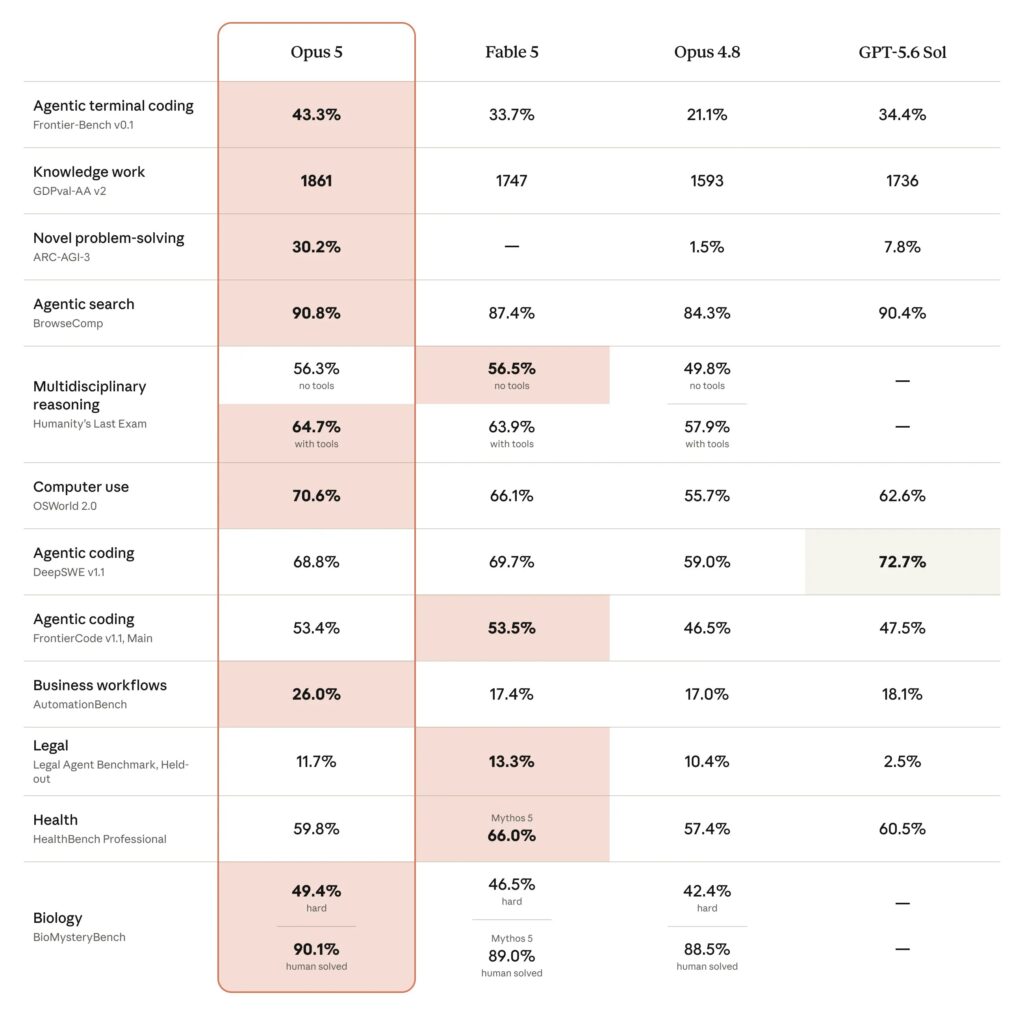
The user can adjust this effort level to trade off between more reasoning and faster, more cost-effective responses. This flexibility is especially relevant in business contexts, where not every task justifies using the most demanding setting.
Claude Opus 5 vs GPT-5.6: two ways to segment the range
Anthropic and OpenAI have reached a similar conclusion: a single model can no longer efficiently handle all tasks. Both companies have divided their offerings into several tiers based on capacity, speed, and price.
Opus 5 is positioned as Anthropic’s advanced daily-use model, below Fable 5 for high-demand projects and Mythos 5 for certain scientific and cybersecurity capabilities. OpenAI’s GPT-5.6 family offers a different structure: SOL targets the top tier, TERRA seeks a balance, and LUNA prioritizes speed and low costs.
| Model | Position in lineup | Price per 1 million tokens | Declared focus |
|---|---|---|---|
| Claude Opus 5 | Advanced daily model | $5 input / $25 output | Code, analysis, and professional agents |
| Claude Fable 5 | Anthropic’s frontier model | Not specified | Long projects, maximum capacity |
| Claude Mythos 5 | Specialized model | Restricted access | Advanced science and cybersecurity |
| GPT-5.6 Sol | OpenAI flagship | $5 input / $30 output | High-demand agent tasks |
| GPT-5.6 TERRA | Balanced option | $2.50 input / $15 output | Professional use at lower cost |
| GPT-5.6 LUNA | Fast and economical choice | $1 input / $6 output | High volume, low latency |
OpenAI’s published prices put GPT-5.6 Sol at $5 per million input tokens and $30 per million output tokens. Opus 5 matches the input cost but reduces output to $25. TERRA and LUNA are significantly cheaper, though they occupy different levels within the GPT-5.6 range.
This difference might seem minor per query but adds up when an agent generates large amounts of code, reviews lengthy documents, or chains dozens of calls. Still, the actual cost depends not just on token prices but also on the number of attempts, tool usage, reasoning length, and the need for correction.
That’s precisely Anthropic’s commercial premise: a slightly more expensive-per-token model could be more cost-effective per finished job if it requires fewer steps, makes fewer mistakes, and needs less supervision to reach the goal.
Currently, there’s no independent, standardized comparison proving Opus 5 generally outperforms GPT-5.6. Anthropic highlights benchmarks like Frontier-Bench, CursorBench, ARC-AGI 3, AutomationBench, and OSWorld 2.0, while OpenAI publishes its internal evaluations for GPT-5.6. Variations in configuration, tools, and reasoning levels prevent straightforward score comparisons.
Beyond code: automation, science, and professional work
Anthropic has also tailored Opus 5 for enterprise tasks that require combining reasoning with tool usage. In Zapier AutomationBench, a test measuring end-to-end business process completion, the company reports its success rate is about 1.5 times higher than the next best model at the same cost.
One example from Zapier involved analyzing a spreadsheet of multiple accounts to identify at-risk clients, alert the responsible staff, and generate a retention summary. According to the company, Opus 5 completed the entire flow, whereas earlier versions failed to finish it.
Improvements are also seen in financial analysis, legal documentation, and large repository review. Box reports Opus 5 outperformed Opus 4.8 by 8% in internal tests, with 11% better data analysis and 17% more thorough due diligence. Other early access participants note fewer tool calls, less repetition, and greater stability across runs.
In life sciences, Anthropic reports advances over Opus 4.8 in structural biology, organic chemistry, and bioinformatics. The model scored 10.2 percentage points higher in a spectral interpretation test and 7.7 points better predicts how sequence changes affect protein function.
While promising, these results are internal comparisons between generations of Claude. Anthropic doesn’t claim Opus 5 replaces its most specialized systems; in fact, Mythos 5 remains ahead in complex biological research and offensive cybersecurity.
More capacity with specific limits in cybersecurity
Opus 5 can review code and find vulnerabilities, but Anthropic maintains restrictions on binary analysis, penetration testing, and exploit creation. The company explains it approaches Mythos 5 in identifying flaws but clearly lags when turning findings into actual exploits.
This design choice ensures Opus 5 remains useful for development and defensive security teams without access to the most sensitive capabilities.
The firm estimates its safety classifiers will intervene around 85% less often than with Fable 5, reducing false positives. Meanwhile, specialized tasks can be handled via its verification program for cybersecurity professionals.
In early testing, Anthropic gave Opus 5 a score of 2.3 on misaligned behaviors—a low rating among recent models—and noted it exhibits fewer deceptive behaviors and less tendency to perform irreversible actions without prior checks.
Task-based pricing gains importance over isolated benchmarks
Claude Opus 5 is now available on Anthropic’s platforms and via API under the token claude-opus-5. It maintains Opus 4.8’s rate and introduces a fast mode, reportedly roughly 2.5 times quicker but at double the base price.
This launch signals where the market is heading. Competition among OpenAI, Anthropic, and others no longer hinges solely on benchmark scores. Companies need to understand how much a task costs, how many errors must be corrected, and whether an agent can sustain a project over hours without losing focus.
Opus 5 aims to meet this need. It’s not the latest or cheapest model on the market, but it’s based on another principle: delivering enough intelligence to handle tough jobs daily without constantly resorting to the most expensive available model.
Frequently Asked Questions
What is Claude Opus 5?
An Anthropic model tailored for programming, professional analysis, automation, and multi-step agent tasks.
Is Claude Opus 5 cheaper than GPT-5.6 Sol?
Both cost $5 per million input tokens. Opus 5 charges $25 per million output tokens, compared to GPT-5.6 Sol’s $30 standard rate.
Does Opus 5 replace Claude Fable 5?
No. Fable 5 remains the top-tier model for long projects. Opus 5 aims to provide comparable performance at a lower cost for routine tasks.
Where is Claude Opus 5 available?
It is accessible via Claude.ai, Claude Code, Claude Cowork, and the API. It’s the most powerful model within Claude Pro and the default for Claude Max.
