
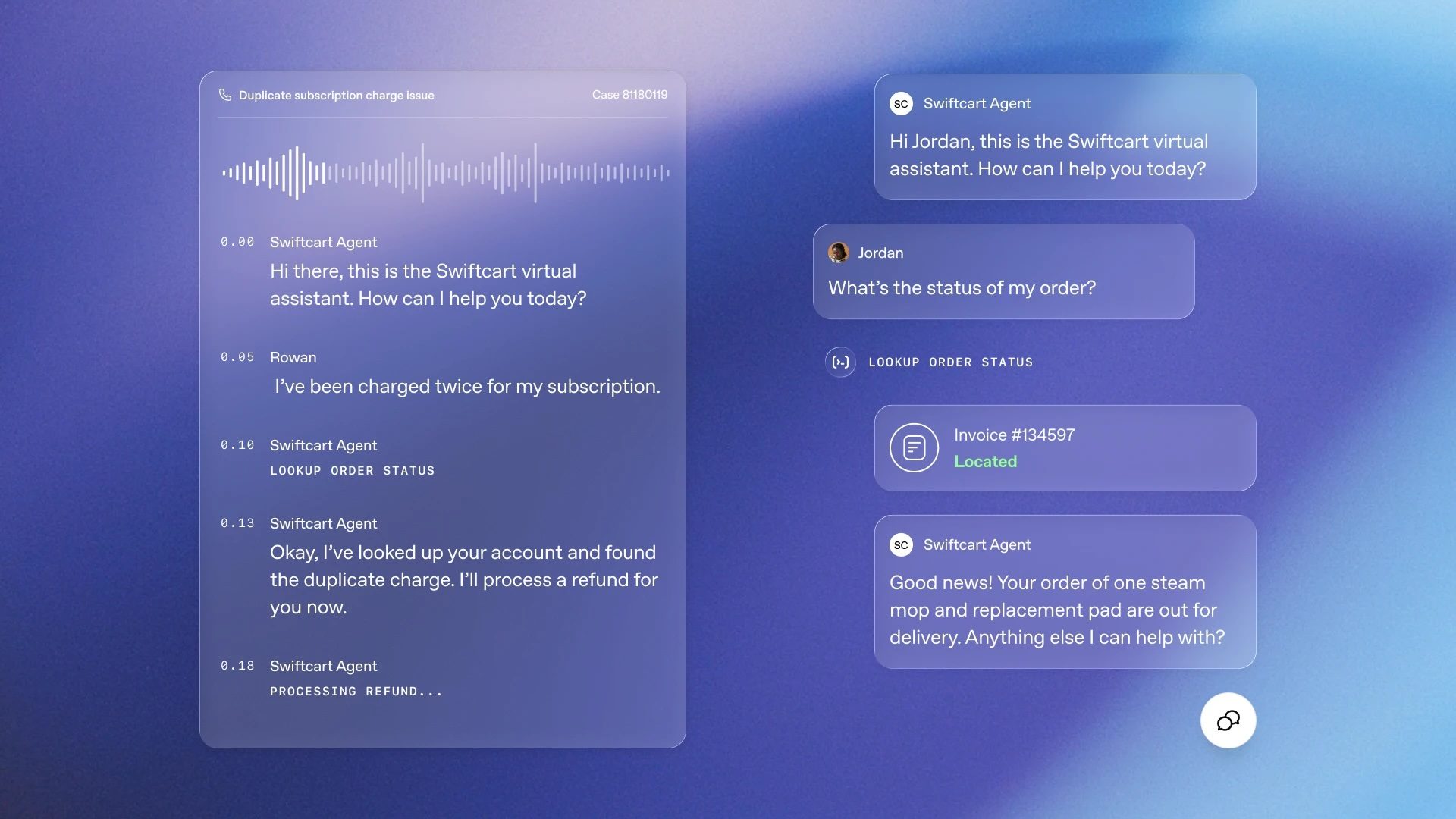
OpenAI has introduced Presence, an enterprise platform for deploying AI agents capable of handling queries, accessing internal systems, executing authorized actions, and transferring cases to a person when necessary. The product operates via voice and chat, is available to a limited group of large clients, and requires direct involvement from OpenAI engineers or selected integrators.
Key Highlights of OpenAI Presence in 20 Seconds
- Presence combines AI models, permissions, policies, assessments, and human oversight.
- Agents can query corporate data and complete pre-authorized actions.
- OpenAI claims its automated phone support resolves 75% of incidents.
- BBVA, SoftBank, and IAG are exploring application opportunities for the platform.
- It is not yet available as a self-service product.
The company is trying to bridge a gap many organizations have already encountered when experimenting with AI: creating a demo capable of answering questions is relatively simple. Maintaining it in production, connected to real data, and authorized to modify accounts, process refunds, or handle incidents requires far stricter controls.
Presence is neither a new model nor a standard chatbot. It presents itself as a software layer and service that integrates reasoning, internal procedures, security rules, connections with enterprise applications, evaluations, and escalation mechanisms to human workers.
Each deployment begins with a defined scope. The agent can be tasked with addressing billing issues, reviewing insurance claims, or responding to internal IT support requests. It only gains access to the knowledge and tools necessary for that specific task.
From Assistant to Action Executor
Conversational assistants typically limit themselves to providing information. Presence aims to enable conversations that can conclude with an action within the company’s systems.
For example, in a billing complaint, the agent could identify the customer, review their account, check the applicable policy, and issue a refund if criteria are met. The company predefines which operations can be completed automatically and which require approval.
It also establishes when human intervention is necessary. A simple inquiry can be resolved without leaving the automated channel, while cases with conflicting data, financial risk, or sensitive information may be escalated to an employee.
This separation of permissions is among the product’s most critical elements. An agent should not have unrestricted access to all corporate applications just for handling customer interactions. Presence allows for limiting its capabilities based on the task, department, channel, or risk level.
Initially, OpenAI offers the platform for real-time experiences via voice and chat. Its application areas include customer service, demand generation, and internal processes where incorrect decisions could have significant consequences.
The company also has a commercial page that lists email as one of the channels supported by Presence, although during limited general availability, confirmed conversational deployments focus on voice and chat.
Codex Improves the Agent Without Replacing It
Enterprise agents need to adapt to constant changes. A new promotion, a contractual modification, or an internal app update can render instructions used weeks earlier obsolete.
Presence incorporates a review process supported by Codex. The system analyzes conversations, transfers to operators, and quality signals to identify situations where the agent failed to complete a task or followed an incorrect procedure.
Based on these insights, Codex can suggest updates to instructions, policies, or testing protocols. company managers review these changes, compare them to the current production version, and decide whether to approve them.
The agent should not alter its permissions or automatically learn from every conversation. OpenAI proposes a controlled process where each modification can be tested before deployment to users.
Simulations allow testing responses to common requests, rare cases, and high-risk scenarios. Evaluations ensure the agent achieved the correct outcome, used tools appropriately, adhered to policies, and requested human help when needed.
This approach seeks to address a key challenge of generative model-based systems: responses may seem convincing yet be incorrect or violate internal procedures.
OpenAI Tests Presence in Its Own Phone Support Line
OpenAI already uses Presence in its English-language phone support line, available in the United States at 1-888-GPT-0090.
The company states that the agent can verify callers, query account information, and perform certain authorized actions. According to their data, it currently resolves 75% of incoming issues without human assistance.
OpenAI also reports that improvements based on Codex reduced transfers to human operators by 15 percentage points over a ten-day period.
These are internal metrics and don’t fully measure service quality. To gauge real-world performance, one would also need to consider user satisfaction, case complexity, subsequent errors, and the number of reopened claims.
The resolution rate indicates that Presence is already operational in a service used by actual customers, not just internal tests. OpenAI notes that the product has been shaped by years of collaboration with enterprise partners.
BBVA, SoftBank, and IAG Explore the Technology
OpenAI has identified BBVA, SoftBank, and International Airlines Group (IAG) as companies currently experimenting with this platform, though projects are at different stages.
BBVA is testing a voice service in Mexico for everyday banking needs. SoftBank is exploring natural conversations in Japanese, while IAG is investigating the use of agents for handling high-demand periods, such as during adverse weather events.
Details regarding the number of customers involved, operational capabilities, or launch timelines are not specified. The deployment of these solutions will also require human oversight, especially in sensitive scenarios.
Banks and airlines handle sensitive data and are subject to regulation. Any deployment will need to incorporate identity verification, activity logging, data protection, and clear procedures for escalating cases to humans.
A Managed Product, Not a One-Click Tool
Presence is available through a limited general access program for enterprise clients that meet OpenAI’s requirements. Currently, there’s no version that can be directly purchased or configured from a public console.
Deployments will be managed by Forward Deployed Engineers—professionals from OpenAI working closely with each client to select processes, connect systems, and define rules. Selected international integrators will also participate.
This approach makes Presence more of a managed project than a standard software license. Businesses don’t just buy access to a model; they must review procedures, decide on automatable actions, and prepare applications to ensure safe usage by the agent.
OpenAI’s entry into this market aligns it with enterprise software providers, customer service companies, cloud giants, and consulting firms. Success depends less on which model produces better answers and more on how effectively it can be integrated into real organizational processes with guarantees.
Presence signifies this new stage. Agents shift from mere conversational assistants to operational intermediaries between traditional software and digital workers. Their value depends less on natural language skills and more on executing tasks correctly, respecting boundaries, and knowing when to step back.
Frequently Asked Questions
What is OpenAI Presence?
It is an enterprise platform for deploying AI agents connected to corporate systems. It combines models, permissions, policies, evaluations, and mechanisms to transfer cases to humans.
What can a Presence agent do?
They can answer queries, access internal information, and execute authorized actions. Their capabilities depend on the permissions set for each specific task.
Is it available for any company?
No. Presence is offered through a limited program for select enterprise clients and is not yet available as a self-service product.
Will Presence replace customer service employees?
OpenAI envisions it as a system capable of handling some requests and transferring others to human operators. Human agents will still be needed for complex, sensitive, or unforeseen cases.
