
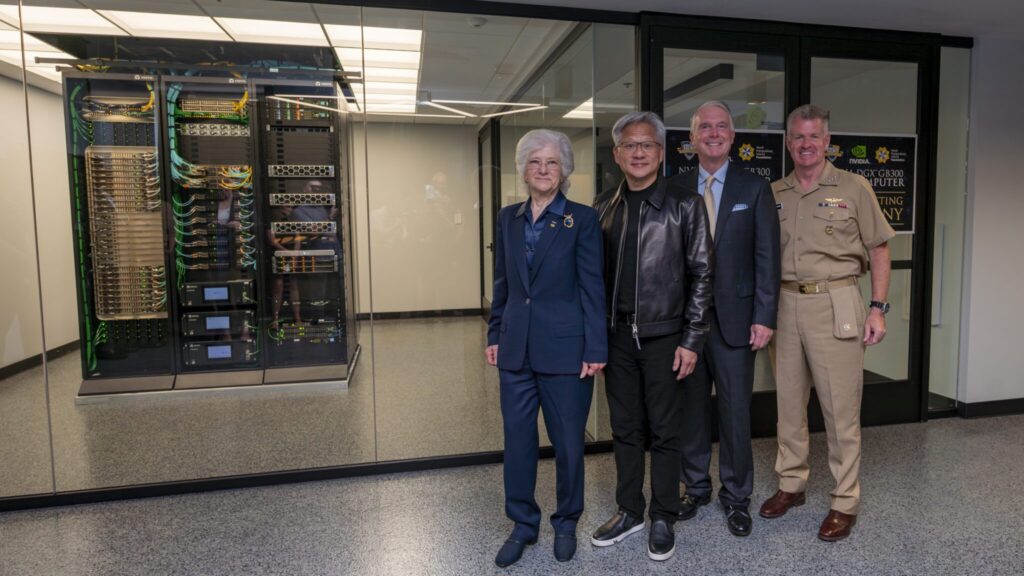
The United States Naval Postgraduate School has launched an NVIDIA DGX GB300 system dedicated to training and research in applied artificial intelligence for defense. Installed on its campus in Monterey, California, the supercomputer will enable model training, simulations, and processing of sensitive information within the institution itself, without relying on external cloud infrastructures for all workloads.
The keys to NVIDIA’s military supercomputer in 30 seconds
- The Naval Postgraduate School has activated the first NVIDIA DGX GB300 installed within a U.S. military organization.
- Over 1,500 resident students and approximately 600 faculty members will have access to local training and inference capacity.
- The projects cover cybersecurity, meteorology, autonomy, oceans, digital twins, and disaster response.
- NVIDIA donated the system to the university’s foundation.
- DDN, VAST Data, and Vertiv contributed storage, data management, cooling, and integration.
The activation took place on July 22 during Converge @ NPS, with participants including Jensen Huang, founder and CEO of NVIDIA; Samuel Paparo, Commander of the U.S. Pacific Fleet; and Ann Rondeau, President of the Naval Postgraduate School (NPS).
The institution highlights the system as the first NVIDIA DGX GB300 deployed within the U.S. military sphere. Its arrival is part of a research and development agreement signed by NVIDIA and NPS in December 2024 to expand the use of artificial intelligence in education, applied research, and national security.
AI installed on campus
The DGX GB300 will provide AI computing access to over 1,500 resident students and around 600 faculty members. The Naval Postgraduate School trains U.S. officers and allied personnel in disciplines such as space operations, engineering, oceanography, cybersecurity, autonomy, and operational analysis.
The new system allows some of these tasks to be executed on campus. This is particularly important when projects involve restricted data, operational information, or simulations that shouldn’t be automatically sent to a public cloud provider.
The infrastructure supports both training and inference. Training involves creating or tuning models using proprietary datasets, while inference runs these models to generate predictions, classifications, or responses.
NPS indicates that the system will support research in artificial intelligence, cybersecurity, autonomous systems, modeling, and operational analysis. NVIDIA adds other fields such as weather prediction, disaster response, and the creation of digital twins of complex environments.
This deployment does not turn the campus into a large data center. The university itself describes it as an integrated system within its existing high-performance computing infrastructure. The setup combines processing, memory, networking, storage, and management software into a platform designed to expand with multiple units.
The team also utilizes NVIDIA Mission Control, a software layer for monitoring and managing AI infrastructure. Its functions include workload deployment, resource status monitoring, and managing DGX systems as a unified platform.
From ocean models to military digital twins
One of NPS’s main research areas is ocean and atmospheric studies. Researchers develop models to represent sea state, forecast weather changes, and analyze how different conditions can impact naval operations or emergency response activities.
These tasks often demand large data volumes and numerous repetitions. A model might need to evaluate thousands of combinations of wind, temperature, pressure, waves, or currents before producing a useful forecast. GPU acceleration enables many of these computations to run in parallel.
The university also collaborates with MITRE on digital twin environments built on NVIDIA Omniverse libraries. These systems recreate physical spaces and operational conditions to study navigation, decision-making, and autonomous system behavior in uncertain scenarios.
A digital twin isn’t a perfect copy of the real world. It’s a computer-generated representation that combines models, data, and physical rules to test decisions without the initial cost or risk of a real-world trial.
In military contexts, digital twins can be used to study the behavior of vehicles, communications, sensors, or human teams under changing conditions. They can also generate synthetic data to train algorithms when real data is scarce, classified, or costly to obtain.
The system will also facilitate internal development of foundational models. This doesn’t necessarily mean NPS will create a competitor to large commercial models. It could involve specialized models trained or fine-tuned to interpret weather data, detect security anomalies, process signals, or support specific planning tasks.
Military AI requires local infrastructure and trained personnel
Delivering the DGX GB300 isn’t solely about expanding computational capacity. The U.S. aims for its officers to understand how to use AI, including its limitations, risks, and decision-making effects.
Samuel Paparo stated during the event that future commanders will operate in environments where information flows more rapidly, reducing response times. According to him, the advantage won’t just come from better algorithms but from having personnel capable of interpreting results and applying human judgment.
This nuance is crucial because an AI-generated recommendation can be based on incomplete data, contain errors, or misrepresent a new situation. In military, meteorological, or civil protection scenarios, an incorrect prediction can have serious consequences beyond consumer applications.
Direct access to the infrastructure allows students to experiment with models instead of only using finished tools. NVIDIA has also expanded its collaboration through the Deep Learning Institute, which offers training materials to help educators incorporate AI content into various programs.
This relationship also benefits NVIDIA. The company deploys hardware and software in an institution that trains future technology leaders, operators, and procurement officials. At the same time, it strengthens its presence within the U.S. government’s AI initiatives.
The system was donated to the Naval Postgraduate School Foundation, which also funds research projects requiring computing power and memory. In 2025, the foundation allocated $825,000 to the first Digital Trident AI Challenge, supporting projects related to national security issues.
A DGX GB300 needs more than GPUs
Deploying the system involved several specialized vendors. DDN provided high-performance data infrastructure for storing, protecting, and supplying information to AI workloads.
VAST Data offered a unified platform for data access management across on-premises, cloud, and edge environments. Vertiv handled racks, power supplies, liquid cooling, testing, and commissioning.
These components illustrate why an AI supercomputer isn’t just about GPU count. Accelerators must receive data at high speed, communicate efficiently, and dissipate significant heat. If storage, networking, or cooling fall behind, much of the system’s potential remains underutilized.
The DGX GB300 family is based on the Grace Blackwell Ultra architecture. In rack-scale configuration, the GB300 NVL72 platform integrates 72 Blackwell Ultra GPUs and 36 Grace CPUs, with NVLink interconnects reaching 130 TB/s total bandwidth. NVIDIA has not publicly disclosed the exact configuration or overall cost of the Monterey system.
Details about the specific models being trained, datasets used, or projects classified remain undisclosed. The available information outlines general research and educational goals rather than specific military operational capabilities.
Nonetheless, the activation of DGX GB300 clearly indicates a trend: public and defense institutions want autonomous capacity for experimenting with AI. Cloud remains useful for expanding resources, but local systems offer greater control over data, access, availability, and configuration.
Frequently Asked Questions
What is the Naval Postgraduate School?
It is a U.S. Navy postgraduate university located in Monterey, California. It trains U.S. military officers and allied personnel, and conducts applied research in defense and national security.
What will the NVIDIA DGX GB300 be used for?
The university plans to use it for model training and inference, cybersecurity, weather forecasting, autonomous systems, simulation, digital twins, and disaster planning.
Is this the first DGX GB300 in the U.S. military?
NPS describes it as the first NVIDIA DGX GB300 supercomputer installed within a U.S. military environment.
Did NVIDIA sell the system to the university?
No. According to NPS, NVIDIA donated the hardware to the university’s foundation, while several partners provided storage, infrastructure, and technical support.
via: blogs.nvidia
