
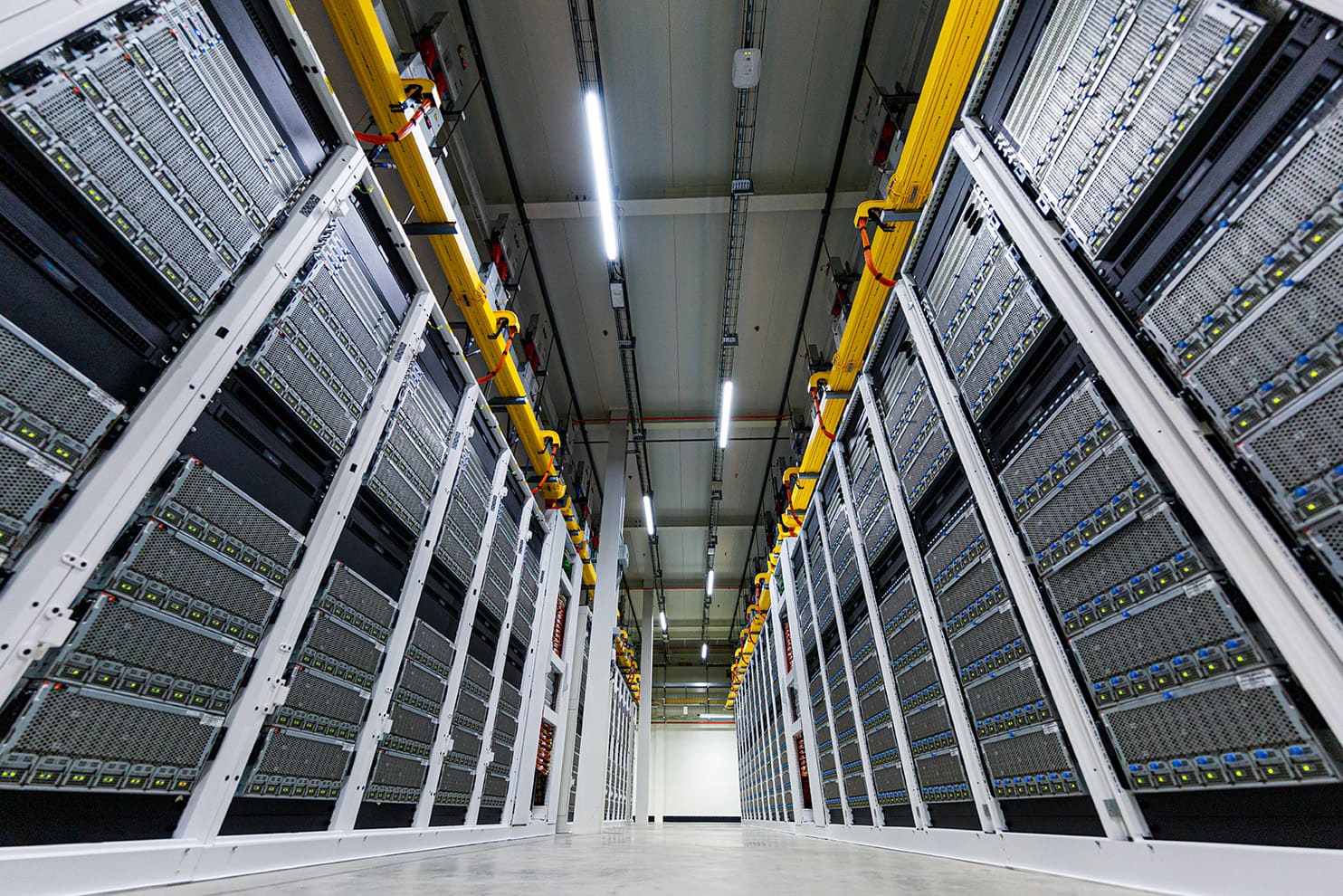
Microsoft has signed a multi-billion dollar commitment to utilize part of the artificial intelligence infrastructure that Mistral is deploying in Europe. The agreement gives the American group more regional capacity, expands the presence of French models on Azure, and demonstrates how large North American providers are adapting their offerings to compete for European contracts that require more control over data, operations, and continuity.
The key points of the Microsoft and Mistral agreement in 20 seconds
- Microsoft will contract European capacity from Mistral for several years.
- Medium 3.5 and OCR 4 are now available on Microsoft Foundry.
- Azure Local will enable running open models in private facilities.
- The agreement improves residency and operational autonomy but does not eliminate legal, commercial, and technological dependencies on the U.S.
This is not a new share purchase or acquisition of Mistral. Microsoft commits to consuming capacity from its European clusters, while the French company gains a client capable of supporting investments that require purchasing thousands of GPUs, contracting energy, and building infrastructure before demand arrives.
The operation also reflects a broader shift. AWS, Microsoft, and Google have realized that simply installing servers in Frankfurt, Paris, or Madrid and calling it European is no longer enough. Governments, banks, industries, and critical operators want to know who manages the system, what jurisdiction affects the provider, who controls the keys, and whether the service could continue during a political or commercial crisis.
Microsoft stops offering only cloud services
The relationship between Microsoft and Mistral began in 2024 with a conventional structure. Azure provided computing capacity and distribution, while the French company contributed models that Microsoft could incorporate into its catalog.
The new agreement introduces a reverse approach. Microsoft will use part of the GPU infrastructure built by Mistral to increase its own AI capacity in Europe and provide services to its clients. Mistral thus ceases to be just a manufacturer of models that consumes U.S. cloud services and starts selling computing resources to Azure as well.
Mistral Compute offers dedicated clusters on physical servers, orchestration via Kubernetes, and access to NVIDIA GB200, GB300, and B300 accelerators. The company aims to reach 200 MW of sovereignty-rated capacity within the European Union by 2027.
The agreement also includes the distribution of specific products:
| Component | Announced Availability |
|---|---|
| Mistral Medium 3.5 | Microsoft Foundry and Copilot Studio |
| Mistral OCR 4 | Microsoft Foundry |
| Open models by Mistral | Azure and Azure Local |
| Mistral Infrastructure | European capacity used by Microsoft |
| Offline environments | Private deployments via Azure Local |
Microsoft Foundry allows selecting models and building applications or agents on top of them. Copilot Studio is aimed at enterprise automation, while Azure Local brings part of Azure’s software and management to infrastructure controlled by the client.
For Mistral, the advantage is gaining access to Microsoft’s commercial channel without giving up direct marketing of their models and infrastructure. For Microsoft, it means adding European capacity and a local brand to a sovereignty offering that has until now relied mainly on data centers, contractual controls, and regional partnerships.
U.S. hyperscalers invest to continue being European
Digital sovereignty has become a commercial category. The large U.S. groups are not abandoning Europe amid increasing regulatory requirements. They are investing so their platforms can still be contracted when public tenders and regulated sectors demand more autonomy.
In 2025, Microsoft announced it would increase its European data center capacity by 40%, expand operations across 16 countries, and surpass 200 centers on the continent by 2027. Since then, it has added multi-billion-dollar investments in various markets, created a European advisory council composed of regional citizens, and incorporated contractual commitments for continuity with governments and institutions.
It also works with local partners. Bleu, created by Orange and Capgemini, offers Microsoft services in France under a French operational structure. In Germany, Delos Cloud, a SAP subsidiary, pursues a similar model for the public sector. These alliances aim to separate daily operations from the U.S. parent company, although the products still rely on Microsoft technology.
AWS has followed an even more visible strategy. Its European Sovereign Cloud began operations in January 2026 from Brandenburg with an independent partition, dedicated accounts, and operations within the European Union. Amazon has committed €7.8 billion until 2040 for this infrastructure.
Google Cloud, for its part, offers a combination of data borders, dedicated facilities, disconnected environments, and operation through regional partners. Additionally, Google announced a €5.5 billion investment in data centers, offices, and energy projects in Germany until 2029. Not all of this amount is allocated to sovereignty services, but it enhances the infrastructure with which Google aims to compete in the European market.
The pattern is clear: U.S. companies are allocating capital to physical infrastructure, regional entities, European personnel, local alliances, and legal commitments. They do not do this to voluntarily reduce their presence but to prevent sovereignty demands from favoring European providers outside their platforms.
Microsoft goes a step further with Mistral. Instead of just building another Azure region, it contracts capacity from a French company and integrates it into its own offerings. This approach allows presenting a European alternative without relinquishing the channel, software, and commercial relationship with Microsoft.
Having servers in Europe does not fully resolve sovereignty
The agreement improves certain aspects of control but not all. The concept of sovereignty often encompasses different issues that need to be distinguished.
| Dimension | What it requires | What the agreement provides |
|---|---|---|
| Residency | Data processed and stored in Europe | European capacity from Mistral |
| Operation | Personnel and management under regional control | Depends on deployment and contractual terms |
| Jurisdiction | Limit orders from foreign authorities | Does not disappear when a U.S. company intervenes |
| Technology | Control of models, hardware, and software | European models, but GPUs and platforms are partly U.S.-based | Portability | The ability to switch providers | Open models help, proprietary integrations may hinder |
| Continuity | Maintain service during a crisis | Improved with local and disconnected environments |
Physical location is the simplest aspect. Jurisdictional issues arise when a company under U.S. jurisdiction maintains data within its possession, custody, or control. The CLOUD Act states that certain providers can receive orders to deliver information under their control, even if stored outside the U.S. The specific application depends on the service, contractual entity, keys, and who can access the data.
Using Mistral Compute directly may change part of that analysis if the French company retains operational control and Microsoft only consumes capacity. However, if the service is deeply integrated with Azure, Foundry, Microsoft identities, and managed systems from the U.S.-based platform, the boundary becomes less clear.
Technological autonomy is also not complete. Mistral, being European, develops its own models, but its clusters use NVIDIA accelerators. Enterprise software may include Azure, Windows, Kubernetes, U.S.-based security tools, and components sourced globally.
That does not invalidate the alliance. Absolute sovereignty is difficult in an industry where chips are designed in the U.S., mainly manufactured in Asia, and integrated with international software. What matters is understanding which dependencies remain, which can be replaced, and what would happen if a provider stopped collaborating.
Microsoft and Mistral offer a concrete improvement over exclusive dependence on a conventional Azure region: more European computing, French models, and deployments that can be maintained in private facilities. But this architecture should be viewed as a combination of providers, not as a fully European tech stack.
The operation exemplifies the new competition for digital sovereignty. Europe aims to reduce dependencies, while U.S. companies are investing to become part of the solution. The result could be increased capacity and options for the European market, though it also risks using the term sovereignty to describe services still dependent on the same global platforms.
Frequently Asked Questions
Is Microsoft directly investing in Mistral AI?
The new agreement does not include a new equity stake. Microsoft commits to using European capacity from Mistral for several years.
Why does Microsoft need Mistral infrastructure?
It allows adding AI capacity in Europe and providing a localized alternative to clients demanding greater control over data, operations, and continuity.
Does a European data center guarantee digital sovereignty?
No. Data residency is only one part. Jurisdiction, key control, administrative access, used software, and migration capabilities must also be considered.
What do U.S. companies gain from these investments?
They maintain access to European public contracts and regulated sectors, adapt their services to new demands, and restrict the market space for local independent providers.
