
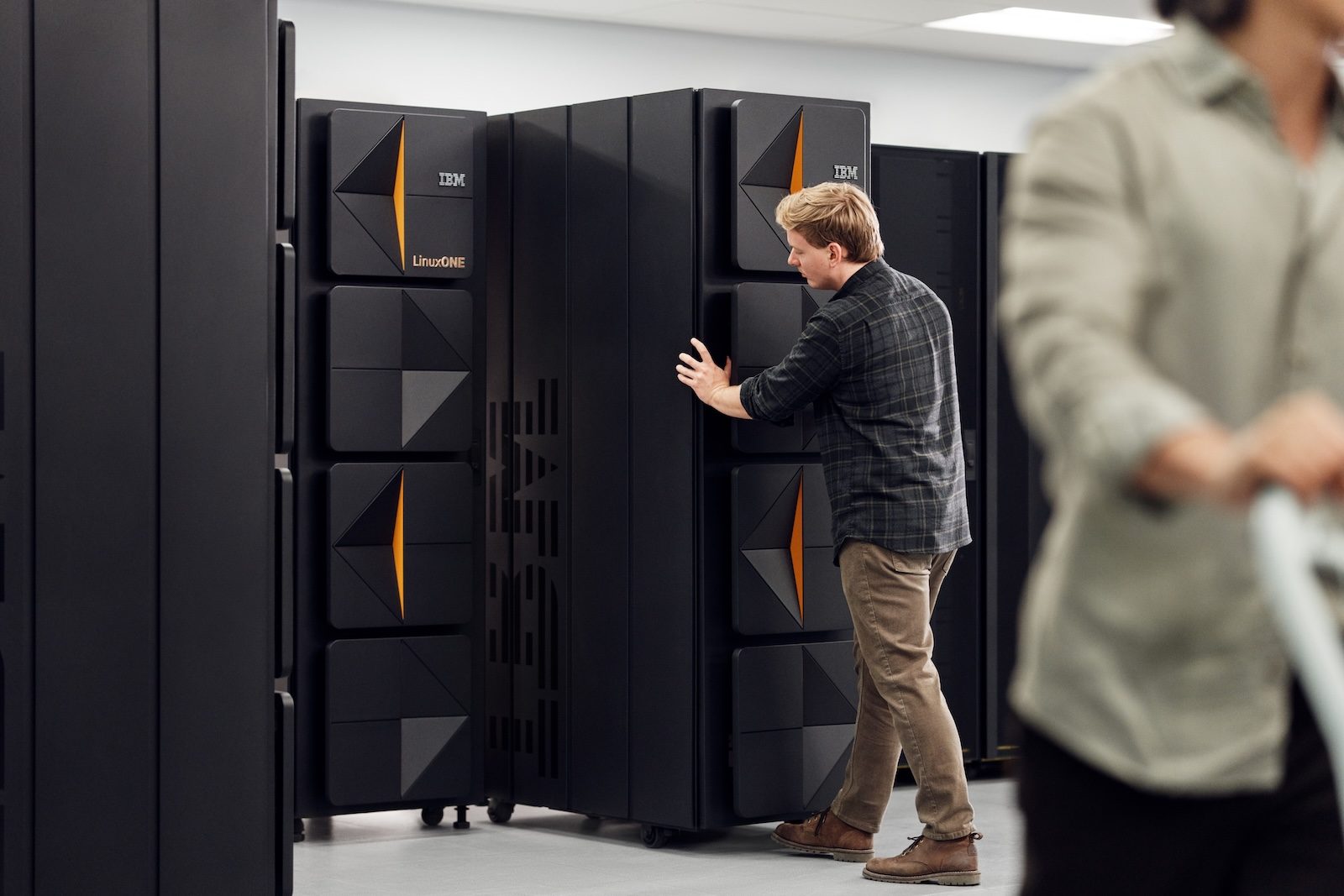
IBM has announced new configurations of IBM z17 and IBM LinuxONE 5 designed to address a very current problem in data centers: lack of space, rising costs, and the need to place critical workloads where they fit best. The innovation is not just an hardware update but also in the format. For the first time, IBM offers rack mount options alongside single frame systems across its entire Z and LinuxONE portfolio.
There’s more behind this move than meets the eye. For years, mainframes have been associated with large data center rooms, banks, government agencies, and central systems with a very unique architecture. IBM isn’t abandoning that world, but it is trying to make it more flexible. The new configurations allow installing IBM Z components in standard customer racks or receiving systems already packaged in a single IBM cabinet, with intelligent power distribution and the ability to coexist with other infrastructure within the same environment.
Market pressures help explain this announcement. Companies handling critical workloads, sensitive data, financial transactions, COBOL applications, enterprise Linux, or high-value databases face increasingly expensive data centers with less availability. IBM cites the CBRE global report from 2026, mentioning very low occupancy rates and rentals exceeding $400 per kW per month in some markets. In this context, density, efficiency, and physical flexibility are again top business arguments.
z17 and LinuxONE 5 go to the rack
The new configurations support up to 82 cores and 18 TB of memory in two processor drawers, which IBM presents as approximately a 20% increase in cores and a 12% increase in memory capacity. The company also states that a single processor on IBM z17 ME2 offers z/OS configurations running at full speed with 10% more performance per core compared to IBM z16 A02, although actual results depend on workload and setup.
The family is organized into several options. IBM z17 single frame arrives as a pre-packaged solution ready for deployment in an IBM rack. IBM z17 rack mount allows installing IBM Z components directly into standard customer racks. IBM LinuxONE Rockhopper 5 targets high-density Linux workloads, with AI acceleration on-chip, confidential computing, and post-quantum cryptography. IBM LinuxONE 5 Express is a compact 18U entry for organizations with a smaller set of workloads but with security, resilience, and enterprise performance needs.
| System | Approach | Format |
|---|---|---|
| IBM z17 single frame | Packaged IBM Z system ready for deployment | Closed IBM rack |
| IBM z17 rack mount | Installation in standard customer racks | Customer rack |
| IBM LinuxONE Rockhopper 5 | High-density enterprise Linux | Single frame and rack mount |
| IBM LinuxONE 5 Express | Compact entry for fewer workloads | 18U |
The goal is clear: bring capabilities traditionally associated with large mainframe platforms into more adaptable configurations. IBM isn’t trying to turn z17 or LinuxONE into ordinary servers. The aim is to reduce physical and operational friction for companies that can no longer afford to design their data centers around a single family of systems.
AI integrated into transactions
Another key aspect of the announcement is artificial intelligence. IBM emphasizes that z17 and LinuxONE 5 are not just platforms for running traditional critical workloads but also systems prepared for AI inference near the data and within the transaction itself.
The new configurations continue the previously announced approach for the z17 and LinuxONE 5 family: IBM Telum II processor, support for Red Hat OpenShift AI, and IBM Spyre accelerator for multimodel inference. The idea is to run predictive and generative AI in environments where sensitive data cannot easily move to an external cloud or where latency and traceability are critical.
This strategy is particularly relevant in banking, insurance, administration, healthcare, telecommunications, or financial retail. Using AI to generate text or automate office tasks is one thing; applying models to transactions, fraud detection, risk assessment, scoring, compliance, or processes requiring resilience and strict controls is another.
IBM’s advantage is that AI doesn’t have to live separately from the system holding critical data. If inference runs on the same platform or very close to it, data movements are reduced, controls are simplified, and security guarantees typical of the core environment can be maintained.
More automation for a platform that needs fewer specialists
IBM recognizes that one of the main barriers to mainframe adoption isn’t just cost but also talent. Operating IBM Z requires specialized knowledge, and many companies have concerns about the availability of profiles with experience in z/OS, COBOL, security, capacity, and central system operation.
That’s why the announcement includes new software capabilities. IBM Infrastructure Management for Z and LinuxONE consolidates provisioning, configuration, and operation into a unified interface, supporting Terraform and Infrastructure as Code (IaC). The goal is to bring management practices closer to those familiar to modern platform, automation, and DevOps teams.
Also introduced is IBM COBOL Elevate for z/OS, a tool designed to simplify modernization and improve COBOL application performance on z17 without reprogramming or highly specialized skills, according to IBM. This is an important message: the company is not encouraging clients to abandon COBOL but to extract greater value from applications that remain critical.
| New Software | Goals |
|---|---|
| IBM Infrastructure Management for Z and LinuxONE | Provisioning, configuration, and operation with Terraform and IaC |
| IBM COBOL Elevate for z/OS | Modernization and performance optimization of COBOL applications without rewriting |
| IBM Crypto Discovery & Inventory | Visibility into your cryptographic posture |
| Post-Quantum Cryptography | Preparation for emerging cryptographic risks |
Positional cryptography post-quantum also features prominently. IBM states that post-quantum security is now standard on z17 and LinuxONE Rockhopper 5, along with confidential computing and enterprise-scale secret management. Additionally, the new capabilities of Crypto Discovery & Inventory aim to provide security teams with a consolidated view of their cryptographic stance to prepare for post-quantum standards.
Mainframe doesn’t disappear, it adapts
From time to time, the idea that the mainframe is in retreat is repeated. The reality is more nuanced. Many critical workloads continue running on IBM Z because the cost of replacing them, operational risks, and migration complexity are enormous. Banks, insurers, governments, and large enterprises still depend on systems that prioritize resilience, security, transactional performance, and compatibility.
What is changing is the environment surrounding the mainframe. It can no longer be isolated. It must integrate with hybrid clouds, containers, APIs, observability, automation, AI, modern security policies, and teams working with standard tools. IBM’s announcement aligns precisely with this: making Z and LinuxONE occupy less physical space and less mental distance within enterprise architecture.
The rack mount format can make sense for organizations wanting to place these platforms alongside x86 servers, storage, networking, security appliances, or OpenShift environments. It can also open opportunities for smaller clients or specific use cases where physical and operational formats previously seemed excessive.
This isn’t total democratization of the mainframe. It remains a specialized enterprise infrastructure. But it’s an effort to remove rigidity from a platform IBM aims to keep relevant in the era of AI, hybrid cloud, and saturated data centers.
Availability
IBM announced that the new configurations z17 single frame, z17 rack mount, IBM LinuxONE Rockhopper 5, and IBM LinuxONE 5 Express will be generally available on August 12, 2026. IBM Infrastructure Management for IBM Z and LinuxONE will launch on August 14, 2026, with IBM COBOL Elevate for z/OS available from September 18, 2026.
The strategic takeaway is straightforward: IBM is not trying to sell mainframes as nostalgic technology but as compact, automatable platforms ready for critical workloads with AI. In a market obsessed with GPUs, public cloud, and AI data centers, IBM reminds us that many companies’ most sensitive value still resides in central systems. And those systems also need to better fit, consume more efficiently, and connect more seamlessly with the rest of the infrastructure.
Frequently Asked Questions
What has IBM announced?
New compact configurations of IBM z17 and IBM LinuxONE 5 in single frame and rack mount formats, along with new management, modernization, and security tools.
Why is the rack mount format important?
Because it allows installing IBM Z and LinuxONE components in standard customer racks, facilitating integration with existing infrastructure and optimizing data center space.
What capabilities do the new configurations offer?
IBM mentions up to 82 cores and 18 TB of memory across two processor drawers, with improvements over previous comparable configurations in core count and memory.
What role does AI play in z17 and LinuxONE 5?
IBM integrates multimodel inference via Telum II, support for Red Hat OpenShift AI, and Spyre Accelerator to enable predictive and generative AI for transactional and critical workloads.
When will they be available?
The new systems will be available on August 12, 2026. IBM Infrastructure Management arrives on August 14, and COBOL Elevate for z/OS on September 18.
via: newsroom.ibm
