
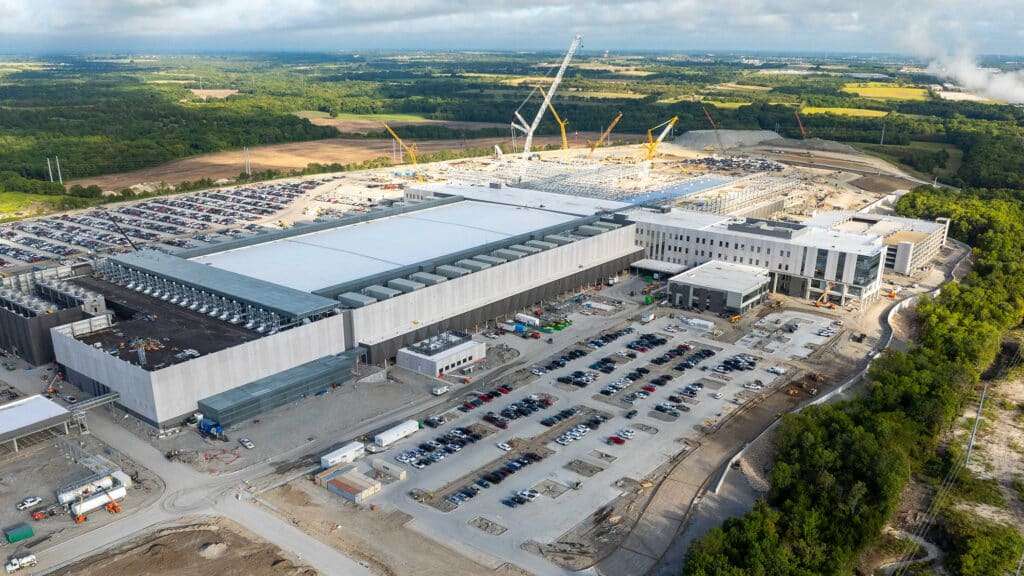
QTS Data Centers and Lancium have announced a new data center campus near Turkey, in Hall County, Texas, which could attract over $10 billion in investment. QTS will design, build, and operate the buildings, while Lancium will provide the land and electrical and civil infrastructure for a site prepared for large-scale loads.
The key points of the QTS and Lancium campus in 20 seconds
- Projected investment exceeds $10 billion.
- The project relies on an electrical interconnection of up to 1 GW.
- The companies estimate 7,000 jobs during peak construction and about 350 permanent positions.
- The campus will use closed-loop cooling and will not connect to Turkey’s municipal water system.
The project is part of Lancium’s Clean Campuses network in Texas, designed to support the AI expansion and cloud infrastructure growth. The company is already working on large-scale sites in Abilene and Childress, in addition to the new Hall County development. These campuses feature gigawatt-scale interconnections, combining grid access with generation, storage, and flexible demand management.
The $10 billion figure represents an estimate of the capital investment that could accumulate during the project’s development, not an immediate expenditure or a fully allocated budget. The companies have not yet announced construction timelines, the number of buildings, initial computational capacity, or potential tenants of the campus.
A campus connected to a 1 GW electrical infrastructure
The project’s official page presents the Hall County site around a 1 GW interconnection that is progressing through the ERCOT review process, Texas’s electric grid operator. This power level equals 1,000 MW, though it does not necessarily mean the campus will consume all that capacity upon opening.
Data centers are typically developed in phases. Demand increases as buildings are completed, servers are installed, and clients contract capacity. The maximum electrical access indicates the project’s potential size but does not reveal the initial load or its average utilization.
| Key Campus Data | Announced Information |
|---|---|
| Location | Near Turkey, Hall County, Texas |
| Projected Investment | Over $10 billion |
| Electrical Infrastructure | Up to 1 GW interconnection |
| Landowner and Developer | Lancium |
| Data Center Developer and Operator | QTS Data Centers |
| Peak Construction Jobs | Up to 7,000 |
| Estimated Permanent Jobs | About 350 |
| Cooling System | Closed-loop |
| Water Supply | Own wells or approved external sources |
| Municipal Water Use in Turkey | Not expected |
| Energy Storage & Solar | Planned within the energy design |
| Opening Timeline | Not announced |
Lancium will handle the civil and energy infrastructure of the site. QTS will manage the design, construction, and operation of the buildings housing the computing systems. Both companies state they will fully finance the electrical upgrades necessary to connect and supply the campus.
| Participants | Responsibilities |
|---|---|
| Lancium | Land, campus development, civil works, electrical infrastructure |
| QTS | Design, construction, and operation of data center buildings |
| ERCOT and Transmission Providers | Review and integrate new demand into the grid |
| Campus Clients | Installing or contracting for computing capacity |
| Local Authorities | Permits, regional coordination, community relations |
Lancium plans to complement grid connection with battery storage and behind-the-meter solar resources. The aim is to manage demand and introduce flexibility into the electrical system, though specifics about battery capacity, solar generation, or energy percentage within the campus have not been disclosed.
Lancium has years of experience developing technologies to make large industrial loads controllable. In 2025, it granted ERCOT a free license covering several patents related to participation of flexible loads and coordinated resources in the electric market. While this does not automatically approve new data centers, it exemplifies the kind of energy management Lancium intends to implement on its campuses.
Cooling without continuous water consumption
Water usage has become a critical concern for new data centers, especially in rural or water-scarce areas. QTS and Lancium assure that the campus will use a closed-loop cooling system that recirculates the same fluid repeatedly.
According to the companies, this system will not require additional water for cooling during normal operation. Water needed for toilets, kitchens, cleaning, landscaping, and other building functions will come from on-site wells or approved external sources.
Lancium states the development will not connect to Turkey’s municipal water supply and will not extract water from the local network used by homes, schools, and businesses. The company also mentions a stormwater runoff prevention plan to manage runoff during construction and operation phases.
| Water Use Area | Announced Solution |
|---|---|
| Server Cooling | Closed-loop recirculation |
| Initial System Fill | Source from on-site or approved outside sources |
| Restrooms and Kitchens | On-site wells |
| Cleaning & Maintenance | Own water or approved external supplies |
| Landscaping | On-site resources |
| Municipal Water in Turkey | Not planned |
| Stormwater Management | Specific prevention and containment plan |
Although closed-loop cooling reduces ongoing water withdrawal compared to traditional evaporative towers, it does not eliminate all water needs. Initial fill, maintenance, possible losses, and general facility use will still require water sourcing.
It remains unclear which specific technology QTS will employ. Closed-loop systems may use outside air, heat exchangers, refrigerant liquids, or combinations of methods. The choice will depend on rack heat density, climate conditions, and the hardware of future clients.
Thousands of jobs during construction, but only 350 will be permanent
QTS and Lancium estimate that construction could employ up to 7,000 workers at peak activity. This includes temporary jobs related to civil works, electrical, structural, cooling, security, equipment installation, and other tasks needed to build several buildings.
The permanent jobs are estimated at around 350, including QTS employees, maintenance, security, and personnel from companies leasing space on the campus.
| Estimated Employment Impact | Number of Jobs |
|---|---|
| Maximum during construction | Up to 7,000 |
| Permanent employment | Approximately 350 |
| Ratio of temporary to permanent jobs | About 20 to 1 |
This pattern is common in large data centers. While construction demands significant workforce effort, post-operations are highly automated, requiring fewer personnel than a conventional factory with similar investment.
Both companies plan to collaborate with schools and training programs to create pathways into technical jobs. They also intend to contribute to water infrastructure, educational centers, emergency services, and other projects to be coordinated with local authorities and the community.
Details on the size of these contributions, potential tax incentives, or economic agreements between the project and the county have not yet been disclosed. Revenue generation from taxes will depend on the final investment structure, exemptions granted, and how quickly the buildings are constructed and equipped.
QTS expands capacity for AI and hyperscale clients
QTS operates data centers in the U.S. and Europe, with over 2 GW of contracted critical power. Its client base includes hyperscale companies, enterprises, and government agencies, with a workforce exceeding 2,000 employees by early 2026.
The Hall County campus would expand this potential capacity in a market where cloud providers and model developers need facilities capable of housing tens of thousands of accelerators. These systems consume more electricity and generate more heat than traditional enterprise data centers.
Lancium provides energy-specific expertise. The company develops campuses that combine large grid connections, batteries, own generation, and load control systems. Its approach focuses first on enabling energy access, then on bringing in operators to build the computing infrastructure.
| Element | QTS | Lancium |
|---|---|---|
| Main activity | Data center design and operation | Energy infrastructure and campus development |
| Contribution to project | Buildings, operations, client relations | |
| Expertise focus | Hyperscale, enterprise, public sector | |
| Presence in Texas | New Hall County campus | |
| Public scale | Over 2 GW contracted | |
| Current and potential capacities | Campus from 1 GW with room to expand |
The planned size places the project among major US developments tied to AI expansion, though key decisions remain to be made. Companies need to complete electrical reviews, obtain permits, secure equipment, and determine which phases will be built first.
The announced investment of over $10 billion, 7,000 construction jobs, and 1 GW capacity represent the maximum potential. The actual impact will only be clear once QTS and Lancium publish detailed schedules, the capacity of the initial phase, client contracts, and the economic terms agreed with local authorities.
Frequently Asked Questions
Where will the new QTS and Lancium campus be built?
Near Turkey, in Hall County, northern Texas.
How much power will the campus have?
Lancium is preparing an up to 1 GW electrical interconnection. The power used during the first phase has not been disclosed yet.
Will it use water from Turkey’s municipal supply?
No, they assure. Cooling will use a closed-loop system, and all other water will come from on-site wells or approved external sources.
When will it begin operations?
QTS and Lancium have not announced construction timelines or opening dates, nor identified future tenants of the campus.
via: q.com
