
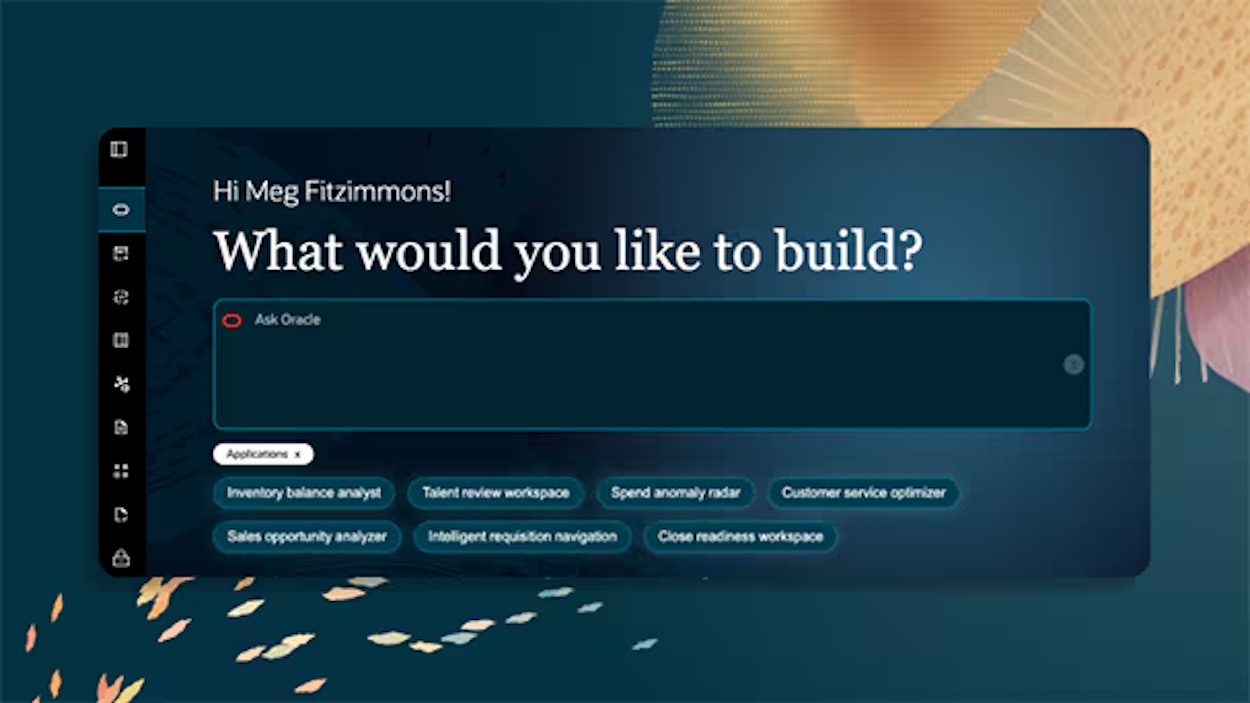
Oracle has introduced a new development experience for AI Agent Studio that enables creating and running agentic applications directly within Oracle Fusion Cloud Applications. The solution brings together no-code, low-code, and professional developer tools, with access to data, workflows, permissions, and approvals already defined in business systems across finance, HR, supply chain, and customer service.
The key to Oracle’s agentic applications in 30 seconds
- Oracle will allow building complete applications coordinated by multiple specialized agents, not just isolated assistants.
- Agents will run within Fusion Applications, inheriting permissions, approvals, and audit records.
- Users can create them via natural language, Visual Studio Code, command line, and Git-based workflows.
- The platform will support Codex, Claude Code, and external agents.
- AI Agent Studio will remain available at no extra cost for Oracle Fusion Applications customers.
The difference from a conventional copiloto lies in the scope. An assistant typically responds to questions, summarizes information, or recommends actions. Fusion Agentic Applications are designed to coordinate multiple agents, make decisions within defined policies, and execute operations on real enterprise objects.
For example, they could be used to accelerate financial closing, manage collections, reduce escalations in customer support, review HR transactions, or respond to supply chain incidents. Oracle presents these applications as result-oriented systems, though their autonomy will depend on the permissions, controls, and approvals configured by each organization.
Agentic applications within ERP, HCM, SCM, and CX
Oracle aims to prevent agents from functioning as an external layer connected retroactively to enterprise software. The new experience embeds them within the Fusion Applications runtime environment, which already includes identities, access rules, business objects, processes, and audit records.
This approach can reduce some of the effort required to move a prototype into production. When a company develops an agent outside its management platform, it must separately handle authentication, data access, approvals, observability, traceability, and system maintenance.
| Element | External ERP-connected Agent | Native Fusion Agentic Application |
|---|---|---|
| Identity and permissions | Requires additional integration | Inherits Fusion controls |
| Access to enterprise objects | Via API and connectors | Natively according to permissions |
| Approvals | Must be designed separately | Uses existing workflows |
| Audit | Needs its own logs | Integrated with Fusion traceability |
| Orchestration | External platform | Oracle Fusion runtime |
| Maintenance | Multiple separate components | Managed via AI Agent Studio |
| User experience | May be fragmented | Integrated into enterprise app |
The architecture does not eliminate AI-related risks. An agent with access to invoices, payrolls, orders, or employee records can cause significant errors if it misinterprets instructions or uses incomplete data.
The advantage is that companies can apply the same restrictions they use for humans and applications. An agent could prepare a payment proposal but would require approval before execution. Similarly, it could query certain records without permission to modify them.
Oracle assures that actions will be logged and subject to policies and human oversight. The effectiveness of these controls will need to be validated once these new capabilities are deployed in real environments and used on complex processes.
What can a Fusion Agentic Application include?
| Component | Function |
|---|---|
| Agents team | Distributes tasks among specialized agents |
| User interface | Displays results, exceptions, and approval requests |
| Workflows | Orders the steps needed to achieve an outcome |
| Tools | Allows querying or modifying authorized systems |
| Policies | Defines limits, rules, and execution conditions |
| Approvals | Introduces human oversight for sensitive actions |
| Fusion objects | Connects to invoices, employees, orders, customers, and other records |
| Activity logs | Maintains traceability of decisions and operations |
Oracle cites use cases such as improving collections management or reducing service escalations. In practice, an application could review overdue invoices, check customer history, assess risk, prepare a communication, and request approval before taking action.
In HR, another system might analyze requests, verify internal policies, identify missing documentation, and prepare a recommendation. The final decision could still rest with a manager when legal or labor implications are involved.
From natural language to Visual Studio Code and Git
The new experience offers multiple development paths. Business users can describe their application needs in natural language using Agentic Applications Builder. Technical profiles will have access to Visual Studio Code, command line interfaces, Git repositories, local validation, and continuous integration and deployment processes.
Oracle refers to the developer-oriented set of tools as AI Studio Skill. This component enables working with programming assistants like Codex and Claude Code, in addition to Oracle’s native tools.
| Profile | Available tools | Intended use |
|---|---|---|
| Business user | Natural language and visual builder | Define simple processes and apps |
| Low-code developer | Components, workflows, connectors | Expand applications without building from scratch |
| Professional developer | Visual Studio Code, CLI, Git | Build, validate, and deploy complex projects |
| Oracle partner | Templates, examples, architectures | Create reusable solutions for clients |
| Programming assistant | Codex, Claude Code, Oracle tools | Generate and review code or configurations |
Compatibility with familiar tools can facilitate the integration of agentic development into existing workflows. Using Git allows version control, change review, and rollback when modifications produce undesired results.
Local validation and debugging are also important. An agentic application may not run a fixed flow; it can select tools, distribute tasks, and respond differently depending on context. Therefore, testing should cover both the final outcome and decisions made during the process.
Oracle is also preparing a public GitHub repository with templates, initial projects, sample applications, and reference architectures. The goal is to reduce the time required to start new developments and to provide a common foundation for clients and partners.
No-code, low-code, and pro-code in a single platform
| Mode | Main benefit | Risks to monitor |
|---|---|---|
| No-code | Enables participation by business users | Creating automations without fully reviewing implications |
| Low-code | Speeds up integrations and workflows | Dependence on prebuilt components |
| Pro-code | Offers greater flexibility and control | Increases technical complexity |
| AI-assisted development | Reduces repetitive tasks | Automatically generated incorrect code or policies |
| Reusable templates | Speeds up deployment | Applying a design without adapting it to actual processes |
Democratizing development can expand the number of people able to create automations but also necessitates reviews. A well-described workflow from a business perspective might violate security policies, grant excessive permissions, or use data it shouldn’t process.
The platform will need to balance ease of use with publishing controls, role separation, and change review. Oracle affirms that these capabilities will be integrated into the Fusion environment, but each customer will define who can create, test, approve, and deploy applications.
Oracle opens Fusion to proprietary and third-party agents
AI Agent Studio will support not only Oracle-developed agents but also those from partners, third parties, and clients within the same execution system.
Support for communication patterns among agents will enable Oracle AI Data Platform or external tools to participate in Fusion workflows. The challenge will be maintaining access controls and traceability when parts of the reasoning or operations depend on services running outside Oracle.
| Agent origin | Planned integration |
|---|---|
| Oracle Fusion Applications | Native access to apps and business objects |
| Oracle AI Data Platform | Participation in enterprise workflows |
| Oracle partners | Agents and apps published in the marketplace |
| Third parties | Connected via interoperability mechanisms |
| Internal development | Custom agents built by each organization |
Oracle will also expand the AI Agent Marketplace. The catalog, currently focused on agents, will include complete agentic applications, connectors, workflows, templates, and reusable components.
The company reports that over 80,000 professionals have already received certified training in Oracle AI Agent Studio. It also notes that Fusion Applications include more than 1,000 agents, and in 2026, 22 agentic applications were introduced.
| Oracle-reported indicator | Number |
|---|---|
| Agents delivered via Fusion Applications | Over 1,000 |
| New Fusion Agentic Applications announced in 2026 | 22 |
| Certified AI Agent Studio professionals | Over 80,000 |
| Additional cost for AI Agent Studio | None for Fusion clients |
| Development environments | No-code, low-code, pro-code |
These figures are provided by Oracle and do not specify how many agents are actively in production, their level of autonomy, or how many clients are using the 22 announced applications. An agent listed in a catalog does not necessarily mean it is widely deployed.
Availability at no extra cost does not mean that running these applications is free. Clients may need licenses for Fusion, cloud capacity, storage, integration, consulting, and administrative resources. Oracle has not published an operational cost breakdown associated with the agents or the models used.
Oracle’s proposal places it in the race to turn enterprise planning systems into autonomous execution platforms. SAP, Salesforce, Microsoft, and other vendors are also integrating agents into their applications.
Oracle’s main advantage is that agents run where the processes and data already reside within Fusion. The key question will be whether companies accept a growing portion of their operations relying on agentic applications and whether the built-in controls are sufficient to prevent incorrect actions on critical processes.
Frequently Asked Questions
What is a Fusion Agentic Application?
It is an enterprise application composed of multiple specialized agents that coordinate tasks and perform actions on processes, data, and objects within Oracle Fusion Applications.
How does it differ from a copiloto?
A copiloto typically assists the user with recommendations or content. An agentic application can coordinate multiple agents, follow workflows, utilize tools, and execute operations within defined permissions.
Will programming skills be required to create these applications?
Not necessarily. Oracle will provide a natural language-based builder, low-code tools, and a professional environment compatible with Visual Studio Code, command line, and Git.
Does Oracle AI Agent Studio have an additional cost?
Oracle states it will be available at no extra charge for Fusion Applications customers. However, this does not include costs related to licenses, infrastructure, integration, or professional services.
via: oracle
