
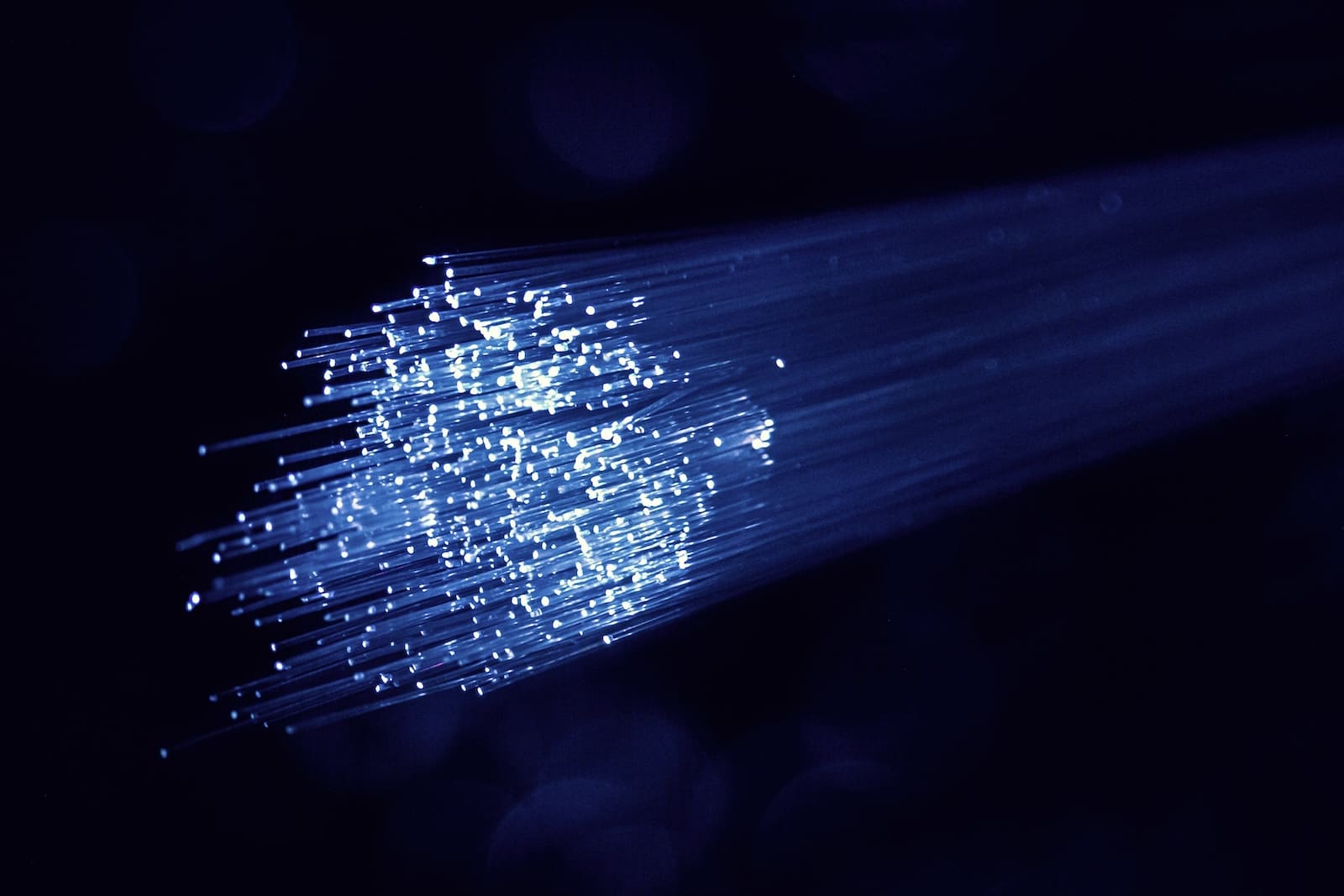
When talking about artificial intelligence, almost all the attention goes to chips, data centers, liquid cooling, or electricity consumption. It makes sense. These are the most visible elements of a technological race that has become a strategic matter for companies, governments, and major cloud providers. But there is a much less conspicuous piece without which none of that would work: fiber optic cable.
Almost everything that happens on the internet first passes through a very thin glass thread, thinner than a human hair, capable of carrying enormous amounts of information via light pulses. Video calls, model training, cloud storage, streaming content, transactions, backups, and data traffic between data centers all depend on this silent infrastructure. It’s underground, in submarine cables, metropolitan networks, inside buildings, and also in the racks connecting servers, switches, and cabinets.
A glass thread moving the world’s traffic
Fiber optic cable may seem like just another cable, but inside it’s quite different from what its exterior appearance suggests. It doesn’t carry electricity like copper cable. It transports light. And that completely changes its possibilities.
At the center of the fiber is an ultra-pure glass core through which the signal travels. Surrounding that core is another layer, called the cladding, with a slightly different refractive index. This small difference is the physical key to the entire system: it allows the light to bounce within the core and keep moving forward without escaping. This phenomenon is known as total internal reflection.
Outside, additional protective layers are added. First is usually a buffering coating that protects against microbends or mechanical damage. Then come reinforcement elements, often made of materials like aramid or Kevlar, which help withstand tension and pulling. Finally, an external cover guards against moisture, abrasion, and chemical agents. All these layers exist to safeguard a structure that, at its most delicate, measures only a few microns.
In single-mode fiber, the most common type for long distances and backbone networks, the core is typically about 8 or 9 micrometers. This is minuscule — for comparison, a human hair is about 80 micrometers in diameter. The heart of the fiber is roughly one-tenth of that.
Why light doesn’t escape and how it becomes data
The principle is elegant and highly practical. When light travels through the core and reaches the boundary with the cladding at an appropriate angle, it bounces and continues inside the fiber. This allows it to travel kilometers upon kilometers, carrying encoded information in the form of light pulses.
These pulses represent bits—ones and zeros. When we talk about 400G, 800G, or even higher speeds, we’re essentially talking about the capacity to send an enormous number of light pulses every second. Here lies the less visible magic of the internet: what appears to the user as a webpage, an AI model query, or a file transfer is, for the network, an organized sequence of light traveling through glass.
The signal doesn’t travel at the speed of light in a vacuum, but it’s still extremely fast. Inside the glass, it moves at around 200,000 kilometers per second—roughly two-thirds of the speed of light in a vacuum. Additionally, signal loss is very low, enabling coverage of very long distances with high efficiency.
The wavelength used also matters. In optical telecommunications, common windows include 850 nm, 1,310 nm, or 1,550 nm, selected for their transmission properties and based on the type of fiber and equipment used. These are technical details that users never see but that determine link design, optical modules, distances, and performance.
Single-mode and multimode: similar on the outside, different in purpose
Not all fiber is suitable for the same applications. One of the most important distinctions is between single-mode and multimode fiber.
Single-mode fiber is designed for light to travel in a single path or mode. This reduces dispersion and allows for much greater distances with high bandwidth. It’s the usual choice for long-distance networks, metropolitan interconnections, carrier links, data center interconnects, and many backbone networks where capacity and latency are critical.
Multimode fiber, on the other hand, has a wider core, typically 50 or 62.5 micrometers, allowing light to follow multiple paths simultaneously. This simplifies some scenarios and can be useful over short distances, but introduces more dispersion and limits reach. That’s why it’s often used in confined environments like inside buildings, campuses, or certain sections of data centers.
Simply put, multimode performs well over short distances, while single-mode is the main driver for moving large volumes of traffic efficiently over long distances. Both remain essential but serve different roles.
The silent foundation of AI and data centers
The current craze around artificial intelligence has made visible technologies that were previously of interest mainly to highly technical profiles. Now, there’s talk of GPUs, direct-to-chip liquid cooling, energy consumption, high-density rooms, and new data centers designed for training loads and inference. But all this infrastructure needs a nervous system that connects each piece to the rest. That’s where fiber comes in.
AI clusters aren’t just about computing power. They are distributed machines exchanging data constantly between servers, switches, and storage. If that connectivity isn’t up to par, overall performance suffers. That’s why fiber optic cables aren’t just accessories around AI—they’re part of its operational backbone.
The same applies outside data centers. Models are trained in one location, stored elsewhere, and serve requests from multiple regions while consuming data from networks, users, sensors, or enterprise platforms worldwide. The cloud may seem intangible to the user, but in reality, it rests on a vast physical network in which fiber optic cables play a central role.
There are more glamorous technologies, but few are so decisive. You won’t see fiber in the main picture of a new AI infrastructure launch, but it’s present in almost every important plan: submarine cables connecting continents, metropolitan rings, interbuilding connections, carrier links, and within the data centers themselves.
Maybe that’s why it’s often forgotten. It’s discreet, works silently, and rarely makes headlines. But while the world debates digital sovereignty, computing capacity, and AI, a part of the future continues traveling inside a tiny glass filament just a few microns wide.
Frequently Asked Questions
What exactly is fiber optic cable?
It’s a transmission medium made of a glass or similar material thread that carries data using light pulses instead of electrical signals.
Why is fiber optic cable so important for AI?
Because it connects servers, storage, networks, and data centers. Without high-capacity, low-latency connectivity, AI clusters couldn’t operate efficiently.
What’s the difference between single-mode and multimode fiber?
Single-mode uses a very thin core and allows for long-distance transmission with less dispersion. Multimode has a wider core, supports multiple light paths, and is mainly used over shorter distances.
Is fiber optic only used in domestic internet?
No. It is also employed in backbone networks, submarine cables, data centers, enterprise campuses, carrier networks, cloud interconnects, and virtually all modern digital infrastructure.
