

China’s possible decision to restrict foreign access to its most advanced AI models is not just a commercial anecdote. It’s a further sign that foundational models have moved beyond being simple digital products to become strategic infrastructure.
In recent years, many European companies have built their first AI projects based on a comfortable assumption: there will always be an accessible US API, open or low-cost Chinese models to test, and choosing the best model at any given moment would not have significant geopolitical consequences. That phase is coming to an end.
The United States has already demonstrated it can restrict chips, accelerators, access to models, or advanced capabilities for national security reasons. If China advances in that direction, it would follow a similar logic: protecting its most powerful models, reducing international exposure, and reserving certain capabilities for its own economy. For Europe, the message is uncomfortable but useful: regulation alone is not enough if no key parts of the stack are controlled.
Models Are also Infrastructure
In cloud, cybersecurity, or telecommunications, Europe has been discussing digital sovereignty for years. In AI, that debate arrived later because the market was moving too fast and because results from major lab APIs were hard to match. But as models start integrating into critical processes, access shifts from being a convenience to becoming a dependency.
A foundational model is not just a chatbot. It’s the reasoning layer that can be connected to internal documentation, code, tickets, customer data, administrative processes, financial analysis, support, industrial operations, education, healthcare, or defense. If that layer is entirely dependent on providers subject to policies of third countries, the company or administration using it does not have real control of its architecture.
The issue is not using American or Chinese models. The problem is lacking alternatives.
Technically, enterprise AI should be designed with the same criteria as any other critical infrastructure: portability, redundancy, observability, cost control, security, reversibility, and governance. Model choice cannot be an informal decision by individual teams or developers; it must be integrated into the architecture.
| AI Stack Layer | Dependence Risk | Technical Response |
|---|---|---|
| Foundation Model | Conditional access, price hikes, policy changes | Portability and multiple providers |
| Proprietary API | Functionality lock-in and SDK dependencies | Abstractions and OpenAI/Anthropic-like compatibility |
| Sensitive Data | Legal or geopolitical exposure | Private RAG, European or local deployment |
| Inference | Variable costs and latency | Own models, open source, or private cloud |
| Evaluation | Uncertainty about which model suits each task | Internal benchmarks and continuous assessment |
| Agents | Uncontrolled spending due to iterations | Routing, lightweight models, task-based limits |
Open Source Does Not Guarantee Sovereignty
The rise of open models has been one of the best news for the sector. Models like Qwen, DeepSeek, GLM, Llama, Mistral, and others have shown that not all value is locked behind closed APIs. But opening does not equal sovereignty.
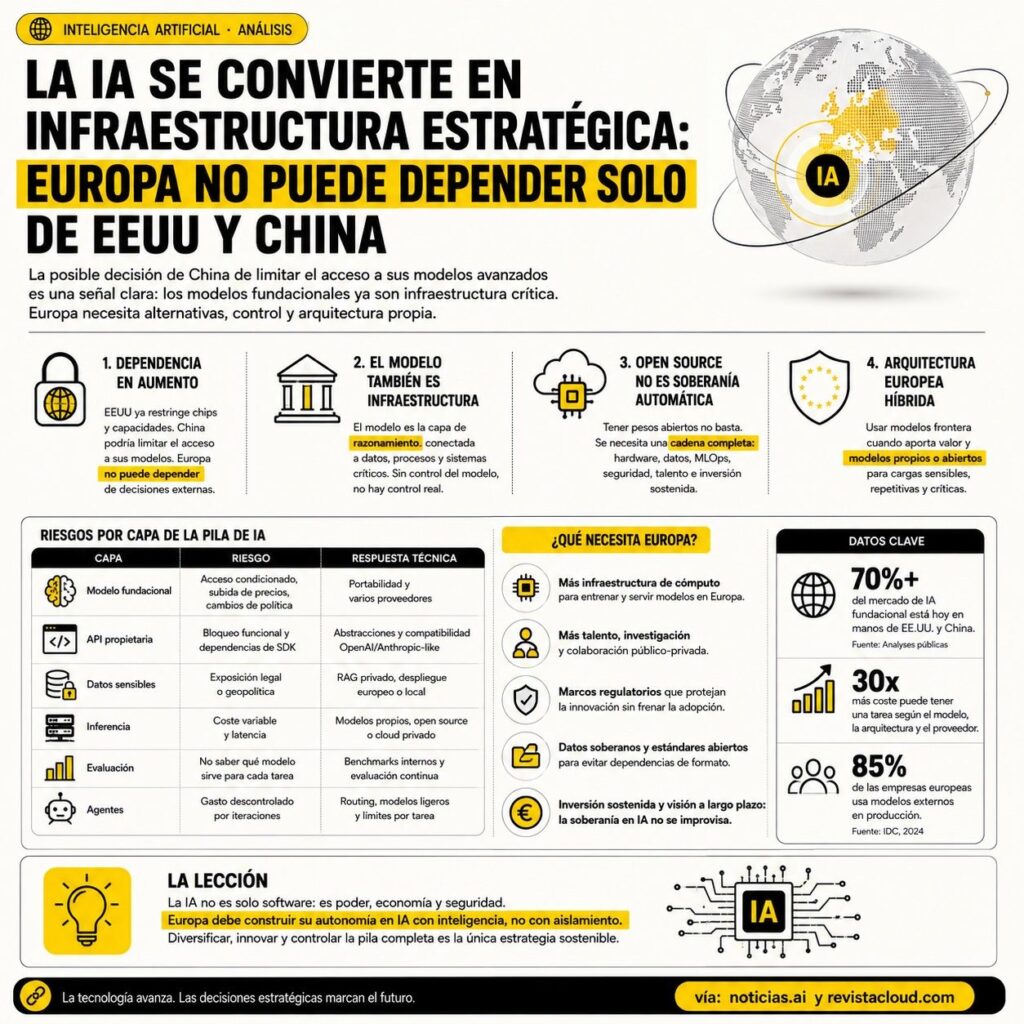
A model with open weights can be downloaded, fine-tuned, and run on your own infrastructure, offering much more flexibility than a closed API. However, a complete supply chain is still necessary: hardware, data centers, efficient inference, tooling, MLOps, evaluation, security, support, updates, documentation, talent, and deployment capacity at scale.
If the model originates from China and access to new versions, training data, documentation, related services, or higher-capacity variants becomes restricted, dependency persists. The same applies if a US-origin model’s license, API, or availability change. That’s why Europe needs more than just “using open source.” It must develop, train, deploy, and maintain its own or sufficiently aligned models with its interests.
Mistral AI is the most visible European example, but it cannot alone carry all of Europe’s AI sovereignty. More actors, greater specialization, increased investment, broader enterprise adoption, and more available compute infrastructure for training and serving models are needed.
Europe’s Architecture Must Be Hybrid
The answer should not be to isolate within a European bubble or ban foreign models. That would be technically absurd. Cutting-edge models will still be necessary for many tasks: complex reasoning, research, advanced programming, multimodal analysis, planning, or high-autonomy agents.
But not all workloads require frontier models. Many enterprise tasks are more repetitive, bounded, and cost- or privacy-sensitive: document classification, extraction, internal search, report summarization, employee support, ticket analysis, internal knowledge retrieval (RAG), configuration review, internal translation, or draft generation.
For these, a hybrid architecture makes sense:
| Workload Type | Recommended Model |
|---|---|
| Regulated or Confidential Data | European, private, or self-hosted model |
| High-Volume Repetitive Tasks | Light, affordable, controlled model |
| Internal RAG | Open or European model with own infrastructure |
| Advanced Reasoning | External frontier model, if it adds value |
| Business Agents | Routing among multiple models depending on phase |
| Software Development | Mix of local, private cloud, and top-tier models as review |
This architecture requires a component that many companies still lack: a decision layer over models. It’s not just about calling an API; it’s about automatically choosing the appropriate model for each task, budget, context, data, and audit level.
Practically, this involves building or adopting AI gateways, internal model catalogs, evaluation systems, task-based cost metrics, fallbacks, data policies, and private deployment when necessary.
Europe Must Move Models, Not Just Regulate Them
Europe has demonstrated the ability to establish regulatory frameworks. The AI Act is the most obvious example. But sovereignty is not just about imposing obligations on AI developers or users. It also requires the capacity to run AI locally, with domestic providers, competitive models, and a manufacturing industry capable of supporting them.
This entails data centers optimized for AI, competitive energy, access to GPUs and accelerators, low-latency networks, private cloud, European inference providers, talent in training and fine-tuning models, and real use cases in companies and governments.
It also involves smarter public procurement. If a European administration only buys AI from non-European providers because they’re the only ones offering a closed product, sovereignty remains words. If it demands portability, European deployment, auditability, open models where appropriate, and substitutability, the market will start to change.
The same applies to enterprises. A company integrating AI into its processes without considering exit strategies, compatibility, or alternatives is repeating well-known mistakes from cloud, enterprise software, and virtualization: over-dependence on a critical layer and discovering exit costs too late.
The Technical Stack for a Less Dependent AI
A serious European strategy should consider the entire stack, not just the models:
| Component | What Europe Should Strengthen |
|---|---|
| Models | Foundational, specialized, multilingual, and sector-specific |
| Data | High-quality, legal, auditable, European datasets |
| Inference | Efficient platforms in private cloud, edge, and bare-metal |
| Hardware | Access to GPUs, accelerators, and ready data centers |
| Orchestration | Agents, tools, RAG, and enterprise connectors |
| Security | Evaluation, red teaming, privacy, and leak control |
| Evaluation | European benchmarks and real use case testing |
| Market | Public procurement, enterprise adoption, and commercial support |
Europe’s advantage may not lie in winning the race for the largest general-purpose model. Instead, it could be in building reliable, auditable, multilingual, integrable, and sector-specific models for industries where Europe has a strong presence: banking, energy, healthcare, automotive, defense, legal, public administration, telecommunications, manufacturing, or logistics.
Generalist models will tend to decrease in cost and become commoditized. The real value will be in the layers that turn them into practical systems: proprietary data, vertical workflows, security, integration, deployment, and support.
China’s Warning Should Accelerate Decisions
China’s potential restrictions should not be seen only as news from Beijing. They are a warning about the new AI landscape. Advanced models represent economic, military, industrial, and cultural power. Countries that develop them will protect them when they see fit.
Europe has two options: continue acting as a large consumer of foreign AI, with good regulation but limited own capacity; or leverage this phase to deploy European models, build European infrastructure, and develop less dependent enterprise architectures.
This is not about abandoning OpenAI, Anthropic, Google, Qwen, DeepSeek, or GLM. It’s about ensuring none of these options are indispensable. Robust tech infrastructure is designed so that critical components can be replaced without rebuilding everything.
AI should follow suit: portability, proprietary models, private cloud, European open source, continuous evaluation, and a clear policy on what data can leave and what must stay inside.
If the US and China restrict their top models, Europe cannot stand still. It must move its own.
Frequently Asked Questions
What is China studying with its AI models?
According to reports by Reuters, Beijing is considering restricting foreign access to some of its most advanced, current, and future AI models.
Why does this matter to Europe?
Because many European companies depend on US models and are testing open or low-cost Chinese models. If both blocks restrict access, Europe’s technological margin shrinks.
Does open source solve the problem?
It helps significantly but is not enough. Infrastructure, support, evaluation, security, deployment, updates, and operational capacity are also essential.
Should Europe only use European models?
Not necessarily. A hybrid architecture makes sense: use global models where beneficial, but keep European or self-made alternatives for sensitive and strategic workloads.
What is the first technical step for companies?
Inventory use cases, measure costs per task, classify sensitive data, test alternative models, and create an abstraction layer to switch providers without rebuilding the system.
