
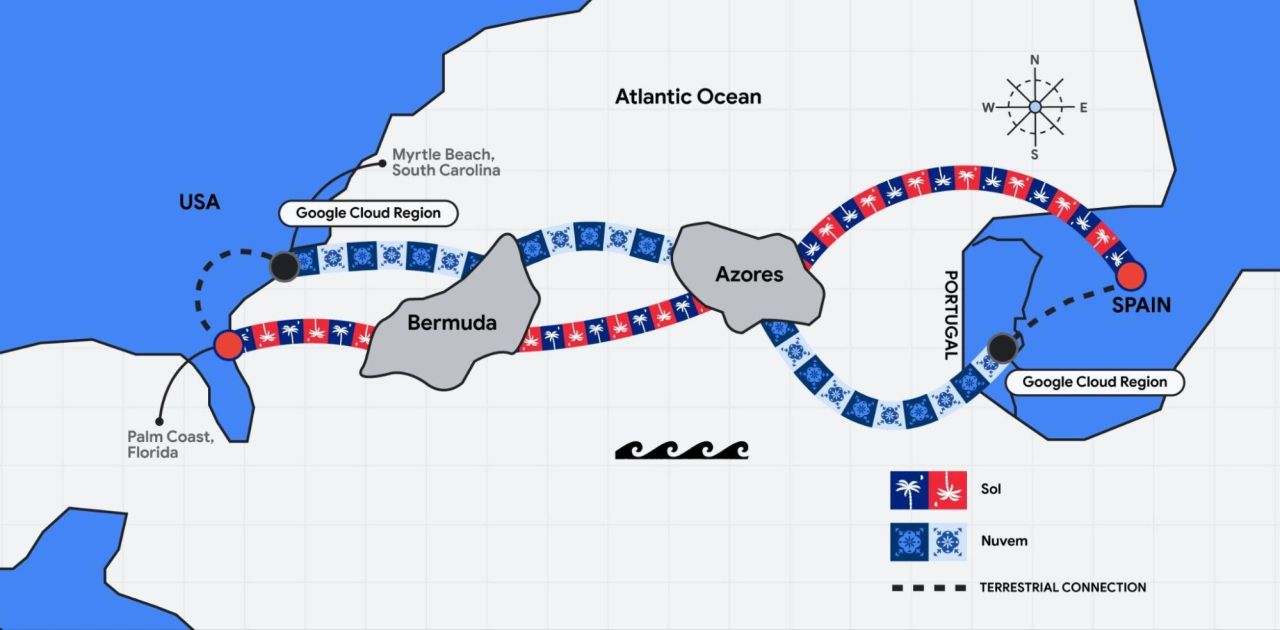
Google is deploying an unusual underwater architecture in the Atlantic. Nuvem and Sol are not two isolated cables linking the United States with Europe, but two complementary routes crossing at strategic points that can serve as physical backups for each other. The design reinforces an increasingly clear idea in cloud infrastructure: resilience is no longer solely a matter of capacity but is built from the fiber up.
Nuvem, announced in 2023, will connect Myrtle Beach, South Carolina, with Sines, Portugal, with branches toward Bermuda and São Miguel in the Azores. Sol, announced in 2025, will link Palm Coast, Florida, with Santander in Spain, passing through Bermuda and the Azores. Google has explained that both systems will interconnect via land in the U.S. and Iberia, and will share presence in Bermuda and the Azores. This mesh makes the two cables much more than simple capacity duplicates—it’s a resilient, diversified infrastructure.
Two routes to avoid dependence on a single Atlantic connection
Public FCC documentation for Nuvem describes a system with 16 fiber pairs, with an approximate design capacity of 24 Tbps per pair and 384 Tbps total. The main route will span about 6,900 kilometers between Myrtle Beach and Sines, with additional segments of approximately 170 kilometers toward Bermuda and 124 kilometers toward the Azores. According to the regulatory filings, Nuvem will be the first system to connect directly the U.S. with the Azores and mainland Portugal, as well as the first transatlantic cable with a landing point in Bermuda.
Sol follows the same logic but with a different entry point. It will rely on Palm Coast, Florida, in the U.S., and reach Santander in Spain, with Telxius as a partner for landing services on the Spanish side. Google describes it as the only active fiber optic cable between Florida and Europe, and a way to better integrate Madrid’s cloud region into its global network.
| System | Main Route | Intermediate Points | Fiber Pairs | Indicated Capacity |
|---|---|---|---|---|
| Nuvem | Myrtle Beach, South Carolina – Sines, Portugal | Bermuda and São Miguel, Azores | 16 | 384 Tbps |
| Sol | Palm Coast, Florida – Santander, Spain | Bermuda and Azores | 16 | Approximately 392 Tbps, according to industry sources |
| Joint Function | Dual transatlantic routes | Interconnectivity in U.S., Iberia, Bermuda, and Azores | 32 total | Resilience and route diversification |
The references to Atlanta and Madrid, common in network analysis, should be understood as approximations of land nodes or backbone destinations connected via these routes—not as official submarine landings. Confirmed public landing points are Myrtle Beach and Sines for Nuvem, and Palm Coast and Santander for Sol.
Diversity is key. Much transatlantic traffic has historically concentrated in well-known routes and landing stations, such as the U.S. Northeast, Virginia Beach, the UK, France, and Ireland. Google is strengthening an alternative through the North Atlantic and Southern Europe, with entries via South Carolina, Florida, Portugal, and Spain. For a company handling search traffic, video, cloud, AI, data replication, and enterprise services, having physically separate paths reduces exposure to outages, congestion, or local incidents.
Bermuda and Azores become more than just transit points
The presence of Bermuda and Azores is strategic, not decorative. In long-distance submarine cables, intermediate points provide energy, operation, maintenance, technical segmentation, and system management capabilities. They also enable an island to shift from dependency on external routes to becoming part of a global connectivity architecture.
Bermuda has recognized this opportunity. Its government has celebrated the landing of Nuvem and Sol as investments in digital infrastructure, economic resilience, and competitiveness. The island has developed legislation for submarine cable corridors, permits, and protected zones. Google is developing a landing station near Annie’s Bay in St. David’s, capable of hosting multiple systems.
Similarly, in the Azores, São Miguel serves as a support point for two of Google’s private transatlantic routes. The reasons go beyond geography; the Atlantic islands can offer redundancy, maintenance access, and an advantageous position to split long routes. In case of failure, cut, or degradation, an architecture with multiple entry and exit points provides greater flexibility to reroute traffic.
Industry promotional materials refer to Nuvem and Sol as “sibling cables.” The metaphor works because they share critical network elements: Bermuda, Azores, terrestrial connections, and integration with Google’s cloud infrastructure. If one route faces a problem, the other can act as an alternative. This is not mere capacity redundancy purchased from another operator but built into the backbone of the hyperscaler itself.
The cloud also goes under the ocean
Nuvem and Sol exemplify how the roles of major cloud providers have evolved. For years, hyperscalers were major capacity buyers on cables operated by consortia or carriers. Now, they finance, design, and control private cables, landing stations, and terrestrial routes. This allows better control over latency, cost per bit, operational security, and availability.
For Google Cloud, this move aligns with the AI demand and distributed services. AI models, data platforms, and enterprise apps need to transfer huge volumes between regions. Latency matters, but stability does too. A cable system is evaluated not only by maximum capacity but also by how it performs during failures.
There’s also a regulatory dimension. The FCC identifies Starfish Infrastructure as an indirect subsidiary of Google for Nuvem, with different group entities controlling segments in U.S. waters, international waters, Bermuda, and Portugal. This structure reflects how complex deploying submarine infrastructure has become: each jurisdiction requires permits, security, defined ownership, and clear responsibilities.
The timeline still requires caution. Google initially announced Nuvem would be operational in 2026. Some industry sources maintain that for Nuvem, while Sol is expected to be ready by 2027. Others suggest both may not be fully operational until 2028 due to terrestrial work, landing stations, and backhaul routes still to complete. Without public confirmation from Google about these delays, it’s wise to distinguish between official project dates and realistic full commercial availability.
For Spain and Portugal, the strategic importance is clear. Santander and Sines are emerging as key transatlantic entry points, while Madrid and other Iberian nodes can be better integrated into Google’s global cloud network. The Iberian Peninsula aims to position itself as a digital bridge between America, Europe, and Africa. With Nuvem and Sol, this ambition is supported by two private routes operated by one of the world’s largest digital infrastructure providers.
Frequently Asked Questions
What are Nuvem and Sol?
They are two transatlantic submarine cables by Google. Nuvem connects the U.S. with Portugal, while Sol connects the U.S. with Spain, both passing through Bermuda and the Azores.
Why are they called twin cables?
Because they share intermediate points and will be interconnected by land routes in the U.S. and Iberia. This architecture allows one route to serve as a backup for the other.
What capacity will Nuvem have?
Regulatory documents mention 16 fiber pairs with a total design capacity of around 384 Tbps.
What does Spain gain with Sol?
Santander becomes a new transatlantic entry point, and Madrid’s cloud region is better connected to Google’s global network.
via: LinkedIn
