
Meetings have become one of the clearest use cases for generative artificial intelligence. Recording, transcribing, summarizing, extracting tasks, and retrieving past decisions fit very well with current models. That’s why tools like Otter, Fireflies, Fathom, and Granola have grown around platforms like Zoom, Google Meet, Microsoft Teams, and other video conferencing environments.
Meetily offers a different perspective on the same problem: doing all that without sending audio to the cloud by default. The project, published as open-source software under the MIT license, positions itself as a privacy-focused meeting assistant that records, transcribes, and summarizes meetings on the user’s own device, with native versions for macOS and Windows, and source builds for Linux. Its GitHub repository describes it as an app built with Rust, with local transcription based on Parakeet and Whisper, summaries using Ollama, and cloud-free processing when used in local mode.
This idea comes at an opportune moment. IBM estimates the average global cost of a data breach at $4.4 million in its 2025 report, warning that the rapid adoption of AI without proper governance and controls increases organizational exposure. In this context, every sensitive meeting recording that ends up on an external platform is also a risk decision.
The local alternative to cloud-based note-takers
Meetily does not seek to differentiate solely on price or features. Its main message is architectural: recordings, transcriptions, and processing can remain on the device or local infrastructure. This sets it apart from many meeting assistants that operate as cloud services and store audio, text, or metadata on third-party platforms.
In practice, Meetily captures audio from the microphone and system, generates real-time transcriptions, and allows producing summaries with local models or external providers. The official website states that transcriptions and recordings are processed locally, while summaries are configurable: they can run with local models via Ollama or leverage an API from Claude, OpenAI, Groq, or other compatible services.
This nuance is important. Meetily can function as a local tool, but stops being entirely “offline” if the user chooses to send the transcription to an external provider for summarization. The advantage is that the decision remains in the hands of the user or the IT team, not dictated by the product.
| Feature | Meetily’s Approach |
|---|---|
| Transcription | Local using Whisper or Parakeet |
| Summaries | Local Ollama or external providers (optional) |
| Audio | Captures microphone and system audio |
| Platforms | Works with Zoom, Teams, Meet, and other meeting apps |
| Systems | macOS and Windows; Linux from source code |
| License | MIT license in open-source edition |
| Architecture | Tauri, Rust backend, Next.js frontend |
| Privacy | Local processing by default for audio and transcription |
The tool also supports importing old audio files to generate new transcripts or repeat the process with different models or languages. This can be useful for teams aiming to improve past minutes, reconstruct decisions, or apply newer models to existing recordings.
Why it matters for regulated companies
The value of a meeting assistant is not only in saving time. In many organizations, a meeting can contain commercial information, personal data, strategies, negotiations, security incidents, financial decisions, intellectual property, or sensitive workplace conversations. Recording and transcribing this on an external service may be justified but must be governed.
Here, Meetily fits into a broader trend: bringing useful AI into the workplace without moving sensitive data outside the chosen perimeter. Not all companies need to train their own models, but many need to control where conversations are processed and who can access them.
For professional firms, product teams, consultancies, clinics, legal departments, startups with sensitive IP, or companies with compliance requirements, a local tool can reduce exposure. It doesn’t eliminate all risks, since recordings must still be protected, encrypted, and managed per policies, but it shifts the trust model. Audio no longer necessarily travels to an external platform; it remains on the device or within the organization’s defined environment.
This approach also reduces dependency on paid APIs for basic tasks. If transcription and summarization run on local models, the marginal cost drops, and users can work even offline. The trade-off is clear: quality, speed, and convenience will depend on available hardware, chosen models, and configuration.
Rust, GPU acceleration, and a desktop app for local AI
Meetily is built as a desktop application using Tauri, with a Rust backend and Next.js frontend. This choice aligns with a category of local AI tools aiming to combine modern interfaces, native performance, and system resource access. For recording meetings, capturing system audio, managing models, and executing real-time transcription, a desktop app provides more control than a browser extension.
The project claims to include automatic GPU acceleration depending on the platform: Metal and CoreML on Apple Silicon, CUDA on NVIDIA, and Vulkan for AMD and Intel. It also incorporates Whisper and Parakeet models, with promises of up to four times faster live transcription in certain scenarios, according to the repository’s description.
That figure should not be taken as an absolute guarantee. Performance depends on hardware, models, audio quality, language, and whether real-time or post-processing transcription is used. Recent release notes mention a post-processing mode that disables live transcription during meetings and processes the full recording afterward—useful when accuracy outweighs real-time display.
The tool has also incorporated practical improvements, such as support for compatible OpenAI endpoints, persistent configuration for models and providers, fixes for system audio selection on Windows, and pre-built FFmpeg packaging to avoid runtime downloads.
Open source doesn’t mean no business model
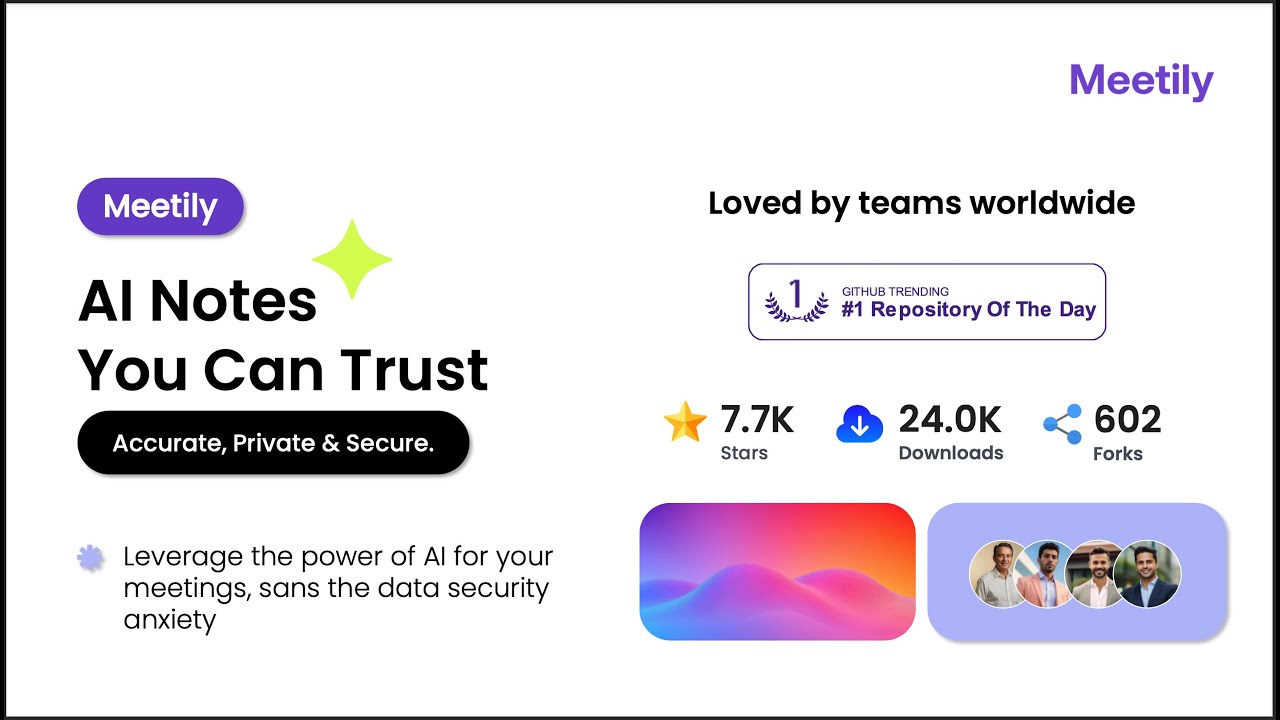
Meetily Community Edition is presented as free and open source, but the project also offers a Pro version. The official website reports over 13,000 stars on GitHub and more than 279,000 downloads—figures that should be read as metrics published by the project itself.
The Pro version targets users and teams needing greater accuracy, custom summary templates, advanced exports, automatic meeting detection, speaker identification, meeting chat, calendar integration, self-hosted deployment for teams, and compliance-oriented features. The project’s own README clarifies that Community Edition will remain free and open source, while Pro covers more advanced workflows and team scenarios.
This model makes sense. A local tool for individual users can stay open source and community-driven, but companies often require centralized management, support, auditing, managed deployment, templates, policies, and exports. Here, the value shifts from merely transcribing to integrating the tool within organizational workflows.
There’s also a competitive angle. The market for meeting assistants has become flooded with SaaS subscription products. Meetily demonstrates that part of this value proposition can be rebuilt on local models and open-source software. While it may not replace all cloud services—especially in organizations valuing deep integrations, team collaboration, and centralized management—it introduces pressure on the traditional SaaS model.
Privacy as a product argument
Privacy has long been a defensive argument: something companies demanded post hoc in contracts and audits. With tools like Meetily, it starts becoming a core product feature. For certain users, the fact that audio does not leave their device is not just a technical detail, but the main reason to choose the tool.
This can change the market. Many organizations have accepted cloud solutions because no suitable alternatives were available. If local AI applications improve in installation, speed, accuracy, and user experience, some sensitive workloads might move back onto devices or private servers.
This shift aligns with the maturity of small and medium models. Whisper, Parakeet, Ollama, and compatible local-execution models enable tasks once reserved for cloud services to be handled on a modern laptop—albeit not always with the same quality as managed infrastructure, but sufficiently useful for many scenarios.
The next phase of enterprise AI will not only be about choosing between “cloud” and “local.” It will involve decisions on what data can leave, what tasks stay internal, which models run where, and who is responsible. Meetily positions itself squarely in this ongoing conversation.
What still needs to be demonstrated
Enthusiasm for Meetily should not obscure the pending questions. Local transcription requires sufficient hardware. Speaker diarization—reliably identifying who said what—is still a challenging function, often part of the Pro offering. Accuracy across languages, accents, noise, and multi-participant meetings will have to be assessed case by case.
Local security also presents challenges. That data does not leave the device doesn’t automatically mean it is protected. Recordings and transcripts must be encrypted, organized, deleted when appropriate, and safeguarded against malware or unauthorized access. In corporate settings, policies regarding recording consent, retention, access, external model usage, and exporting must also be established.
Thus, Meetily should not be seen as a magic solution, but as a more controllable technical alternative. Its strength lies in offering options: default local processing, open source code, interchangeable models, and integration capability with internal infrastructure.
The category of meeting note-takers will not disappear—in fact, it will likely be one of the most used AI tools in everyday work. The difference now is that not all options require handing over meeting audio to proprietary, closed platforms. Meetily demonstrates that significant parts of this work can be brought back to the user’s computer.
Frequently Asked Questions
What is Meetily?
Meetily is an AI-powered meeting assistant that records, transcribes, and summarizes meetings with local processing, available as an open-source project under the MIT license.
Does it work without the cloud?
Transcription and audio processing can happen locally. For summaries, users can choose Ollama locally or external providers like Claude, OpenAI, Groq, or other compatible endpoints.
Which meeting platforms does it work with?
Meetily captures system and microphone audio, so it can work with Zoom, Google Meet, Teams, Discord, Slack Huddles, Webex, and other tools.
Is it a direct alternative to Otter or Fireflies?
It can be for users who prioritize privacy, local control, and open-source software. For large teams, comparisons will depend on management, collaboration, accuracy, support, and compliance features.
What risks remain even when using locally?
Recordings and transcripts must be protected, encrypted, and managed according to policies. Additionally, if summaries are outsourced to an external provider, some content may leave the local environment.
