

Movistar has begun testing a new layer of protection against SMS fraud with some customers. The feature, called Advanced Fraudulent SMS Detection, aims to block messages that attempt scams, impersonations, or phishing links before they reach the user. The technical aspect is interesting; the privacy considerations are inevitably sensitive: to operate, the system needs to analyze not only message metadata but also its content.
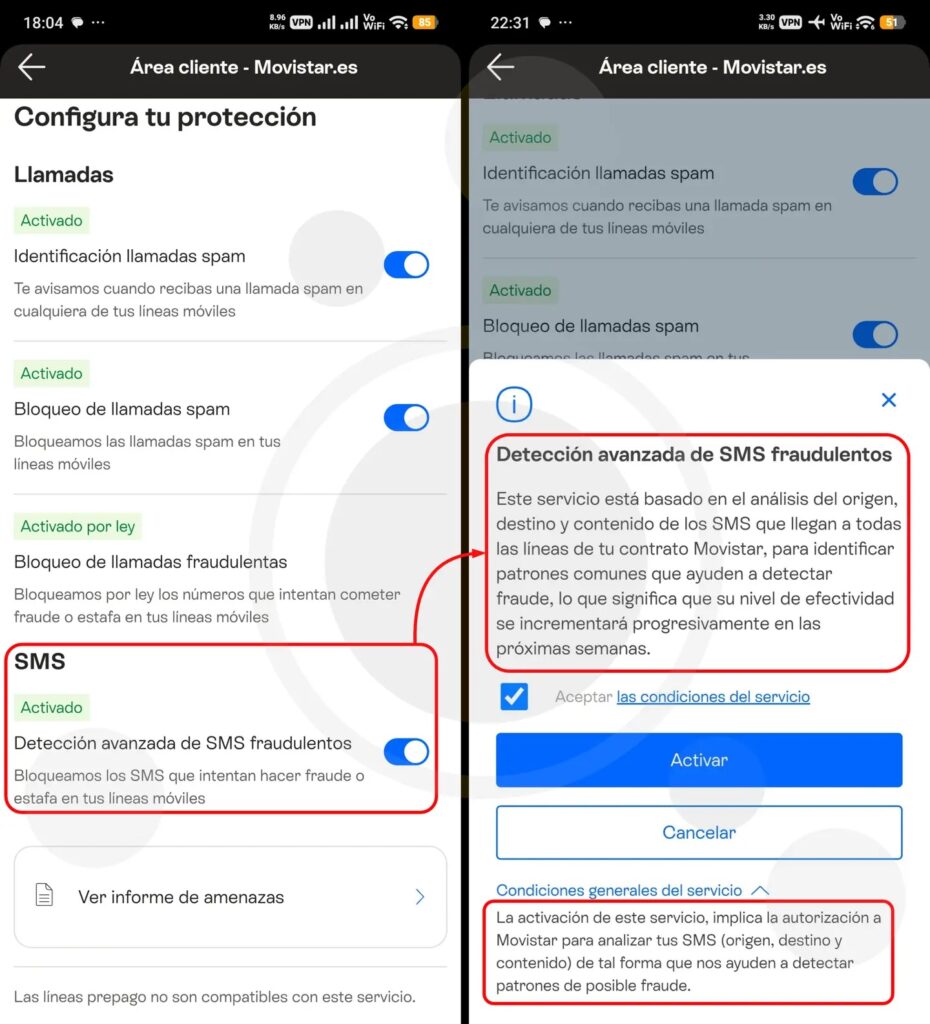
The carrier presents this protection as a voluntary option. Users must activate it and explicitly authorize the analysis of incoming SMS to their mobile lines under their plan. According to information shown to some customers and collected by BandaAncha, the service is based on analyzing origin, destination, and content to identify common fraud patterns and improve its effectiveness over time.
This move comes at a time when telephone fraud is evolving. Calls with manipulated caller IDs now face more regulatory and technical barriers, but SMS remains an effective channel for criminals. The reason is simple: many users still trust messages that appear to come from their bank, Post, Treasury, DGT, or a courier company.
The technical issue: SMS alias can be spoofed
Business SMS often use alphanumeric aliases. Instead of receiving a message from a long number, the user sees a sender like “Bank,” “Post,” or “DGT.” The phone groups messages with the same sender into the same thread, so a fraudulent SMS can appear alongside previous legitimate communications if the attacker manages to use a similar or identical alias.
This is one of the vulnerabilities that the Alias Registry, promoted by the CNMC, aims to address. Order TDF/149/2025 introduced measures to combat impersonation scams via calls and messages, including mechanisms against fraud in numbering and in SMS, MMS, and RCS identifiers.
Full implementation of blocking obligations for messages with unregistered aliases has been postponed until September 15, 2026. From that date, according to CNMC, only messages with previously registered aliases linked to legitimate entities should be delivered to Spanish users, and operators must block those using unregistered aliases or coming from unrecognized providers.
While this registry can significantly reduce impersonation-based smishing, it doesn’t eliminate the problem. Attackers can still use mobile numbers, SIM farms, new senders, changing domains, urgent texts, and malicious links that don’t rely on spoofing a known alias. This is where pattern analysis, powered by AI, comes into play.
What an AI brings to the operator’s network
An SMS filter placed within the operator’s network has a different vantage point than an app installed on the phone. It can observe entire campaigns, detect repetitions, compare messages sent to many lines, analyze domains, identify suspicious sender-content combinations, and act before the SMS reaches the device.
Movistar’s promise is to apply this logic to incoming messages. If the system detects patterns indicative of fraud, it could block or filter the SMS before the user clicks on a link. This defense is especially useful against mass campaigns that tweak small details to evade simple rules.
The challenge is that the content can vary greatly. Fraudulent SMS may come from a number with no prior history. It can use different phrases each time. It may shorten links or use newly created domains. It can mimic the tone of a real entity. To detect such tactics, it’s not enough to analyze just the origin number; interpretation of the text and context is essential.
| Analyzed signal | Why it matters |
|---|---|
| Sender | May reveal fake aliases, new numbers, or bulk sending patterns |
| Destination | Helps detect campaigns targeting many lines within the same network |
| Content | Assists in identifying false urgency, malicious links, or impersonation |
| Included URL | May indicate suspicious domains, redirections, or active phishing |
| Pattern repetition | Allows blocking campaigns even if senders or texts change |
| Campaign history | Improves detection as similar messages appear |
This approach is not exclusive to Movistar. The sector has been working for years to improve anti-smishing filters, but results aren’t perfect. An academic study on commercial tools against smishing found room for improvement across multiple layers of SMS delivery ecosystems, with difficulties in blocking recent attacks without generating false positives.
The uncomfortable part: analyzing private message content
The fundamental question isn’t whether it’s worthwhile to block smishing — it is. The real issue is what privacy cost is acceptable to do so. SMS can contain access links, codes, medical appointments, banking notices, professional information, private conversations, or personal data. Even though SMS doesn’t have end-to-end encryption like WhatsApp or Signal, it remains a form of private communication.
That’s why explicit user authorization is central. If the user enables protection, they agree that Movistar can analyze SMS on their included lines to detect fraud. If not activated, the operator should not apply this advanced content analysis. This distinction is crucial for both individual users and companies with corporate lines.
In deploying such a system, details matter. It’s not enough to say AI is used. The service should clearly explain what is analyzed, for how long, with what level of anonymization, whether messages are stored or only processed, how to revoke consent, what happens with false positives, and whether users can access blocked messages or protection statistics.
For domestic users, this decision boils down to trust and risk. Someone who receives many SMS from banks, couriers, or authorities might prefer to activate this extra layer. For older adults or those more vulnerable to scams, it can provide valuable protection. For businesses, decisions must consider security, legal, and privacy aspects—especially if lines handle access codes, internal communications, or sensitive data.
Movistar already incorporated AI into call filtering
This new SMS layer aligns with Movistar’s broader strategy of presenting its network as an active protection element. The carrier already offers functions to block scam calls and identify spam calls through the My Movistar app, with management via user profile and network protection settings.
Telefónica also announced in March the Nuisance Calls feature, designed to identify and notify users of unwanted or spam calls directly on their device. The rollout was scheduled for March 16, 2026, positioning it as a safeguard against invasive or suspicious telemarketing calls.
The technical and legal difference with SMS is notable. Voice calls’ detection often relies on call behavior: volume, timing, duration, destinations, reputation, or campaign patterns. In SMS, message content and included links are key signals. This increases potential effectiveness but also raises concerns about handling sensitive data.
What does this mean for users
For the average user, the main takeaway is a choice: more protection against fraudulent SMS in exchange for allowing the operator to analyze message content for fraud detection. It’s not a feature to enable without reading the explanation, but it shouldn’t be dismissed based solely on the headline.
The benefit is clear in scams involving bank impersonation, fake fines, nonexistent packages, tax refund notices, fake support messages, or links mimicking official portals. Many scams succeed because they arrive at the right moment, with urgency, through a channel the user associates with legitimate communications.
Nevertheless, no AI replaces basic prudence. Never enter bank passwords from links received via SMS, share verification codes, or call numbers from suspicious messages without verifying through official channels. A filter can reduce threats but won’t eliminate all attempts.
This measure also indicates the future direction of telecom security: less reliance on device-only defenses and more analysis within the network. This can better protect against mass campaigns but will require operators and regulators to be more transparent. When security depends on analyzing communications, users need to know exactly what is being checked, why, and within what limits.
AI can help close one of the favorite avenues of digital fraud. The condition is that this protection doesn’t turn into a black box. If Movistar can clearly explain the service, limit processing, and give users actual control, it can be a useful defense while the Alias Registry rolls out fully. Otherwise, confidence could quickly shift from security to suspicion.
Frequently Asked Questions
Will Movistar automatically read all SMS?
No. The Advanced Fraudulent SMS Detection is an optional function that requires customer authorization.
What does this protection analyze?
Based on information shown to some users, it analyzes the origin, destination, and content of SMS on contract lines to detect fraud patterns.
Is it available to everyone?
It doesn’t seem fully rolled out yet. Some customers see the option while the tool remains in initial or training phases.
Can it malfunction and block legitimate messages?
Yes. Any anti-fraud system can produce false positives. That’s why user information about operation and management options are important.
Will the Alias Registry end fake SMS?
It will help against impersonation of known senders but won’t eliminate all fraudulent SMS. Attackers can still use mobile numbers, deceptive links, and dynamic campaigns.
Source and image: bandaancha.eu
