
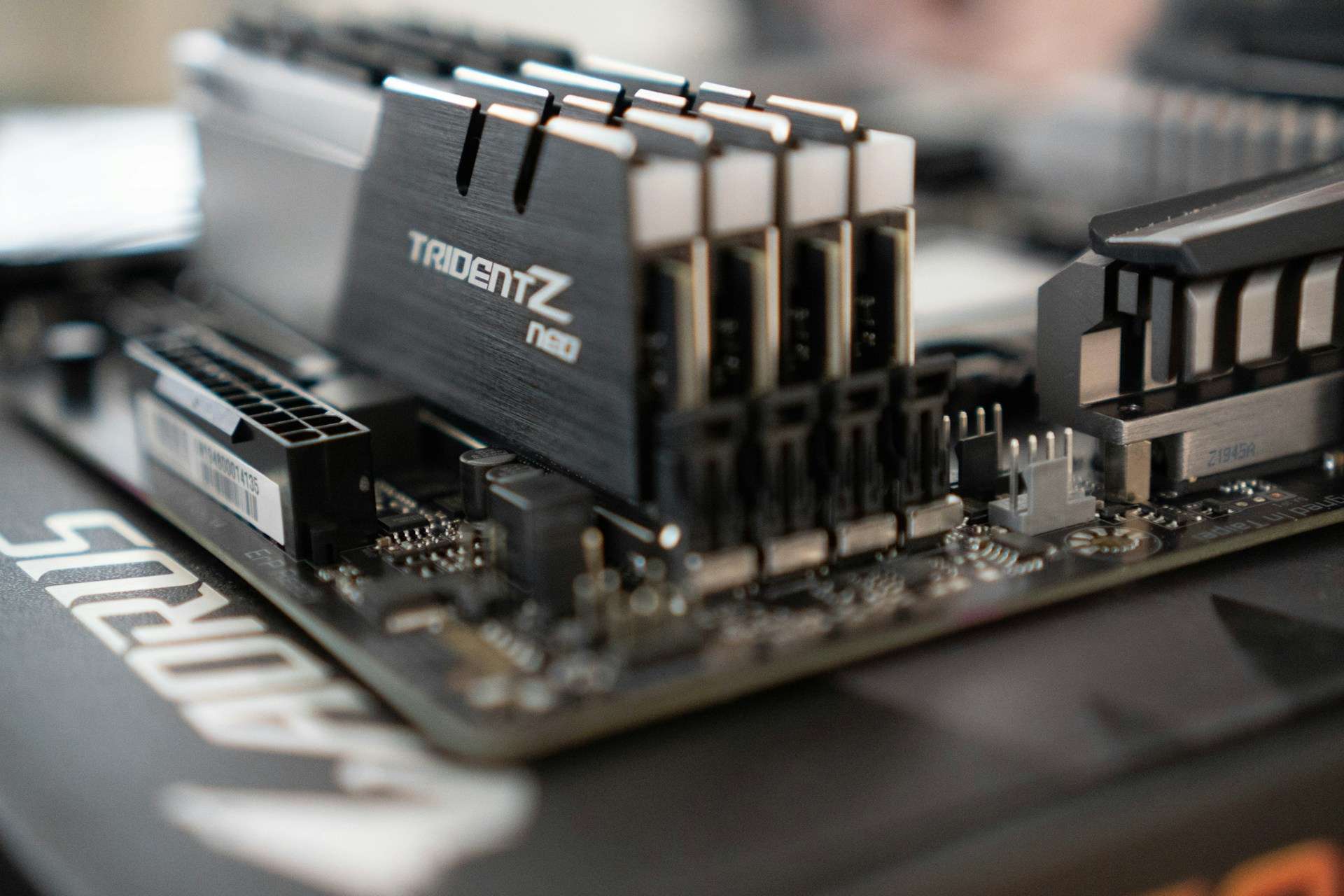
South Korea has decided to treat artificial intelligence as a top-priority industrial issue. Samsung Electronics and SK hynix, the two major Korean memory manufacturers, are preparing factory expansions, advanced packaging, and data center projects aimed at strengthening the country’s role in an increasingly strained supply chain driven by AI demand.
The figure varies depending on the scope considered. The core of the announcement places combined investments by Samsung and SK hynix at 800 trillion won, approximately $518 billion, to establish a new semiconductor hub in southwestern Korea, with two factories per company. An additional 81 trillion won are planned for a packaging cluster in Chungcheong, along with broader national investment plans in data centers, physical AI infrastructure, and robotics.
The immediate takeaway is clear: memory has become a strategic infrastructure for AI. We are no longer just talking about chips for PCs, smartphones, or traditional servers. The expansion of large models, accelerators, training clusters, and inference centers has increased pressure on DRAM, NAND, and especially HBM—the high-bandwidth memory that powers advanced GPUs and accelerators.
An industrial plan of unusual scale
The plan presented by the South Korean government and its leading tech companies is based on three main axes: semiconductors, physical AI infrastructure, and data centers. Samsung has chosen Gwangju as the location for its new chip cluster in the southwest, while SK hynix still needs to finalize the exact site and ensure infrastructure conditions. The strategy also aims to decentralize part of the investment, which is currently heavily concentrated around Seoul’s metropolitan area and the hubs of Pyeongtaek, Yongin, Icheon, and Cheongju.
In parallel, Samsung plans to invest 400 trillion won in new semiconductor factories in Gwangju and another 56 trillion in advanced HBM facilities in Cheonan and Onyang. The company has also announced domestic investments of 2,450 trillion won between 2026 and 2040, with 2,100 trillion allocated to semiconductor clusters including Pyeongtaek and Yongin.
SK hynix, for its part, envisions a new production base in the southwest valued at 400 trillion won, along with existing investments in Yongin, Icheon, and Cheongju. The company aims to complete its fourth Yongin cluster factory by 2033—twelve years ahead of its previous forecast for 2045—and has detailed a 100 trillion-won investment in Cheongju: 80 trillion for NAND fabs and 20 trillion for advanced packaging plants.
| Area | Announced Investment | European |
|---|---|---|
| New Southwest Hub | 800 trillion won | Four new fabs, two Samsung, two SK hynix |
| Packaging Cluster in Chungcheong | 81 trillion won | Enhancing advanced packaging and value chain |
| Samsung in Gwangju | 400 trillion won | New semiconductor fabs |
| Samsung HBM in Cheonan & Onyang | 56 trillion won | High-bandwidth memory capacity |
| SK hynix in Cheongju | 100 trillion won | NAND and advanced packaging |
| AI Data Centers | 550 trillion won in initial phase | 8.4 GW capacity with SK, GS, Naver |
The data center segment is also substantial. The South Korean government targets an initial phase of 550 trillion won to build 8.4 GW of AI data center capacity, involving investments from SK, GS Group, and Naver. It’s projected that the total volume could surpass 1,000 trillion won by 2035.
AI has transformed the value of memory
Memory has traditionally been one of the most cyclical markets in semiconductors. When supply exceeds demand, prices plummet; when capacity is tight, margins soar. AI has changed this dynamic, as some memory types are now critical components affecting system performance.
HBM is the clearest example. Training and running advanced models require moving vast amounts of data within the system, not just powerful accelerators. This bandwidth dependence makes Samsung and SK hynix vital suppliers to NVIDIA, AMD, major cloud providers, and any company building high-performance AI infrastructure.
South Korea’s strategy aims to double its domestic DRAM capacity within five years and accelerate projects initially slated for much longer timelines. The urgency makes sense given the rising demand for data centers but also presents risks: if AI investment slows down or supply grows too quickly, the industry could face overcapacity again. Reuters reported that Samsung and SK hynix stocks fell following the announcement amid concerns from some analysts about potential oversupply.
The expansion isn’t limited to memory. TrendForce warns that increased investment by Samsung and SK hynix may strain critical manufacturing equipment supplies, such as EUV lithography, etching, photomasks, CMP, and deposition tools. If such pressure intensifies, TSMC and Intel might also compete for the same advanced process tools, including sub-2 nanometer nodes.
This leads to two separate discussions. Korea aims to strengthen its dominance in memory and packaging—areas where Samsung and SK hynix are already industry leaders. This doesn’t mean Samsung Foundry will immediately displace TSMC in advanced logic manufacturing. The bulk of Korea’s plan focuses on memory, HBM, NAND, packaging, and infrastructure, not a sudden shift in logic manufacturing leadership.
Infrastructure: energy, water, and talent
Building semiconductor factories isn’t just about constructing buildings. Fabs require stable power supply, ultrapure water, gases, chemicals, logistics, nearby suppliers, specialized personnel, and tightly coordinated permitting processes. This is one of the sensitive points of Korea’s plan—because part of the new investment is moving into regions with less established chip industry infrastructure.
The government argues that the southwest has underutilized energy capacity and potential for renewables. However, industry leaders and experts have warned that creating a semiconductor cluster takes time. Chey Tae-won, SK Group’s president, recalled that establishing the Yongin cluster took nine years, and a chip factory needs land, energy, water, and large pools of talent.
Politically, the decision also carries significance. President Lee Jae Myung wants to distribute the benefits of AI growth beyond Seoul’s metropolitan area and revitalize less industrialized regions. While decentralization could ease bottlenecks in existing hubs, it also complicates execution.
A key question is whether AI demand will sustain such level of investment over a decade. Current signals indicate strong pressure on memory and data center capacity, but the semiconductor industry is accustomed to volatility. A plan needed today could become excessive if client spending adjusts, AI architectures change, or model efficiencies reduce the need for raw capacity.
Global impact: prices, equipment, and industrial sovereignty
For chip and data center customers, Korea’s expansion could positively influence the mid-term by increasing supply of DRAM, NAND, and HBM. More capacity should help alleviate some bottlenecks, although it won’t happen immediately—factories take years to build, equip, qualify, and reach stable performance.
For equipment, materials, and service providers, the plan presents a significant opportunity. Companies like ASML, Applied Materials, Lam Research, Tokyo Electron, and suppliers of photomasks, chemicals, substrates, and packaging solutions may see increased demand. However, this demand could also tighten lead times and elevate prices, especially for advanced tools with limited global suppliers.
For Taiwan, the U.S., Japan, and Europe, this announcement underscores that the semiconductor race is no longer just about targeted subsidies. South Korea aims not only to protect its memory industry but also to align it with AI, data centers, and robotics growth—a long-term industrial policy.
It also reflects a response to geographic concentration. The AI value chain depends on many sensitive points: GPUs, HBM memory, advanced packaging, energy, data centers, and software. Korea can’t control all these elements but can solidify its advantages where it already holds a strategic lead.
Samsung and SK hynix’s announcement doesn’t guarantee an automatic victory. Implementation will be slow, expensive, and susceptible to market cycles. Nonetheless, it marks a clear direction: AI has made memory a geopolitical asset. Producers of HBM, DRAM, and NAND at scale are not just selling components—they are participating in the infrastructure that will underpin next-generation digital services.
FAQs
How much will Samsung and SK hynix invest?
The core announced investment for the new southwest hub amounts to 800 trillion won, roughly $518 billion. There are also associated investments in packaging, HBM, NAND, data centers, and infrastructure.
Why is memory so important for AI?
AI systems need to move large volumes of data between accelerators and memory. HBM, DRAM, and NAND are essential for training and running advanced models in data centers.
Does this directly threaten TSMC?
Not immediately in advanced logic. Korea’s main focus is on memory, HBM, NAND, packaging, and infrastructure, though it may increase competition for manufacturing equipment also needed by TSMC and Intel.
When will the new factories be ready?
Timelines vary per project. SK hynix aims to bring its fourth Yongin fab online by 2033, while some investments in Cheongju target the late 2020s. The southwest fabs still depend on site selection, permits, and infrastructure development.
Will memory prices fall because of this expansion?
In the medium term, it could ease shortages if capacity comes online on time. However, the memory market is cyclical, and prices will depend on actual demand from AI, data centers, PCs, mobiles, and servers.
via: trendforce
