
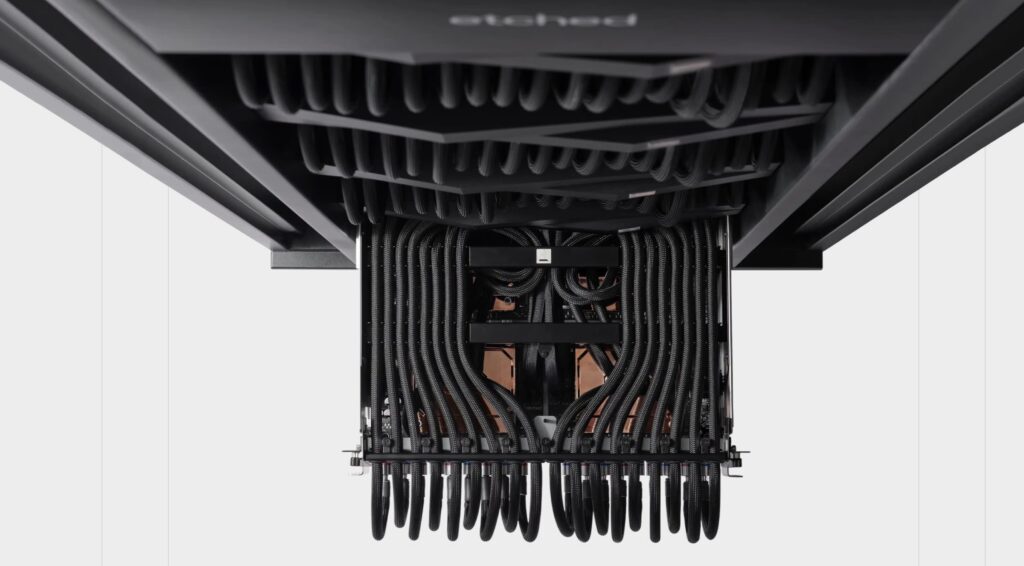
Etched has left stealth mode with one of the most aggressive go-to-market strategies in the AI hardware industry: $800 million raised, over $1 billion in customer contracts, and a functional chip manufactured with TSMC’s N4P process. The startup, based in San Jose, doesn’t want to just sell an accelerator. Its goal is to build complete inference clusters, designed from silicon to rack, including software, cooling, and manufacturing.
The company is arriving at a moment when AI is starting to shift the bottleneck. Training giant models remains expensive, but pressure is increasingly shifting toward inference: running these models millions of times a day with low latency, good cost per token, and manageable power consumption. Each agent, copilot, chatbot, corporate search engine, or language model-based application makes inference a continuous infrastructure challenge.
Etched states that its first silicon, the A0, has already returned from TSMC in N4P and that it is validating its first rack-scale product with customers to meet more than $1 billion in contracted demand. The company also claims that its first racks will start shipping this summer and that production has begun.
A startup aiming to sell clusters, not just chips
Etched’s announcement is noteworthy because it moves away from the typical “we have a faster ASIC” pitch. The company speaks of frontier inference clusters, a category where performance depends on many parts working together: chip, package, memory, board, interconnection, cooling, serving software, simulation, testing, and manufacturing capacity.
According to information released by the company itself, Etched has a team of over 400 engineers from firms like NVIDIA, Google TPUs, Broadcom, SK Hynix, and TSMC. It has raised $800 million across four undisclosed funding rounds, including a strategic investment from VentureTech Alliance, a vehicle linked to TSMC’s ecosystem.
The latest funding round was a $500 million Series, valuing Etched at $5 billion post-money, according to data from Data Center Dynamics. Among the investors and supporters are prominent financial and tech names like Jane Street, Hudson River Trading, Stripes, Radical Ventures, Primary VC, Peter Thiel, Geoffrey Hinton, and Andrej Karpathy.
| Announced Data | Details |
|---|---|
| Total Funding | $800 million |
| Latest Round | $500 million |
| Post-money Valuation | $5 billion |
| Customer Contracts | Over $1 billion |
| Manufacturing Process | TSMC N4P |
| Team | Over 400 engineers |
| Focus | Rack-scale inference clusters |
Etched also claims to have established a factory in Taiwan and built a 2 MW data center, testing facility, and prototyping lab at its California offices. The company hasn’t shared many details about these facilities, but the message is clear: it aims to control more parts of the transition from design to production.
Low Voltage Inference and Cluster-Scale Memory
The technical core of the announcement revolves around two ideas. The first is Low Voltage Inference (LVI). Etched argues that many AI chips can’t sustain their theoretical peak FLOPs because, as utilization increases, power consumption rises and thermal throttling occurs. Its architecture seeks to execute math blocks at less than half the usual voltage used by AI chips, aiming to increase compute density and maintain higher sustained performance.
The company claims it can run dispersed MoE (Mixture of Experts) models with trillions of parameters above 80% of peak FLOPs without thermal throttling. This is a bold claim, but it still requires independent validation and publicly comparable data. Etched has indicated it will share more performance details and roadmaps over the summer.
The second concept is Cluster Scale Memory (CSM). Etched proposes a low-latency shared memory across cluster domains, supported by a proprietary, ultra-low latency and high bandwidth interconnect. The company states its hybrid HBM/SRAM design aims to solve two problems simultaneously: memory capacity and latency between memories.
This directly addresses the challenges of modern inference. In large model workloads, performance depends not only on how many operations a chip can handle but also on how quickly data can be moved, how prefill and decode loads are attended to, how long contexts are, and how low costs are maintained when models are used interactively.
Why inference is becoming the major business opportunity
Etched argues that current infrastructure is not optimized for sustainable and cost-effective frontier model serving. Gavin Uberti, co-founder and CEO, explains: AI is rapidly integrating into all industries and applications, increasing the demand for accelerated inference infrastructure.
This makes sense. Training makes headlines because it requires enormous clusters and multi-billion-dollar budgets. But inference is where applications run every day. A model responding to users, agents, or internal systems incurs costs with each execution. High latency worsens the experience. Elevated power per token shrinks margins. If hardware doesn’t scale efficiently, the product can’t grow.
That’s why specialized solutions are emerging. Some aim for simpler, highly efficient chips tailored to specific model families. Others focus on more memory close to compute. Still others try to reduce reliance on general-purpose GPUs. Etched envisions a holistic system design—chip, rack, software, and manufacturing—co-designed for inference at scale.
The challenge is that competing with NVIDIA isn’t just about chips. It’s about CUDA, networking, HGX/DGX systems, libraries, cloud providers, integrators, support, and a vast developer community. Etched seems to understand this because it presents itself as an infrastructure company, not just a silicon manufacturer.
Manufacturing as a product
One of the most compelling messages comes from Rob Wachen, co-founder of Etched: “Manufacturing is the product.” This phrase captures the current market reality. In AI, a brilliant architecture is rarely useful if it can’t be manufactured, tested, deployed, and operated at scale.
That’s where many chip startups stumble. Achieving a successful tape-out is difficult enough. Producing yields, ensuring proper packaging, validating racks, closing supply chains, securing cloud customers, maintaining software, and meeting schedules becomes even more complex.
Etched claims to have worked with AI clients, cloud providers, and hyperscalers in co-design decisions, and it has tested racks in representative data center deployments, running petabytes of production traffic patterns in its simulator. These are notable claims, but the market will wait for measurable results, public benchmarks, and real deployments to assess the true advantage.
Etched’s entry adds pressure to a rapidly evolving market. The first wave of generative AI dominance was driven by GPU availability. The next phase likely depends on who can reduce the cost of serving large models without sacrificing latency or scalability.
With funding, contracts, a functional chip, and top-tier technical talent, Etched still needs to demonstrate real-world production, performance, and reliability. Nevertheless, its emergence confirms a key trend: inference is no longer a secondary phase of AI. It’s becoming a distinct infrastructure category, with chips, racks, and architectures designed specifically to support massive model usage.
Frequently Asked Questions
What has Etched announced?
Etched has emerged from stealth with $800 million raised, over $1 billion in customer contracts, and a functional chip manufactured at TSMC N4P.
What kind of product are they developing?
They are developing inference clusters for AI, not just chips. Their approach combines silicon, racks, software, memory, cooling, and interconnection.
What is Low Voltage Inference?
An architecture that aims to run mathematical blocks at lower voltages to sustain more performance without thermal throttling.
What is Cluster Scale Memory?
Etched’s approach to creating low-latency shared memory at the cluster scale, combining HBM and SRAM with a proprietary interconnect.
Can they compete with NVIDIA?
It’s still early. Etched has funding, talent, and contracts, but it must demonstrate performance, manufacturing, software, and large-scale deployments against a highly established NVIDIA ecosystem.
