
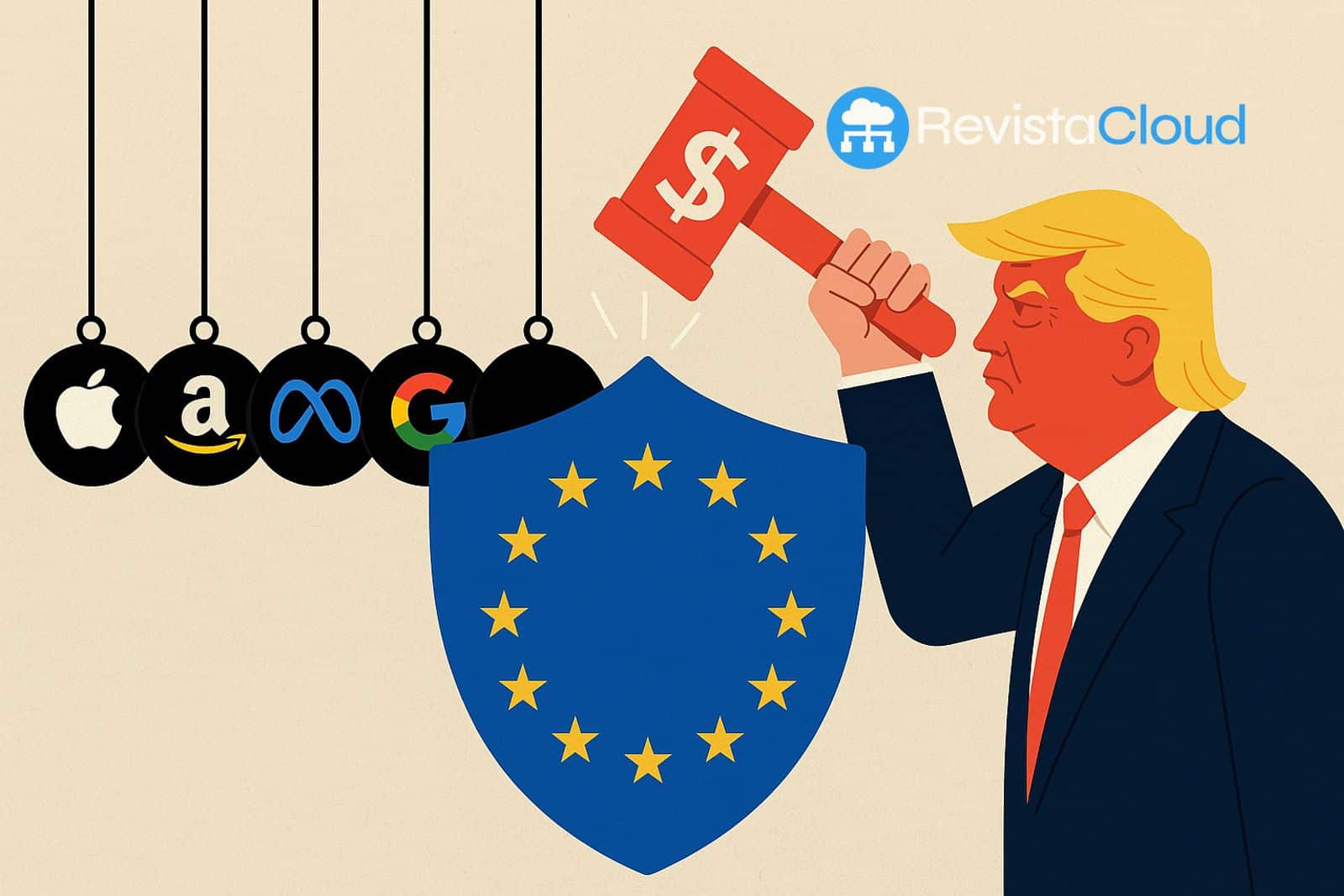
Donald Trump has once again turned European digital taxation into a trade war issue. The U.S. president has threatened to impose 100% tariffs on goods from any country that enforces or expands taxes on digital services aimed at major American tech giants like Google, Amazon, Meta, or Apple.
The warning comes at a particularly sensitive time for the relationship between Washington and Brussels. The European Union has just advanced in implementing its part of the trade agreement with the United States, an arrangement that caps tariffs at 15% for most European exports and eliminates or reduces tariffs on many U.S. industrial goods. Trump’s threat introduces a new, explosive exception: if a European country targets the digital business of Big Tech, retaliation could bypass that framework.
This clash is not new. Europe has long argued that large digital platforms should pay taxes where they generate revenue and monetize users, even if their fiscal headquarters are elsewhere. The U.S., on the other hand, views many of these taxes as discriminatory measures against its tech companies, which dominate much of the global online advertising, digital commerce, social media, mobile operating systems, and cloud services markets.
Digital tax returns to the center of the conflict
Digital taxes originated as a temporary solution to a real problem: traditional tax systems were designed for an economy where physical presence mattered much more. A company would sell, produce, have offices, warehouses, employees, or factories in a country and pay taxes based on that presence. Digital platforms have partially disrupted that model.
Today, a company can sell advertising to Spanish businesses, collect commissions from French retailers, exploit data from Italian users, or mediate transactions across Europe without a physical presence proportional to the revenue it generates in each market. This discrepancy has fueled the perception that traditional tax rules do not adequately capture the value created in the digital economy.
Spain has been implementing a Digital Services Tax (DST), known as the Google tax, since 2021. It levies a 3% tax on certain online advertising, digital intermediation, and data transmission revenues when companies exceed €750 million in global revenue and €3 million from digital services in Spain.
France was a pioneer in this area. Its digital tax also applies a 3% levy on certain digital revenues generated within the country by companies with more than €750 million in worldwide turnover and over €25 million in France. Recently, there has been discussion about increasing the rate to 6%, a move that Washington interprets as a direct escalation against U.S.-based tech firms.
| Country | Digital tax rate | Global threshold | Local threshold |
|---|---|---|---|
| Spain | 3% | €750M | €3M |
| France | 3% | €750M | €25M |
| United Kingdom | 2% | £500M | £25M |
| Italy | 3% | €750M | €5.5M |
| Austria | 5% | €750M | €25M |
The European argument is straightforward: it’s not about punishing American companies but about taxing economic activity generated within European territory. The American perspective is the opposite: although these taxes are broadly worded, in practice, they mainly impact U.S. companies.
Tariffs versus taxes: an pressure point now affecting more than just tech companies
Trump’s threat expands the scope of the conflict because it doesn’t just respond against the digital sector. If taken literally, it would affect all goods exported to the U.S. from countries that maintain or increase a digital tax. This means a fiscal dispute over Google, Meta, or Amazon could end up impacting car manufacturers, machinery, food, wine, chemicals, industrial goods, or luxury products.
This political leverage shifts the potential costs from Big Tech to the broader European exporting economy. The implicit message for countries like France, Spain, or Italy is clear: if you want to collect revenue from U.S.-based platforms, your industrial companies might have to pay the price at the U.S. border.
The European Commission has responded by defending the EU and its Member States’ sovereign right to regulate and tax economic activities within their territories. Brussels maintains that these taxes do not discriminate based on nationality and that they target large companies meeting certain turnover thresholds. It also stated it would respond to unjustified unilateral measures.
The tension arises as Europe seeks to stabilize its trade relationship with the U.S. The current agreement aims to prevent a tariff escalation and to give businesses predictability. However, digital taxes, tech regulations, environmental standards, and non-tariff barriers continue to be points of friction.
The digital euro adds another layer of sovereignty
While Trump’s threats are centered around digital taxes, the European context is broader. Meanwhile, the digital euro has cleared a key vote in the European Parliament and is progressing as a project to strengthen the eurozone’s payment autonomy. Although not designed as a tax or a tool against Big Tech, it fits into the ongoing conversation about Europe’s dependence on digital and financial infrastructures controlled outside the continent.
The European Central Bank envisions the digital euro as a secure, public electronic payment method, free for consumers, and usable across the euro area. Its goal isn’t to eliminate cash but to complement it with a digital alternative backed by the central bank. If the legal framework is approved in 2026, the ECB considers possible issuance around 2029, with pilot tests beforehand.
The geopolitical dimension is evident. Much of Europe’s digital payments rely on international networks like Visa and Mastercard, as well as wallets and payment platforms linked to major U.S. companies. The war in Ukraine, financial sanctions, and trade tensions have reinforced in Brussels and Frankfurt the idea that payments are also strategic infrastructure.
That’s why the European digital debate now encompasses more than just “taxing Google more.” It involves digital taxation, data, cloud computing, payments, artificial intelligence, competition, cybersecurity, and regulatory capacity. The U.S. perceives it as a package that could limit its companies, while Europe frames it as safeguarding its economic sovereignty.
A challenging negotiation for Spain and the EU
Spain is in a tricky position. It was among the first countries to approve a digital tax but also depends on stable trade relations with the U.S. and a predictable environment for its exporters. The Spanish tax was not aimed at a specific company but at a form of digital activity that escapes traditional taxation. In practice, it affects major U.S. firms, making it a political target.
The core issue isn’t whether Big Tech should pay taxes; almost all governments agree they should. It’s about where, how much, and under what rules. The ideal solution would have been a stable multilateral agreement within the OECD, but progress has been slow, and countries bearing the highest fiscal pressure have implemented national or European measures instead.
This patchwork creates uncertainty—technologies face inconsistent tax regimes across countries, European states risk retaliations, and exporting companies might become collateral damage in an ongoing dispute they didn’t cause.
The 100% tariff threat is likely also a negotiation tactic. Trump often uses extreme figures to pressure, generate headlines, and shift the discussion. While it doesn’t mean such tariffs will be applied exactly as threatened, it’s unwise to dismiss the possibility. The U.S.-Europe trade relationship has already shown how quickly things can deteriorate when taxes, technology, and industrial policy collide.
Europe faces a difficult dilemma. If it refrains from taxing digital services out of fear of Washington, it risks leaving a significant part of its digital economy externally dependent. If it maintains rates without coordinated strategies, it could expose its companies to retaliatory measures. The most effective approach probably involves acting collectively, avoiding scattered national solutions, and pushing for an international fiscal framework to reduce arbitrariness.
Technology is no longer just industry; it’s about taxation, commerce, monetary power, and sovereignty. Trump’s threat underscores this: whoever controls digital platforms can turn taxes into a state-level conflict.
Frequently Asked Questions
What has Donald Trump threatened to do?
He has threatened to impose 100% tariffs on goods from countries that apply digital service taxes targeting American companies.
What is a digital tax?
It’s a tax that levies on certain revenues generated by digital services such as online advertising, platform mediation, or data sales.
Does Spain have a digital tax?
Yes. Since 2021, Spain applies a 3% tax on certain digital services for large companies exceeding specific global and national revenue thresholds.
Why does the U.S. oppose it?
Because these taxes are seen as disproportionately affecting U.S. firms like Google, Amazon, Meta, or Apple, even if European rules don’t name them explicitly.
How does this relate to the digital euro?
They are related broader debates about European digital and financial sovereignty, including dependence on non-European payment networks like Visa and Mastercard.
