
The European Union wants Brazil to be more than just a supplier of minerals. Brussels has presented Brasília with a proposal for cooperation on rare earths and critical minerals that promises investment, local processing, technology transfer, and more industrial value within the country. The offer comes amid an international race to reduce dependence on China in a supply chain supporting electric vehicles, wind turbines, defense, advanced electronics, and data centers.
European Commissioner for International Partnerships, Jozef Síkela, argued during his visit to Brazil that the European proposal could be “more beneficial” than U.S. or Chinese alternatives because it is not limited to mineral purchases. This aligns with a message repeatedly emphasized by Luiz Inácio Lula da Silva’s government: Brazil does not want to repeat its historical role as an exporter of cheap raw materials to later buy back much more expensive industrial products.
The visit included a stop in Poços de Caldas, in the state of Minas Gerais, where Australian Viridis Mining and Minerals is developing a rare earth research and processing center. This project is among those selected to accelerate cooperation between the EU and Brazil, at a time when Europe is trying to build alternative supply chains for considered strategic minerals.
Brazil wants added value, not just extraction
Rare earths are not necessarily scarce in the Earth’s crust, but finding, extracting, separating, and refining them in a profitable and environmentally acceptable way is challenging. That’s where the key lies. Having reserves is not enough. The truly strategic part involves separation, refining, manufacturing permanent magnets, and integrating into higher-value industries.
Brazil possesses some of the world’s largest reserves of rare earths, although its current production remains small compared to major market players. The Brazilian opportunity lies in transitioning from geological promise to an industrial chain capable of producing processed materials, attracting technology, and creating qualified employment.
| Resource | Why it matters |
|---|---|
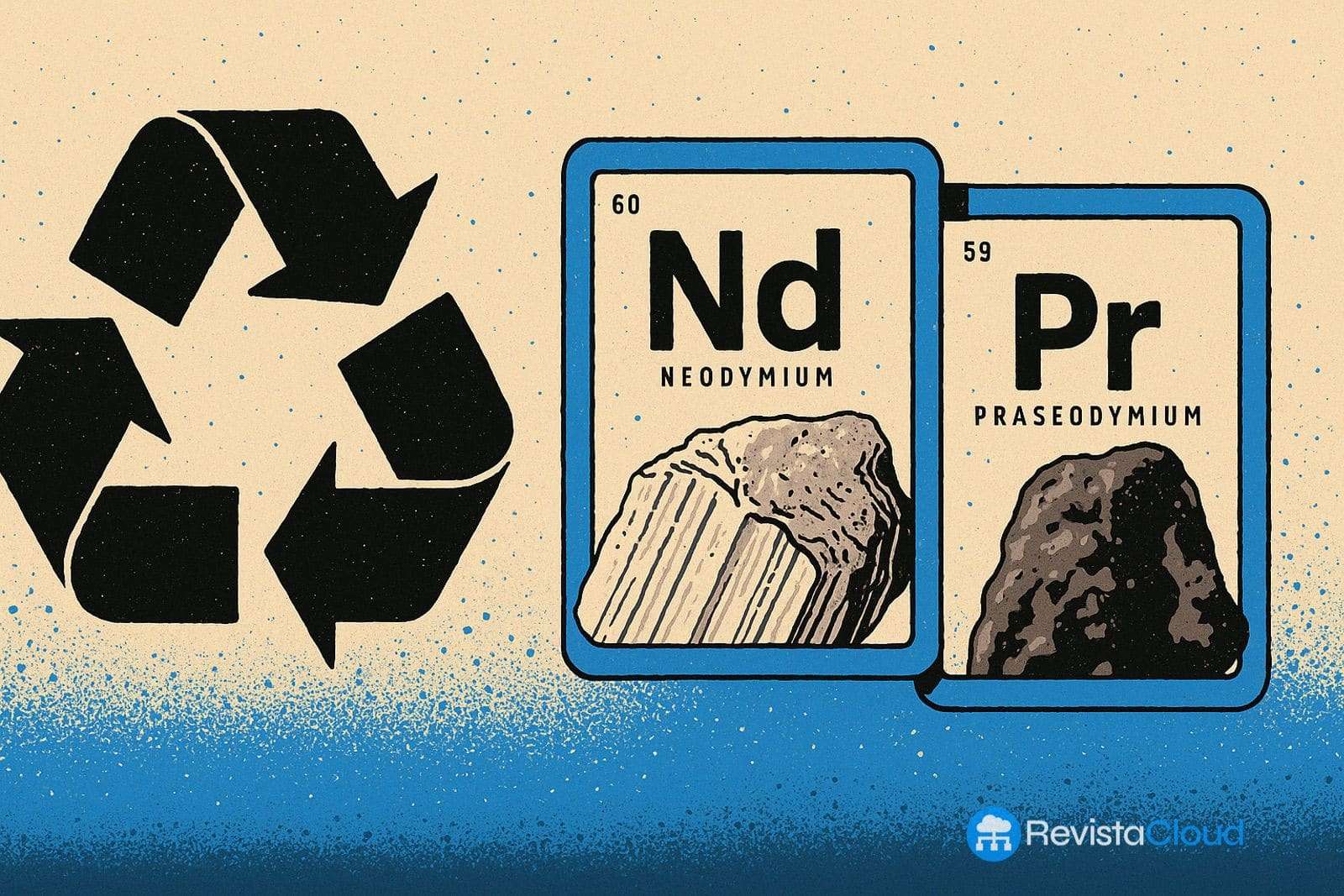
| Neodymium and Praseodymium | Magnets for electric motors, wind turbines, and electronics |
| Terbium and Dysprosium | High-performance magnets and defense applications |
| Lithium | Batteries for mobility and energy storage |
| Nickel | Batteries, steel, and industrial alloys |
| Niobium | Advanced steels, aerospace, and heavy industry |
The European discourse aligns with Brazil’s approach. Síkela advocated that Brazil should shift away from low-margin businesses and focus on creating value domestically. For Brussels, this enables it to present itself as an industrial partner. For Brazil, it opens a pathway to negotiate without exclusively choosing between Washington and Beijing.
Europe competes with the United States and China
Europe’s proposal comes late in a race dominated by China for decades. According to the International Energy Agency, China controls about 91% of global separation and refining of rare earths, and nearly 94% of permanent magnet production. This dominance was not built overnight; it required investment, industrial learning, processing capacity, and sustained policy throughout the supply chain.
The U.S. has also taken steps. Serra Verde, Brazil’s only operational rare earth mine with significant commercial relevance, received a $565 million financing package from the U.S. International Development Finance Corporation. The deal includes an option for Washington to acquire a minority stake, signaling that supply security is now part of U.S. industrial and foreign policy.
| Actor | Goals in Brazil |
| European Union | Diversify supply and establish local processing partnerships |
| United States | Secure access to rare earths outside China |
| China | Maintain influence over a chain it has dominated for years |
| Brazil | Attract investment without exporting only unprocessed minerals |
| Mining companies | Fund projects and secure long-term purchase agreements |
Brazil seeks to leverage that competition. Lula emphasizes that the country is open to investors, including China, as long as separation and processing occur within Brazilian territory. This summarizes a new stance from many resource-rich countries: access to minerals is no longer unconditional but involves discussions about industry, employment, and sovereignty.
Viridis and Solvay: a test for Europe’s strategy
Viridis’s project in Minas Gerais exemplifies Europe’s bet. The company plans to invest around $360 million in a commercial plant capable of producing 15,000 tons of mixed rare earth carbonate annually from 2028. Its pilot unit, inaugurated in May, can process 100 kilos of mineral per hour.
Belgian chemical group Solvay signed this month a letter of intent with Viridis to secure rare earth materials supply. The agreement could expand into technological cooperation and processing, aimed at Solvay’s plant in La Rochelle, France — a key facility for Europe’s ambitions to rebuild separation and refining capabilities.
| Project | Key Data |
| Viridis Colossus | Rare earth project in Minas Gerais |
| Planned industrial scale | 15,000 tons/year of mixed carbonate |
| Estimated investment | $360 million |
| Start target | 2028 |
| European partner | Solvay |
| Type of agreement | Memorandum of understanding for supply (non-binding) |
Though still pending final agreements, financing, and industrial scaling, it demonstrates how the model that Europe aims to promote works: a Brazilian mining company, a European chemical firm with processing capacity, and a political framework promising investment and technological cooperation.
The hard part begins after the announcement
The comparison with China calls for caution. Brazil may have resources and interested partners, but establishing a complete rare earths supply chain takes more than a diplomatic visit. Stable mining, permits, financing, separation technology, industrial clients, logistics, competitive energy, environmental standards, skilled personnel, and a guaranteed demand for years are necessary.
Rafael Moreno, CEO of Viridis, summarized it simply: China took two decades to develop its value chain, not two months. Brazil can accelerate the process if it leverages interest from Europe and the U.S., but it cannot skip all the stages.
| Challenge for Brazil | Why it matters |
| Separation and refining | Market-dominated areas where China has an advantage |
| Financing | Projects require hundreds of millions before producing |
| Permits and environment | Critical mining will face strict scrutiny |
| Long-term clients | Without contracts, projects cannot be financed |
| Technology | Processing rare earths demands specialized knowledge |
| Industrial scale | The pilot plant does not equate to competitive global production |
There is also a risk of inverse dependence. If Brazil signs agreements too focused on a single region or bloc, it could lose leverage in negotiations. That’s why Lula’s strategy seeks to keep multiple doors open. Competition between the EU, U.S., and China can benefit Brazil if it translates into better terms, but it may also turn each mining project into another piece of geopolitical rivalry.
Why Europe needs this agreement
The European Union approaches Brazil out of necessity. Energy transition, electric vehicle adoption, defense industry, and digitalization are increasing demand for critical materials. Europe has industrial capacity, chemical companies, and advanced manufacturers but relies heavily on external supply chains for extraction, refining, and intermediate components.
The European Critical Raw Materials Act and the Global Gateway strategy aim to address this vulnerability. The EU wants secure supplies, diversified partners, and to prevent entire industries from being paralyzed by trade crises, export restrictions, or diplomatic tensions. The challenge is that industrial timelines are longer than political ones. Signing memoranda is quick; building refineries, mines, and magnet factories takes years.
Brazil offers an attractive combination: resources, relatively clean energy, market size, mining tradition, and political will to advance up the value chain. Additionally, Latin America can provide Europe with a less dependent relationship compared to China and one less influenced by U.S. national security concerns.
The new diplomacy of minerals
The contest over Brazilian rare earths exemplifies how globalization is changing. For decades, many raw materials traveled from producing countries to distant industrial centers where most of the value was captured. Now resource-rich countries aim to process more locally, negotiate better, and avoid ending up with only low-margin parts.
Europe is trying to adapt its approach to this new landscape. Securing supply is no longer enough; promises must include employment, technology transfer, local investment, environmental standards, and industrial participation. Brazil must turn these promises into concrete projects rather than just further announcements without sufficient production capacity.
The race for rare earths will not be decided solely by who has the most reserves. It will depend on who can separate, refine, finance, secure long-term contracts, and build political trust. China has a significant advantage. The U.S. is willing to invest public funds. Europe wants to offer a more cooperative alternative. Brazil aims to leverage this competition to shift from merely selling land to selling technology, chemicals, and added value.
If successful, Brazil could become a central piece in the Western critical minerals supply chain. If not, it will remain sitting on valuable reserves while others capture the most profitable parts of the business.
Frequently Asked Questions
Why does the EU want a rare earths agreement with Brazil?
Because it needs to diversify its supply of critical minerals and reduce dependence on China for separation, refining, and permanent magnets.
What does Europe offer Brazil?
The EU promises investment, technology transfer, support for local processing, and purchase agreements that allow Brazil to capture more industrial value.
What role does Viridis Mining and Minerals play?
Viridis is developing a rare earth project in Minas Gerais with a planned commercial plant for 2028, and has signed a letter of intent with Solvay for material supply.
Can Brazil compete with China in rare earths?
It can gain influence, but building a full supply chain takes years. China’s dominance in separation, refining, and magnets was built through decades of investment and industrial scale.
