
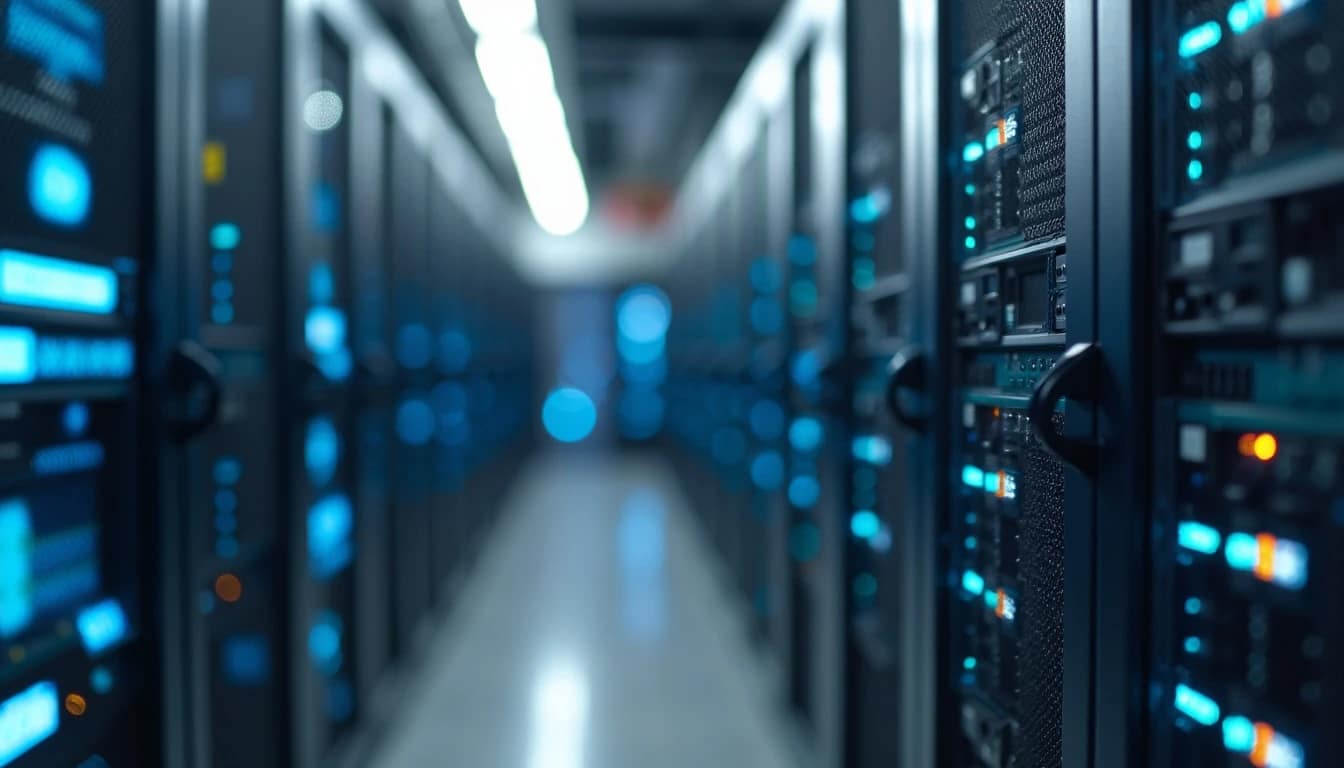
The U.S. data center market has entered a new phase. For years, growth was driven by cloud computing, e-commerce, video, financial services, and corporate digitization. Now, artificial intelligence has elevated the scale of the challenge. It’s no longer just about building more server rooms, but about finding land, energy, electrical grid access, cooling, fiber optics, and sufficient capital to support a new generation of campuses operating hundreds of megawatts.
The United States remains the industry’s main hub. Leading hyperscalers like Amazon Web Services, Microsoft, and Google operate there, alongside major colocation and digital infrastructure giants such as Equinix, Digital Realty, CyrusOne, QTS, DataBank, Flexential, and Iron Mountain. Each holds a unique position in the supply chain, but all are racing to provide capacity for businesses, governments, cloud platforms, and emerging AI models.
Growth is uneven across regions. Areas with good connectivity, available electricity, streamlined permitting, and access to large clients attract more investment. Northern Virginia continues to be a global benchmark, but the map is expanding to other states as energy availability becomes as crucial as latency or proximity to users.
Hyperscalers and colocation: two paths to infrastructure dominance
The U.S. market features two main types of players. On one side are hyperscalers, which build and operate enormous infrastructure for their own cloud services and digital offerings, including AWS, Microsoft, and Google. Their scale follows an internal logic: they need data centers to run cloud, AI, storage, search, productivity tools, advertising, video, enterprise services, and proprietary models.
On the other side are colocation providers and data center REITs, offering space, power, connectivity, and services to multiple clients. Recognizable global brands include Equinix and Digital Realty. Others like CyrusOne, QTS, DataBank, Flexential, and Iron Mountain focus on a range from large campuses for hyperscalers to regional facilities, interconnection hubs, managed services, or secure data storage.
| Company | Main Profile | Role in the U.S. Market |
|---|---|---|
| Amazon Web Services | Hyperscaler cloud | Massive infrastructure for AWS, AI, and digital services |
| Microsoft | Hyperscaler cloud | Azure, enterprise AI, and corporate services |
| Hyperscaler cloud | Google Cloud, global services, and AI infrastructure | |
| Equinix | Interconnection and colocation | Connectivity hubs and access to cloud ecosystems |
| Digital Realty | Colocation and global infrastructure | Large campuses and platforms for enterprise and cloud clients |
| CyrusOne | Hyperscale data centers | High-capacity campuses for major clients |
| QTS | Critical infrastructure and data centers | Strong presence in large-scale projects |
| DataBank | Colocation and edge | Regional facilities, connectivity, and managed services |
| Flexential | Connected colocation and cloud | Focus on enterprise, national network, and hybrid solutions |
| Iron Mountain | Data centers and information management | Secure infrastructure, storage, and critical services |
The distinction between these models matters. A hyperscaler can build facilities for itself and reserve capacity long-term. A colocation provider must balance demand from multiple clients, power contracts, occupancy rates, financing, and expansion plans. Still, the line is blurring: hyperscalers often lease capacity to third parties, and large operators design nearly custom campuses for cloud or AI clients.
Ultimately, all compete for the same physical resources: land with electrical access, substations, transformers, water or alternative cooling systems, power equipment, permits, fiber, and increasingly, energy contracts capable of sustaining high loads over years.
AI shifts the unit of measurement: from racks to gigawatts
Traditional data centers were measured in square meters, racks, availability, and connectivity. In the AI era, the focus is shifting toward megawatts and gigawatts. Training and deploying advanced models require thousands of GPUs or accelerators, vast internal networks, liquid cooling, and electrical supply far exceeding that of previous generations.
This shift influences site selection. Previously, proximity to major metro areas and interconnection points was critical. It’s still important, but the initial question is now: where is electric power available, and how fast can it be connected?
The U.S. grid doesn’t always meet the pace demanded by AI. Some connection requests are moving at scales that a few years ago seemed exceptional. This creates increasing tension among data center developers, utilities, regulators, local communities, and large industrial consumers. Everyone agrees digital demand will keep growing, but debates now center around who pays for grid upgrades, how to protect electric consumers, and what types of generation will power this new load.
| Critical Factor | Why it Matters More in 2026 |
| Firm Power | AI needs continuous, predictable energy |
| Connection Time | Interconnection queues may delay projects |
| Cooling | AI racks increase thermal density and consumption |
| Fiber and Latency | Interconnection remains vital for cloud and data transfer |
| Permitting | States and municipalities compete and tighten conditions |
| Financing | AI campuses require billions in investment |
| Sustainability | Clients and regulators demand lower environmental footprints |
This pressure extends beyond data centers. It impacts manufacturers of transformers, generators, cooling systems, cables, electrical equipment, batteries, generators, substations, and engineering firms. AI is driving an entire industrial supply chain.
A huge market, but one that’s more complex to build
Demand exists. Companies want to deploy generative AI, advanced analytics, agents, automation, video, simulation, cybersecurity, and cloud services. Providers want to grow capacity. Investors see assets with long-term contracts and top-tier tenants. But building data centers in the U.S. is no longer as straightforward as adding buildings to an existing campus.
Constraints may include energy availability, regulations, or local acceptance. Some communities see data centers as sources of indirect investment and employment, while others perceive them as heavy electricity and water consumers that have limited direct employment and strain the grid. The industry must better articulate its value, share infrastructure costs, and demonstrate flexible, efficient operations.
Energy flexibility will be a major topic in the coming years. Not all AI workloads are equally urgent. Some loads can be shifted over time or between regions. If data centers learn to reduce consumption during peak demand, leverage cheaper energy, or move loads to less stressed networks, they could transform from being rigid grid loads into more manageable, flexible consumers.
Sustainability is also becoming less superficial. It’s no longer enough to buy renewable energy certificates. Clients and regulators increasingly scrutinize the timing match between consumption and generation, the actual source of electricity, water usage, heat reuse, and cooling efficiency. AI is prompting the industry to become more transparent.
U.S. maintains an advantage, but the path forward isn’t guaranteed
The U.S. advantage is clear: it has the hyperscalers, capital, tech ecosystem, major clients, the deepest cloud market, and a network of specialized operators that’s hard to replicate. It also benefits from highly mature regions in connectivity and interconnection.
However, this edge could diminish if energy becomes the main bottleneck. Europe, the Middle East, Asia, and Latin America are trying to attract projects through land availability, energy resources, fiscal incentives, or regional access. No market will replace the U.S. easily, but some AI projects could move to regions with faster or cheaper electrical connections.
Therefore, the competition will be not only technological but also geopolitical. Success will favor states that can combine energy, permitting, fiber, talent, legal certainty, and social acceptance. Operators who design denser, more efficient, and flexible data centers will also gain an edge.
The list of major U.S. companies is more than a corporate ranking. It’s a blueprint of the infrastructure supporting the digital economy. AWS, Microsoft, and Google lead in cloud and AI demand. Equinix and Digital Realty provide interconnection and global scale. CyrusOne, QTS, DataBank, Flexential, and Iron Mountain cover colocation, services, edge, security, and continuity.
A data center is no longer just a server-filled building; it’s a piece of industrial, energy, and technological policy. AI has made visible what was once hidden behind the screen: the digital economy relies on physical infrastructure that needs real electricity, real land, and real networks.
The U.S. continues to lead. The question is whether it can build quickly enough without disrupting its own electrical grid balance.
Frequently Asked Questions
Which companies lead the U.S. data center market?
Key players include AWS, Microsoft, Google, Equinix, Digital Realty, CyrusOne, QTS, DataBank, Flexential, and Iron Mountain.
Why is the U.S. data center market growing so rapidly?
Driven by cloud expansion, AI, data storage, enterprise digitization, video, cybersecurity, and real-time processing needs.
What is the biggest challenge in building new data centers?
Energy availability has become a primary constraint. It’s not just about land; available power, grid connection, substations, permits, and cooling are essential.
What is the difference between a hyperscaler and a colocation operator?
A hyperscaler like AWS, Microsoft, or Google manages infrastructure for its own cloud and digital services. A colocation provider like Equinix or Digital Realty offers space, power, and connectivity to multiple tenants.
Is AI changing data center design?
Yes. AI-focused clusters require denser racks, higher power densities, liquid cooling, advanced internal networks, and new electrical architectures.
