
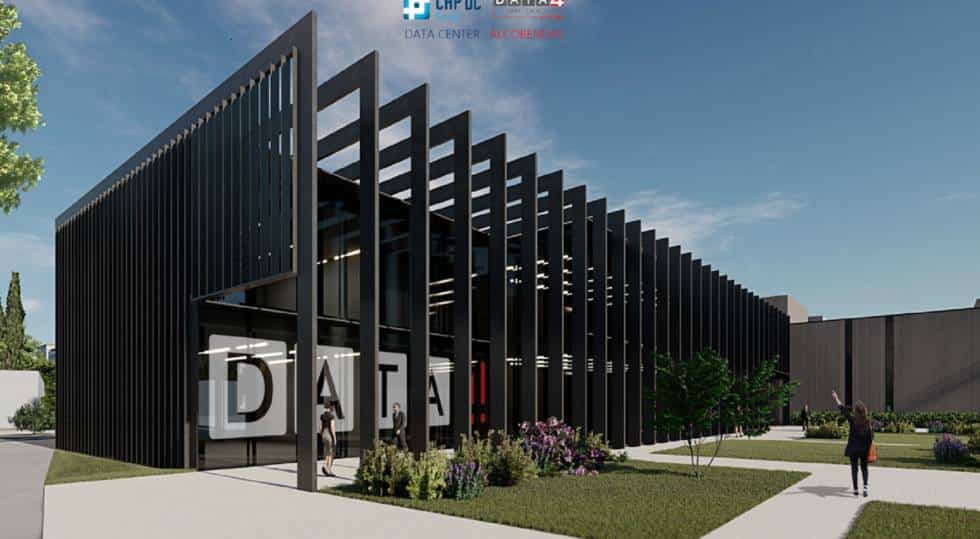
France has just added another key piece to the European race for AI infrastructure. Data4 has announced a €5 billion investment to develop a data center campus in Escaudain, Hauts-de-France, on a former industrial site linked to steel manufacturing. The project aims to reach up to 700 MW of capacity and, if it proceeds as planned, will be the largest campus developed by the company in France.
The figure is impressive, but the truly interesting aspect lies in the context. France is trying to turn three national assets into a competitive advantage: available industrial land, a powerful electricity grid, and a low-carbon energy mix thanks to nuclear power. In a Europe that aims to talk about digital sovereignty, native AI, and reindustrialization, the country is playing a card that others cannot wield with the same strength: stable, abundant, and relatively decarbonized electricity.
Data4’s campus will be located in the Parc des Soufflantes in Escaudain, near Valenciennes. According to the company, it will cover 33 hectares and can reach 700 MW of capacity. The project seeks to transform a former industrial zone into digital infrastructure for cloud and AI, with support from local, regional, and national authorities.
From Steel to AI Computing
The choice of location is no coincidence. Hauts-de-France has a long industrial tradition and a strategic geographic position between Paris, London, Amsterdam, and Frankfurt—four major European markets for connectivity and data. Northern France now aims to position itself as a sort of digital infrastructure corridor for AI, leveraging available land, industrial talent, and access to the electrical grid.
Data4 has followed a similar logic in other projects. The company recalls transforming old Alcatel and Nokia sites near Paris into a 500 MW data center hub. Escaudain would be a step further: a larger campus focused on cloud and AI loads, designed to meet the continuously growing demand.
The project aligns with the French strategy of identifying “ready” or particularly suitable locations for data centers. The French government has indicated 35 zones capable of hosting such projects, many near high-voltage connections and with procedures that could be expedited. In some cases, grid connection requirements could be up to 1 GW.
| Project | Location | Investment | Expected Capacity | Strategic Insight |
|---|---|---|---|---|
| Data4 Escaudain | Hauts-de-France | €5 billion | Up to 700 MW | Industrial reuse and AI campus |
| SoftBank Phase One | Hauts-de-France | €45 billion | 3.1 GW by 2031 | Major AI infrastructure bet |
| SoftBank Total Plan | France | Up to €75 billion | 5 GW | Positioning France as a European hub |
| French Strategy | 35 identified zones | N/A | Some sites up to 1 GW | Land, grid, and streamlined procedures |
Northern France is starting to see large-scale announcements. In May 2026, SoftBank announced a plan for up to €75 billion to develop 5 GW of AI data center capacity in France, with an initial phase of €45 billion and 3.1 GW in Hauts-de-France. Not all of these announcements always materialize on schedule, but the pattern is clear: France wants to attract AI computing capacity before other European countries claim that space.
The French Nuclear Card
France’s advantage isn’t just on the surface. It’s in the electricity. According to RTE, continental France’s electricity generation reached 547.5 TWh in 2025, with 95.2% being low-carbon—mainly nuclear and renewables. Nuclear production hit 373 TWh that year, recovering from the availability crisis that affected the French fleet in 2022.
For an AI data center, this combination is very significant. Artificial intelligence requires enormous amounts of electricity, but not just any electricity. It needs constant power, long-term contracts, grid stability, a low carbon footprint, and capacity to scale without relying solely on intermittent generation. Renewables are essential, but large AI campuses also seek reliable, firm energy.
Here, French nuclear power becomes an industrial asset—not because it solves all problems, but because it provides a foundation that other European markets lack in intensity. In countries with more strained grids, higher dependency on gas, or greater price volatility, attracting large AI loads can be more challenging.
France recognizes this and is promoting it as part of its broader proposal. Official materials about AI highlight low-carbon electricity, high-voltage grids, suitable sites, and the potential to accelerate procedures. Incentives are also noted for large electricity consumers under certain environmental conditions.
The question remains whether France will leverage this advantage for more than just hosting third-party machines. A data center can attract investment, jobs, electric activity, and construction. But true European digital sovereignty requires more: control over infrastructure, the companies that use that capacity, the AI models trained, the data processed, the jurisdiction operations fall under, and how much of the value chain stays within Europe.
Infrastructure alone isn’t enough without European industry
Europe risks becoming merely the electricity ground for others’ AI. If campuses fill with GPUs designed abroad, cloud services dominated by foreign platforms, and closed models trained with external capital, industrial gains will be partial. Investment and jobs may grow, but technological autonomy won’t.
France has a broader opportunity. It can use its energy advantage not only to attract data centers but also to push for more local value creation—integrating electricity infrastructure, manufacturing modules, cooling systems, software, networks, cybersecurity, operations, technical training, and European cloud services. The SoftBank partnership with Schneider Electric in Dunkirk exemplifies this approach: deploying capacity while also manufacturing and integrating energy infrastructure and modular systems for data centers.
Data4 also presents Escaudain as a site of industrial regeneration. The local community speaks of heat recovery, water efficiency, biodiversity reserves, tree planting, landscape integration, and job creation. While these are important, they need to be validated with concrete data as the project advances. Large AI campuses are energy and material intensive, requiring electrical and cooling equipment connections. Sustainability isn’t just a press release; it’s measured in consumption, PUE, water use, heat reuse, local hiring, and how well they coexist with the grid.
The fundamental question is whether France can effectively use these cards. It has nuclear power, a grid, industrial land, and a strong political narrative. But it also faces challenges: permitting, social acceptance, equipment availability, international competition, the need to strengthen infrastructure, and aging nuclear plants. The energy advantage exists but isn’t unlimited.
Escaudain symbolizes the current European moment: where steel once thrived, now AI computing is envisioned. Where industry depended on coal, it now depends on low-carbon electricity, fiber optics, GPUs, and cooling systems. AI doesn’t exist in an abstract cloud; it lives in tangible territories with substations, transformers, power contracts, and political decisions.
If France manages to turn these projects into pillars of European industry, technical training, local suppliers, and its own cloud capacity, it could become one of Europe’s AI hubs. If it only offers electricity and land for others’ machines, it may attract investment but not sovereignty.
Nuclear energy provides France with a winning hand. The real game is deciding whom it plays that card for.
Frequently Asked Questions
What did Data4 announce in France?
Data4 confirmed a €5 billion investment to develop a data center campus in Escaudain, Hauts-de-France, with a planned capacity of up to 700 MW.
Why is Hauts-de-France important for AI?
The region offers available industrial land, electric connectivity, a tradition of industry, and a strategic position among major European data hubs like Paris, London, Amsterdam, and Frankfurt.
What role does French nuclear energy play?
Nuclear provides reliable, low-carbon electricity—crucial for AI data centers needing steady power, stable contracts, and minimized carbon footprint.
Does this mean France will be a European leader in AI?
Not automatically. Having data centers helps, but leadership also depends on models, data, cloud infrastructure, talent, chips, software, cybersecurity, and European companies capable of utilizing that infrastructure.
When will the Data4 campus be operational?
Data4 has indicated that studies and preliminary work will be carried out over the next year. Details on initial capacity and phased timelines have not been publicly disclosed.
