
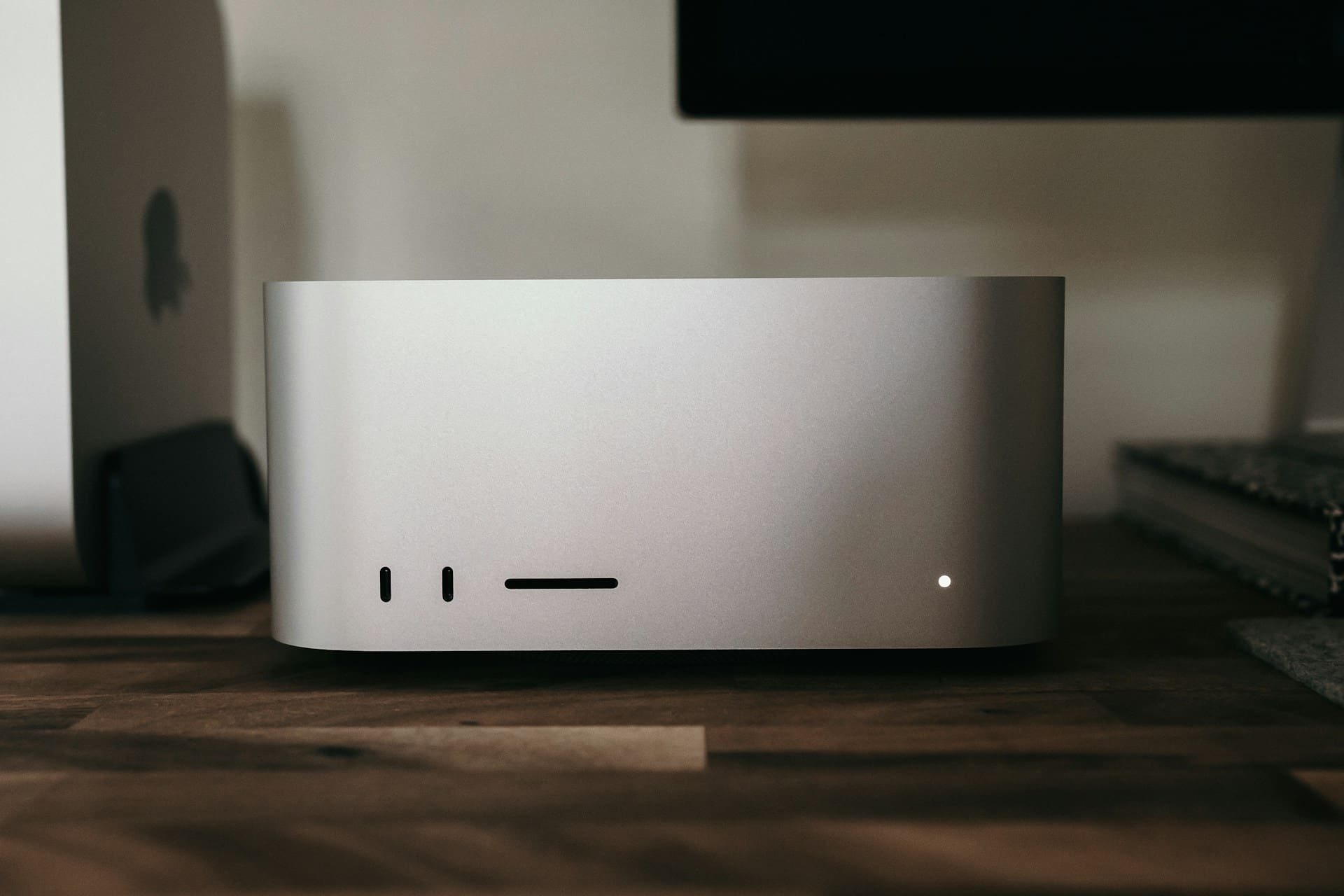
Apple is preparing a new Mac Studio with the M5 Ultra chip that could arrive in 2026. According to information gathered by MacRumors from Bloomberg, it may have been tested with up to 768 GB of unified memory. This figure is remarkable even for an Apple professional station, but it comes at a particularly challenging time: the industry is facing a severe shortage of memory and storage due to the demand from AI data centers.
This contrast clearly defines Apple’s current situation. On one hand, the company needs to demonstrate that its professional Macs still have potential in local artificial intelligence, video production, 3D, development, and demanding creative workflows. On the other hand, it recently raised prices across several product lines precisely because RAM and storage have become more expensive. If launched with that maximum configuration, the Mac Studio M5 Ultra would be a powerful, highly specialized, and likely expensive machine.
The Mac Studio refresh was originally scheduled earlier but appears to have been delayed due to memory supply issues and rising component costs. Bloomberg previously pointed to a window around October 2026, though the schedule has not been officially confirmed. Apple has not officially announced the M5 Ultra or the final configurations, so these details should be treated as supply chain information rather than definitive specifications.
768 GB of unified memory: Why does it matter?
In a Mac, unified memory does not operate like traditional RAM separate from dedicated GPU VRAM. CPU, GPU, and other chip components share the same memory space. This setup reduces data movement between components and makes it easier to work with large projects, AI models, high-resolution videos, complex scenes, or large datasets.
With 768 GB, the Mac Studio would enter a different category compared to a conventional creative desktop. This capacity would be valuable for workloads where the limit isn’t just processing power, but also the ability to keep models, extensive contexts, large files, or multiple environments in memory simultaneously.
| Possible feature | Technical insight |
|---|---|
| M5 Ultra | Latest chip in the M5 family before advancing to new generations |
| Up to 36 CPU cores | Moderate improvement over M3 Ultra, according to leaks |
| Up to 80 GPU cores | Similar to the maximum of the current M3 Ultra |
| Up to 768 GB of unified memory | Major leap for local AI and professional workflows |
| Mac Studio | Compact form factor compared to Mac Pro |
| Possible launch | 2026, no official date confirmed |
The key point isn’t just that Apple might test 768 GB. It’s about which markets they intend to target with such a configuration. By 2026, local AI won’t be just a laboratory curiosity anymore. Companies, developers, and creators are testing with open models, internal assistants, retrieval-augmented generation (RAG), multimedia generation, and agents handling sensitive data. Having substantial local memory allows experimentation without always relying on external APIs or cloud instances.
However, a clear limit remains: more memory doesn’t turn the Mac Studio into an NVIDIA server. The CUDA ecosystem still dominates many professional AI workloads, especially training, optimization, and large-scale deployment. Apple can compete very well in local inference, prototyping, development, video, and integrated creative workflows, but it cannot simply replace a data center GPU cluster.
Price might be the real issue
The recent price increase for the Mac Studio offers a hint of what’s to come. According to U.S. media reports, the Mac Studio M3 Ultra with 96 GB went from $3,999 to $5,299 after the price adjustment. If a configuration with 96 GB already experienced a $1,300 increase, a version with 768 GB could easily exceed $10,000, depending on storage options and other configurations.
Apple already sells high-end professional configurations, but this time the increase wouldn’t be justified solely by more performance or capacity. It would also reflect external pressures: memory chips have become scarce as suppliers prioritize products for AI servers, HBM, enterprise SSDs, and high-margin contracts.
| Configuration | Status |
| Mac Studio M3 Ultra with 96 GB | Available model, with significant price hike |
| Mac Studio M3 Ultra with 512 GB | Sometimes phased out, according to specialized media |
| Mac Studio M5 Ultra with 768 GB | Internally tested but not officially confirmed for sale |
| Entry-level Mac models | Also impacted by the increased memory and storage costs |
Apple’s question is how much actual market demand exists for a Mac Studio over $10,000 focused on memory. For video studios, AI labs, companies with sensitive data, model developers, and research teams, it might make sense. But for independent creators, small agencies, or power users, the jump could be too steep.
AI has shifted the memory market
The potential arrival of a Mac Studio with 768 GB cannot be understood without considering the memory crisis. The demand from AI has redirected capacity at manufacturers like Micron, Samsung, and SK hynix toward HBM and AI server memory. Data centers pay premium prices, sign large contracts, and ensure supply months or years in advance. Consumer electronics find themselves less favored in this scenario.
This affects Apple directly. The company controls its chips, operating system, industrial design, and much of its vertical integration. But it doesn’t manufacture all the memory it needs. If the global chain prioritizes data center AI, even Apple must choose whether to absorb costs, delay products, limit configurations, or raise prices.
| Market pressures | Impact on Apple |
| Demand for HBM for AI accelerators | Less capacity available for consumer memory |
| Rising DRAM and NAND prices | Mac, iPad, and other products become more expensive |
| Large data center contracts | Suppliers prioritize high-margin clients |
| Scarcity of high-end configurations | Apple limits or delays some professional models |
| Higher cost per GB | Extreme RAM options become prohibitively expensive |
The Mac Studio M5 Ultra would, therefore, have dual interpretations. Technically, it would show that Apple can extend its unified memory architecture to a very high level. Commercially, it would demonstrate that AI is driving up costs precisely for the components that make this possible.
A tool for local AI, not for the entire market
The Mac Studio has always occupied a unique space. It’s more powerful than a Mac mini, much more compact than a Mac Pro, and sufficiently flexible for studios, developers, and professionals who don’t require PCIe expansion. With the M5 Ultra and a potential 768 GB option, it could become one of the most interesting desktops for local AI within the Apple ecosystem.
Its main uses would be in inference of large models, agent prototyping, document analysis, video editing, composition, 3D, heavy development, lightweight simulation, and workflows prioritizing data privacy. In corporate settings, it could serve as a lab workstation to test models before moving them to cloud or dedicated infrastructure.
| Use case | Why it fits |
| Local AI | Large memory for extensive models and contexts |
| Professional video | Apple’s edge in multimedia engines |
| 3D and compositing | Heavy projects benefit from shared memory |
| Development | Large compile environments, containers, and setups |
| Sensitive data | Less dependence on external APIs during testing |
| Internal labs | Rapid prototyping without reserving cloud GPUs |
The challenge is that the professional AI market is accustomed to comparing with RTX stations, NVIDIA GPU servers, cloud instances, and compact systems like NVIDIA DGX Spark or Blackwell-based workstations. Apple will need to convince not only with memory but also with software, real performance per dollar, framework compatibility, and ease of deployment.
Apple needs a professional AI answer
The iPhone attracts most of the public’s attention, but the Mac remains an important piece for developers, creators, and technical teams. If Apple wants macOS to stay compelling for local AI, it must offer machines with sufficient memory and tools that don’t require leaving the platform. MLX, Core ML, Metal, and optimizations for Apple Silicon have advanced, but the industry moves fast, and NVIDIA still sets the pace in professional AI.
A Mac Studio M5 Ultra with 768 GB would send a clear message: Apple aims to be part of the professional AI conversation. Not necessarily as a direct alternative to GPU racks, but as a powerful, integrated, and practical local station for an expanding range of model workflows.
The challenge is that it arrives at a time when local hardware is once again becoming more expensive. For years, professional users could justify paying more for Apple if the product delivered performance, silence, stability, and an integrated ecosystem. In 2026, that decision will be more complex, as the memory price increase could push prices to levels that are difficult even for some professionals.
Mac Studio as a gauge of new shortages
Even if the Mac Studio M5 Ultra with 768 GB never reaches production at that capacity, it will serve as a gauge of the new tech industry. Memory has shifted from just a specification to a strategic resource. What happens in AI data centers ultimately affects the price of a Mac, an iPad, a PC, or a console.
Apple might launch a spectacular machine, but the real message is in the supply chain: AI is no longer just consuming GPUs and electricity. It now demands memory, storage, manufacturing capacity, and margins that previously supported consumer electronics. If the Mac Studio arrives with 768 GB, it would be a show of strength. If it doesn’t, it’s also a sign of how much shortages are impacting even Apple.
The final decision will depend on availability, cost, and actual demand. But the trend is clear: professional Macs will need to increase their memory capacity to stay relevant in local AI. And by 2026, that memory will be more expensive than ever.
Frequently Asked Questions
Will the Mac Studio M5 Ultra have 768 GB of RAM?
It’s not confirmed. Apple has tested support for up to 768 GB of unified memory, but the final option will depend on supply, cost, and commercial decisions.
When might it be launched?
Reports point to 2026, with October as a possible window, though Apple has not announced an official date.
Why is so much memory important for AI?
Because it allows running larger models, working with broader contexts, and managing complex datasets or workflows without always relying on cloud solutions.
Will it be better than a system with NVIDIA GPU?
It depends on the use case. Local inference, video, and macOS development may find it very attractive, but many professional AI workloads are still better supported within the NVIDIA ecosystem and CUDA.
via: Appleismo
