
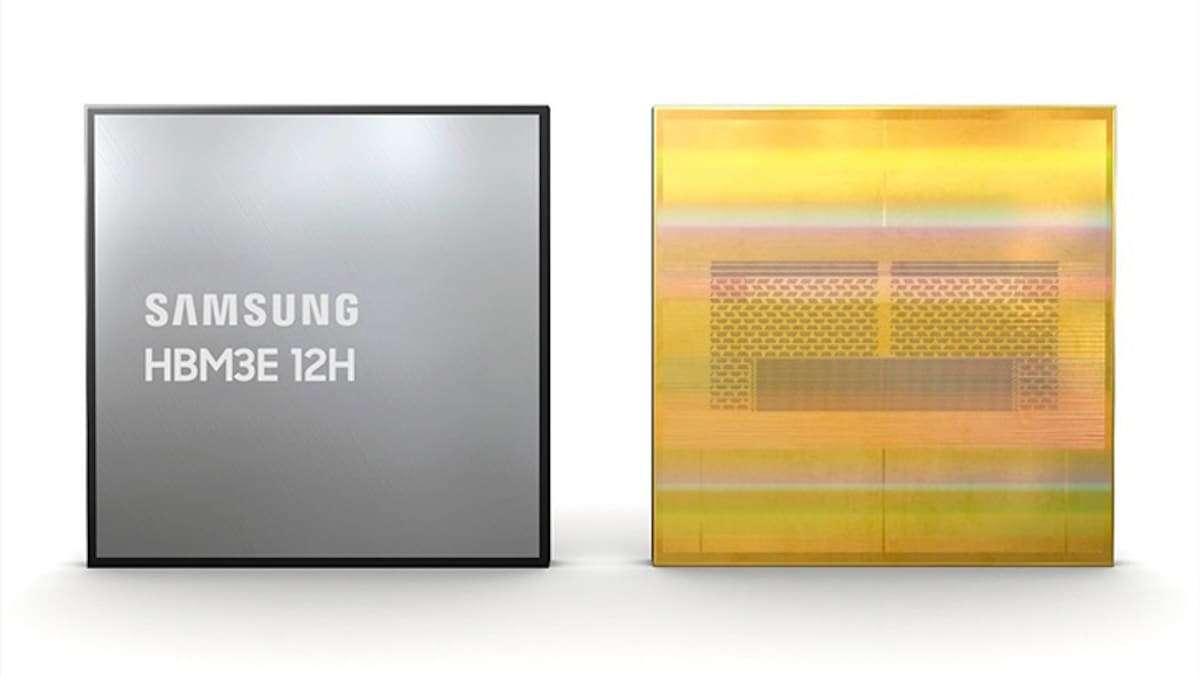
Samsung Electronics is shifting a significant portion of its high-bandwidth memory capacity toward HBM4, the generation that will define the next cycle of AI accelerators. According to industry sources cited in South Korea, the company has already allocated nearly half of its monthly HBM DRAM wafer capacity to HBM4, confirming that Samsung does not want to just catch up on the delays experienced with HBM3E, but aims to regain market share in the upcoming technological wave.
This move comes at a critical time. HBM has become one of the most strategic components of AI infrastructure. Simply having increasingly powerful GPUs or accelerators is not enough; these chips require memory capable of transferring data at tremendous speeds with energy efficiency. In practice, HBM has evolved from a specialized memory to one of the main bottlenecks in artificial intelligence systems.
Half of the HBM Capacity Allocated to HBM4
According to reports from Korean media, Samsung is dedicating around 75,000 wafers per month, out of an estimated total of 150,000 HBM DRAM wafers per month, to the production of HBM4. The remaining capacity is maintained for 12-layer HBM3E; meanwhile, the 8-layer HBM3E production, with lower demand, has been temporarily paused to redirect resources toward HBM4.
This decision is rooted in industrial logic. HBM3E remains necessary to meet current demand, but HBM4 is aligned with the next generation of AI accelerators. For Samsung, which did not achieve the same volume as SK hynix in HBM3E, it is more attractive to focus efforts on the next generation with greater capacity and a broader value proposition that includes memory, foundry services, and advanced packaging.
Samsung announced in February the commercial shipment of HBM4 and has emphasized that its HBM sales are expected to triple by 2026 compared to 2025. It has also started showcasing HBM4E, the subsequent evolution, with 12-layer samples and speeds up to 16 Gbps per pin, designed for even more demanding AI workloads.
| Element | Samsung’s Situation |
|---|---|
| Estimated monthly HBM DRAM capacity | 150,000 wafers |
| Capacity dedicated to HBM4 | 75,000 wafers |
| Remaining capacity | 12-layer HBM3E |
| 8-layer HBM3E | Temporarily paused, per Korean media |
| First commercial HBM4 shipments | February 2026 |
| Commercial goal | Regain market share in HBM and strengthen AI presence |
| Next steps | HBM4E and custom HBM for new accelerators |
This shift does not mean that Samsung is abandoning HBM3E. Rather, it reflects a focus on where they believe the competitive dynamics can be most effectively shifted. In HBM3E, SK hynix has established a clear advantage through certification, volume, and key customer relationships. In HBM4, Samsung aims to enter earlier, with greater capacity and a broader offering that includes memory, foundry, and advanced packaging solutions.
Why HBM4 Is Changing the Competition
HBM4 is not just an incremental bandwidth improvement. It signifies a shift in how memory manufacturers collaborate with accelerator designers. As AI chips grow larger, more customized, and more reliant on memory, the relationship between HBM suppliers and customers moves beyond simple transactional dealings.
Factors such as base die design, integration with the accelerator, packaging, and adaptation to specific designs are gaining importance. This could favor Samsung, as it is one of the few companies that combines memory, foundry capacity, and advanced packaging within a single group. While this integration does not guarantee market share, it provides compelling arguments for clients seeking solutions tailored to their chips.
The expansion of AI ASICs reinforces this perspective. Cloud giants like Google, Amazon, and Microsoft are developing their own accelerators to reduce dependency on standard GPUs and to optimize cost, performance, and energy efficiency for internal workloads. These chips also require HBM, but their specifications may differ from NVIDIA GPUs, opening opportunities for providers capable of custom memory and packaging solutions.
For Samsung, this presents a double opportunity: to sell HBM4 to major accelerator clients while offering a unique combination of industrial capabilities—memory manufacturing, logic processes, interposers, packaging, and support for custom designs. As markets shift toward more specialized architectures, this integrated approach could be highly valuable.
SK hynix Still Holds an Edge, but Samsung Aims to Change the Cycle
SK hynix enters this transition from a strong position. Its early bets on HBM have made it the leading provider of memory for AI accelerators, and its prominence in the stock market now surpasses Samsung as South Korea’s most valuable listed company. Its advantage in HBM3E provides revenue, a solid customer base, and margins, allowing a gradual shift toward HBM4 without aggressive timelines.
Meanwhile, Samsung faces more urgency. Having fallen behind in parts of the HBM3E cycle, it needs to prove it can deliver quality, volume, and timely certification for HBM4. Its capacity allocation indicates a strong commitment: if HBM4 demand grows as expected, Samsung can regain ground; if ramp-up issues arise, the opportunity cost will be high.
| Company | Current Strengths | Main Challenges |
| SK hynix | Leader in HBM3E; strong AI customer relationships | Maintain HBM4 advantages while supporting current demand |
| Samsung | Integrated capacity in memory, foundry, and packaging | Regain trust after delays in HBM3E |
| Micron | Advances in HBM; solid US customer base | Scale capacity amidst Korean competitors |
| Major Cloud Providers | Custom ASIC designs; rising HBM demand | Secure supply; reduce dependence on few suppliers |
Market forecasts point to a more competitive landscape. Some estimates suggest Samsung’s HBM market share could see significant growth this year, while SK hynix’s dominance might ease. Certain projections even indicate that Samsung could challenge for the leadership in 2027 if HBM4 becomes a pivotal generation.
However, market share is not solely gained through capacity. In HBM, clients scrutinize product performance, power consumption, reliability, packaging, and supply stability. Certification delays can cost months and billions in orders, as Samsung has learned with HBM3E.
AI as Critical Infrastructure Elevates Memory’s Importance
This competitive race extends beyond South Korea. The AI supply chain depends on scarce resources: GPUs or ASICs, HBM memory, advanced packaging, high-speed interconnects, energy, and data center capacity. Any weak link can escalate costs or cause delays in deploying models and agents.
HBM memory is particularly critical because it cannot be easily replaced by conventional DRAM. AI accelerators require moving massive data volumes between memory and compute units. As models grow larger and inference/train workloads become more demanding, bandwidth and energy efficiency pressures intensify.
Consequently, manufacturers are rebalancing investments, wafers, and capacity toward HBM. Expanding production, however, is not immediate; it involves wafers, advanced DRAM processes, TSVs, stacking, yield management, packaging, testing, and close collaboration with clients. Capital is committed well before actual market demand is fully confirmed.
Samsung’s focus on HBM4 should be understood within this context. It’s not just a product portfolio decision; it’s a strategic capacity reallocation toward segments promising higher margins and greater influence on global AI infrastructure in the coming years.
New Frontiers: Memory for GPUs and Custom ASICs
Until now, much of the HBM discussion revolved around NVIDIA, whose accelerators fueled the generative AI boom. However, the market is diversifying. Cloud giants develop proprietary chips; AI labs seek to lower costs per token; large cloud providers aim to control more of the AI stack.
This evolution could alter the competitive landscape among memory suppliers. In a world dominated by a single main client, certification with that client defines the market. As more custom ASICs emerge, the importance of adapting to diverse designs and packaging needs increases—and Samsung may see an opportunity to stand out with tailored solutions.
HBM4 arrives precisely as AI transitions from explosive growth to industrialization. It’s no longer solely about training the largest models; it involves serving inference to millions, running agents, powering entire data centers, and reducing energy per operation. Memory plays a direct role in this transition.
The key question is whether Samsung can translate allocated capacity into real market share. It has scale, technology, and resources—but must demonstrate execution. SK hynix is not ceding leadership without contest, and Micron is expanding its presence. The HBM4 battle is likely to be among the most critical semiconductor industry competitions in 2026 and 2027.
Samsung’s decision to allocate half of its HBM capacity to HBM4 reflects an attempt to avoid repeating history with the previous generation. The race now hinges on who reaches the exact intersection of accelerator integration, packaging, and genuine AI demand first—not just who makes the most memory.
Frequently Asked Questions
What is HBM4?
HBM4 is the next-generation high-bandwidth memory designed for AI accelerators, advanced GPUs, and custom chips requiring large data movement with low latency and high efficiency.
Why is Samsung dedicating so much capacity to HBM4?
Because it aims to recover market share in HBM after falling behind SK hynix in HBM3E and because HBM4 will be essential for the next wave of AI accelerators.
What’s the difference between HBM3E and HBM4?
HBM4 offers higher bandwidth, better efficiency, and improved integration with new accelerator designs. It also emphasizes the importance of base die, packaging, and customization for each client.
Can Samsung surpass SK hynix in HBM?
It’s possible if HBM4 becomes a competitive reset opportunity and Samsung executes well on quality, volume, and certification. SK hynix currently maintains a strong lead in customer base and market share.
