
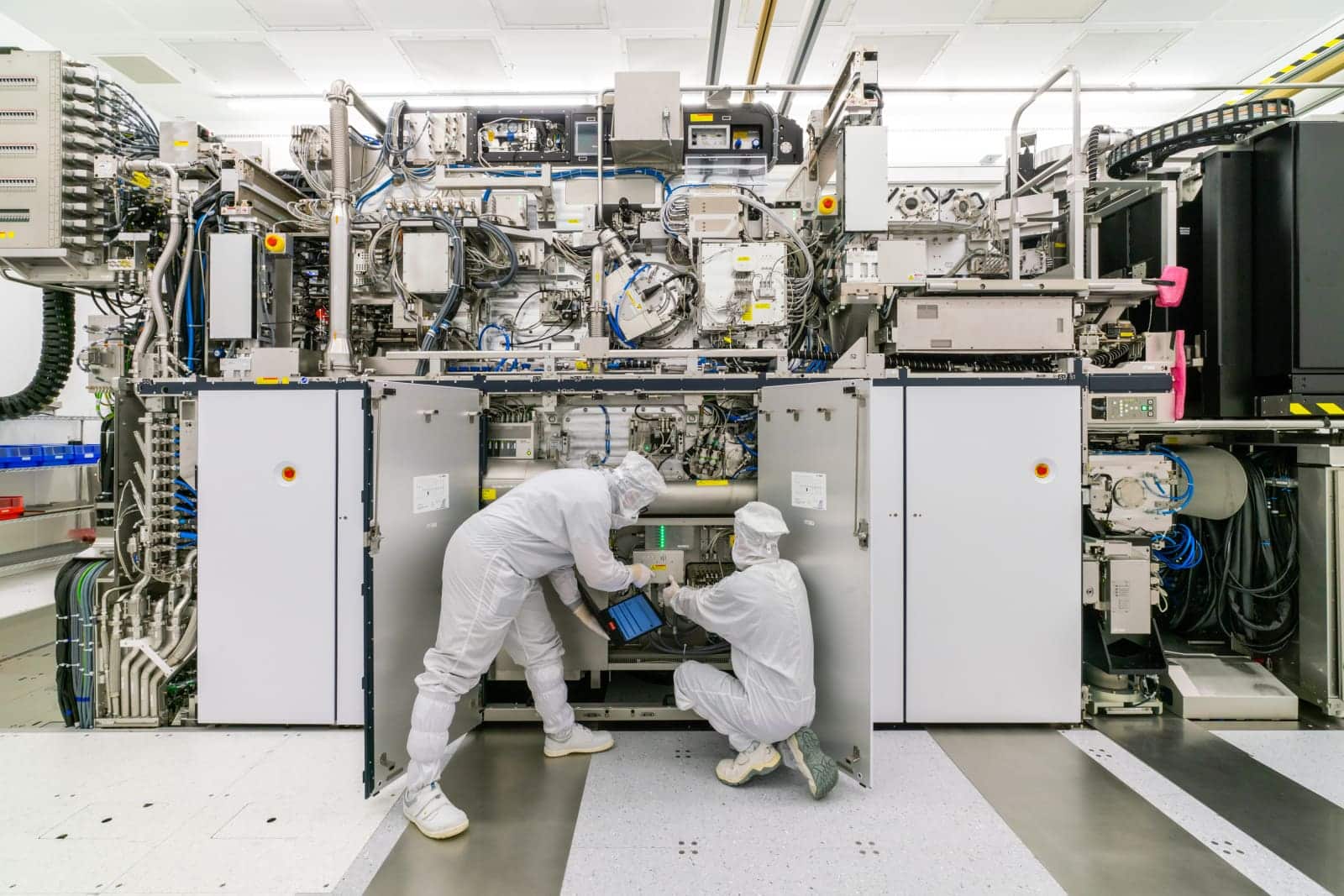
The recent controversy surrounding ASML and China is somewhat unusual even for an industry accustomed to geopolitics. The idea that an EUV machine, one of the most complex industrial tools in the world, could have secretly reached China sounds hard to believe when considering the physical and technical scale of the equipment. We’re not talking about a server, a GPU, or a component that can be hidden in a conventional supply chain. An EUV system weighs around 180 tons, contains approximately 100,000 parts, and requires specialized transportation, prolonged installation, calibration, and ongoing support.
ASML has denied sending any of its extreme ultraviolet lithography systems or components specifically designed for them to China. The Dutch company insists it complies with export regulations and that none of its EUV machines have been delivered to Chinese customers. In the absence of public evidence to the contrary, suspicion seems more revealing of what it indicates—that advanced lithography remains the most sensitive point in the global semiconductor race—than of what it demonstrates.
For China, this episode leaves an uncomfortable lesson. Its progress in chip technology is real, but so are its limitations. It can improve design, encapsulation, software efficiency, production on mature nodes, and manufacturing using highly strained DUV techniques. But without industrial-grade high-productivity EUV, competing sustainably at the most advanced nodes remains much harder, more expensive, and less efficient.
EUV is not just another machine
Lithography is the process that allows for drawing circuit patterns onto a silicon wafer. The smaller and denser these patterns are, the more complex it becomes to manufacture advanced chips that deliver good performance, affordable costs, and sufficient volume. ASML is the only global supplier of EUV equipment for advanced production, a position that makes the company a strategic asset for the United States, the Netherlands, Taiwan, South Korea, China, and the European Union.
ASML’s EUV machines use 13.5-nanometer light to print critical layers in nodes such as 7 nm, 5 nm, and 3 nm. ASML itself explains that its NXE systems are used in the production of advanced logic and memory chips, enabling the printing of complex layers that are unattainable with traditional DUV lithography in the same way.
That’s why any rumor about a possible transfer to China is so sensitive. An EUV machine is not just expensive equipment. It’s a complete chain of dependencies: precision optics, light sources, metrology, software, materials, maintenance, specialized technicians, spare parts, and knowledge accumulated over decades. The physical hardware matters, but continuous service and the ability to keep it within specifications matter almost as much.
The containment of China has not started yesterday. Since 2019, Washington has been pushing to prevent ASML from selling EUV to the Chinese market, and restrictions have since expanded to advanced DUV systems, licenses, spare parts, and software updates in certain cases. The goal is not to halt China’s entire semiconductor industry but to hinder access to cutting-edge manufacturing, especially for chips needed in AI, high-performance computing, and defense.
China advances but at a higher cost per node
China’s response has been to accelerate domestic technology substitution, increase public investment, support manufacturers like SMIC, Huawei, YMTC, and CXMT, and stretch DUV tools through multipatterning techniques. This approach allows for more advanced chips than simple DUV processes would permit, by repeating lithographic steps to approach smaller dimensions.
The problem is that this solution comes at a cost. More steps mean more complexity, longer processing times, higher defect risks, lower yields per wafer, and greater difficulty scaling production. It’s a way to continue making progress, but not a clean substitute for EUV.
Huawei and SMIC’s achievements in producing 7 nm chips without EUV surprised some of the industry and Western policymakers. However, that achievement does not equate to parity with TSMC, Samsung, or Intel at the most advanced nodes. The difference between “being able to manufacture something” and “being able to produce it at volume, with good performance, and at a competitive cost” is enormous.
| Technology | Advantage | Limit for China |
|---|---|---|
| Advanced DUV | Partially available and usable with multipatterning | More steps, higher cost, and lower efficiency at leading nodes |
| EUV | Reduces complexity in critical layers and improves scalability | China does not have access to ASML’s EUV systems |
| Advanced packaging | Can improve performance without relying solely on node advancements | Requires a complex supply chain and advanced memory technology |
| Chip design | Companies like Huawei have demonstrated capacity | Requires manufacturing capability to support it |
| Domestic equipment | Reduces long-term dependence on foreign supply | Advanced lithography takes decades of industrial maturation |
This highlights the difficulty for China. While restrictions haven’t stopped progress, they have increased the cost of each step forward. China can produce useful chips, even advanced ones for certain applications, but reaching the global frontier requires more than reverse engineering or public investment. It requires replicating an industrial ecosystem that companies like ASML, Zeiss, Trumpf, Cymer, and hundreds of suppliers have built over decades.
The importance of reaction over rumors
The reaction of the United States also reveals much. Worrying about the potential presence of EUV technology in China—even without public evidence of a complete machine operating there—demonstrates the strategic sensitivity surrounding lithography. Export controls are no longer limited to complete equipment shipments. They increasingly extend to components, software, maintenance, technical knowledge, specialized personnel, and auxiliary tools.
This creates a challenging scenario for ASML. China has been an important market, especially for less advanced equipment, but political pressure reduces profit margins. The company finds itself in a tension it does not entirely control: it needs to sell, comply with Dutch, European, and US regulations, protect its reputation, and maintain relationships with global clients.
The European Union also faces a delicate position. ASML is one of its key global technological assets, but much of the regulatory pressure comes from the US. The Netherlands has tightened controls, but the dispute underscores how European technological sovereignty is exercised within a landscape dominated by the rivalry between Washington and Beijing.
For China, the lesson is tougher. Purchasing machinery alone isn’t enough. Attracting engineers or building prototypes isn’t sufficient either. EUV lithography is a system technology, not an isolated product. It works because of the integration of optics, vacuum, plasma sources, thermal control, metrology, software, materials, and a global support network. Replicating that capability industrially can take years, even with massive investment.
The race is no longer just about the smallest node
China’s industry is not static. It can offset some limitations with smarter design, chiplets, advanced packaging, software optimization, local memory, specialized accelerators, and mass deployment on less advanced hardware. In AI, success is not always measured solely by the most advanced chip; availability, cost, interconnection, memory, model efficiency, and scalability also matter.
However, at the forefront of manufacturing, lithography remains the limiting factor. If China cannot access industrial EUV or develop a competitive alternative, closing the gap at 5 nm, 3 nm, and beyond will be more difficult. They can produce advanced chips through alternative paths, but likely with higher costs, lower performance, or reduced volume capacity.
Therefore, the ASML-China saga should not be viewed as just about a giant machine that no one can hide. It is a snapshot of the new industrial reality. The tech war is not solely decided by who designs the best chips but by who controls the manufacturing machines, maintains them, supplies essential parts, and determines which countries can access these capabilities.
Export controls are imperfect. They may foster Chinese self-sufficiency, push for alternative solutions, and accelerate national investments. But they can also cause very costly delays in the most difficult segments to replace. EUV is precisely one of those segments.
This episode leaves a clear conclusion: China can advance without ASML EUV, but each step forward on the frontier will be slower, more expensive, and less certain. In semiconductors, that could mean the difference between demonstrating technological capability and commanding an industry.
Frequently Asked Questions
What is an ASML EUV machine?
It is a system of extreme ultraviolet lithography used to print critical layers in advanced chips. ASML is the only global provider of such systems for industrial production.
Does China have ASML EUV machines?
ASML has denied sending EUV systems or components specifically designed for EUV to China. So far, there is no public evidence of a complete EUV machine operating there.
Can China make advanced chips without EUV?
Yes, to some extent. It can use DUV lithography with multipatterning and other techniques, but that increases complexity, cost, and manufacturing difficulty at scale.
Why is lithography so important in the chip war?
Because it defines how far semiconductor manufacturing can physically advance. Designing an advanced chip isn’t enough if there’s no industrial capacity to produce it with good performance, cost efficiency, and volume.
via: scmp
