
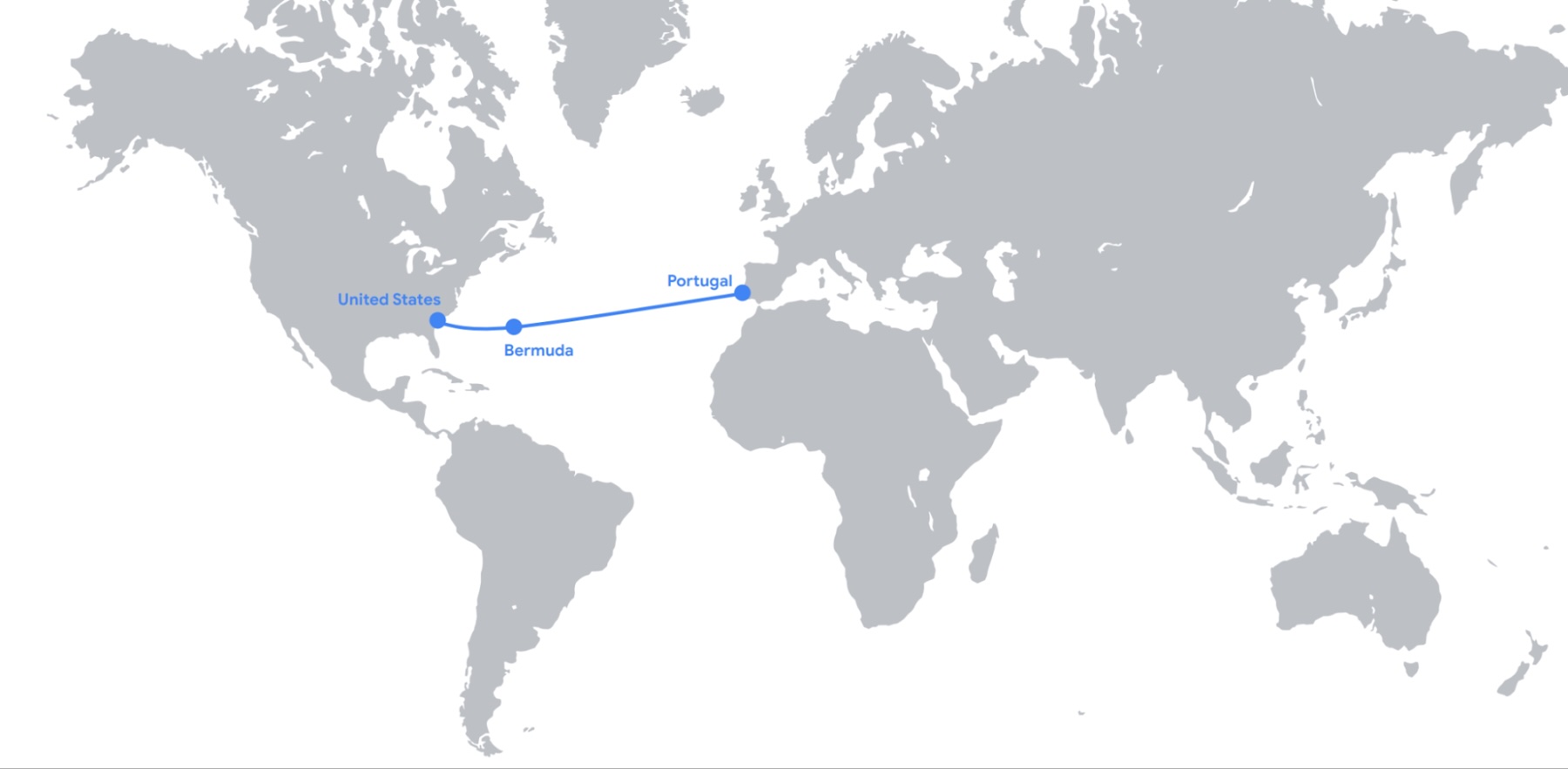
Google has taken another step in its global private network with the landing of Nuvem, its transatlantic submarine cable connecting the United States, Bermuda, and Portugal. The system, whose name means “cloud” in Portuguese, was announced by Google Cloud in 2023 and is scheduled to go into service in 2026. Its goal is to enhance resilience, reduce latency, and diversify traffic routes between the Americas, Europe, and Africa.
The landing in Myrtle Beach, South Carolina, confirms the growing importance of this city as an Atlantic entry point for next-generation cables. Other systems linked to Google also converge there, such as Firmina, reinforcing an increasingly obvious trend: hyperscalers are no longer just contracting capacity from traditional operators; they’re building and controlling their own submarine highways.
Nuvem: 16 fiber pairs and a strategically valuable route
According to data from specialized sources on submarine infrastructure, Nuvem will be approximately 7,194 kilometers long, with 16 fiber pairs and an estimated design capacity of around 384 Tbps, at roughly 24 Tbps per pair. Google has not publicly disclosed all technical details in its initial announcement but confirmed the route between Portugal, Bermuda, and the US, with an expected operational date in 2026.
This route is not just another transatlantic connection. Public FCC documentation identifies landing stations in Myrtle Beach, Annie’s Bay in Bermuda, São Miguel in the Azores, and Sines in Portugal. This structure creates a corridor linking the U.S. East Coast with the North Atlantic and southwestern Europe, with Portugal as the entry point into the continent.
| Element | Nuvem |
|---|---|
| Promoter | |
| System provider | SubCom |
| Main route | USA, Bermuda, Azores, Portugal |
| U.S. landing point | Myrtle Beach, South Carolina |
| European landing point | Sines, Portugal |
| Estimated capacity | 384 Tbps |
| Fiber pairs | 16 |
| Scheduled commissioning | 2026 |
| Main function | Resilience, capacity, and route diversification across the Atlantic |
For Google, the key lies in integration with other cables. Firmina connects the U.S. with South America, while Equiano links Portugal with several African countries. Nuvem adds a critical piece that enhances traffic flow between North America, South America, Europe, and Africa, reducing reliance on saturated routes and providing more options for rerouting in case of failures or demand spikes. Google has already explained that Nuvem, along with Firmina and Equiano, will create new data corridors among these continents.
Portugal emerges as a digital gateway across the Atlantic
Portugal’s role is among the most interesting aspects. Sines and other points along the Portuguese coast are gaining prominence as international connectivity hubs because they combine advantageous geographic positioning, cable landing infrastructure, available land for data centers, and access to European markets. Additionally, many of the major cables connecting Africa to Europe touch Portuguese territory or pass through its influence zone.
Google already has a significant presence in Portugal with Equiano, which links the country to Togo, Nigeria, Namibia, South Africa, and Saint Helena. With Nuvem, Portugal reinforces its position as a bridge connecting North Atlantic, Africa, and southern Europe. It’s no coincidence that Google describes this investment as part of a strategy to improve digital infrastructure and the resilience of international connectivity.
Bermuda also gains prominence. The territory has been seeking to position itself as an Atlantic digital hub through specific legislation for cable corridors and more streamlined permitting processes. Nuvem will be its first direct transatlantic connection to Europe, a notable development for an enclave aiming to become a key interconnection point between America, Europe, and Africa.
The later addition of Sol, another transatlantic cable announced by Google to connect the U.S., Bermuda, the Azores, and Spain, further reinforces this architecture. Google explained that Sol and Nuvem will interconnect via land in the U.S. and Iberia, as well as in Bermuda and the Azores. This mesh increases redundancy and decreases dependency on a single system or route.
Hyperscalers are now controlling the physical layer
The story of Nuvem also reflects a broader market shift. For years, submarine cables were the domain of consortia comprising operators, international carriers, and regional partners. While that model still persists, hyperscalers have taken on a different role. Companies like Google, Meta, Microsoft, and Amazon need to transfer enormous amounts of data across cloud regions, data centers, AI services, streaming platforms, storage, and end-users.
This leads to increasing vertical integration. It’s no longer sufficient to purchase transit or rent capacity in third-party cables. To ensure low latency, availability, and cost control long-term, big tech firms are financing, designing, and owning entire systems. In the case of Nuvem, Google is listed as the owner in specialized maps, while SubCom acts as the provider.
This trend has implications for the cloud market. Submarine capacity isn’t just telecom infrastructure; it’s a competitive advantage for moving loads between regions, replicating data, serving content, training distributed models, and delivering enterprise services with lower latency. AI intensifies this need, as data, models, inference, and storage are distributed across data centers with growing bandwidth requirements.
There’s also a geopolitical angle. Those controlling submarine routes influence part of the digital economy. Cables carry around 95% of international communications, as noted by the Bermuda Business Development Agency in Google’s announcement. In a context of digital sovereignty tensions, cloud dependence, and critical infrastructure resilience, every new private hyperscale cable adds physical weight to the internet’s backbone.
Nuvem is not just another cable across the Atlantic. It’s a piece of a global private network connecting cloud regions, data centers, and strategic markets. Myrtle Beach is becoming increasingly relevant as a U.S. node, Bermuda as an Atlantic transit point, and Portugal as a European gateway to the Americas and Africa. The submarine map of the internet is being redrawn, and Google is making clear its ambition to control more layers of this infrastructure.
Frequently Asked Questions
What is Google’s Nuvem cable?
Nuvem is a transatlantic submarine cable promoted by Google to connect the U.S., Bermuda, the Azores, and Portugal. Its aim is to increase capacity, resilience, and route diversity between the Americas and Europe.
How much capacity will Nuvem have?
Specialist sources and submarine cable maps estimate Nuvem will feature 16 fiber pairs with an approximate design capacity of 384 Tbps. Google did not disclose this figure publicly in their initial announcement.
Why is Myrtle Beach significant?
Myrtle Beach is establishing itself as a landing station for next-generation cables. DC BLOX operates there a facility designed to host up to five submarine cables and up to 19 MW of power.
What role does Portugal play in this network?
Portugal strengthens its position as a digital gateway connecting America, Europe, and Africa. With cables like Nuvem and Equiano, the country gains importance as a transit, interconnection hub, and potential site for new data centers.
via: cloud.google.com
