
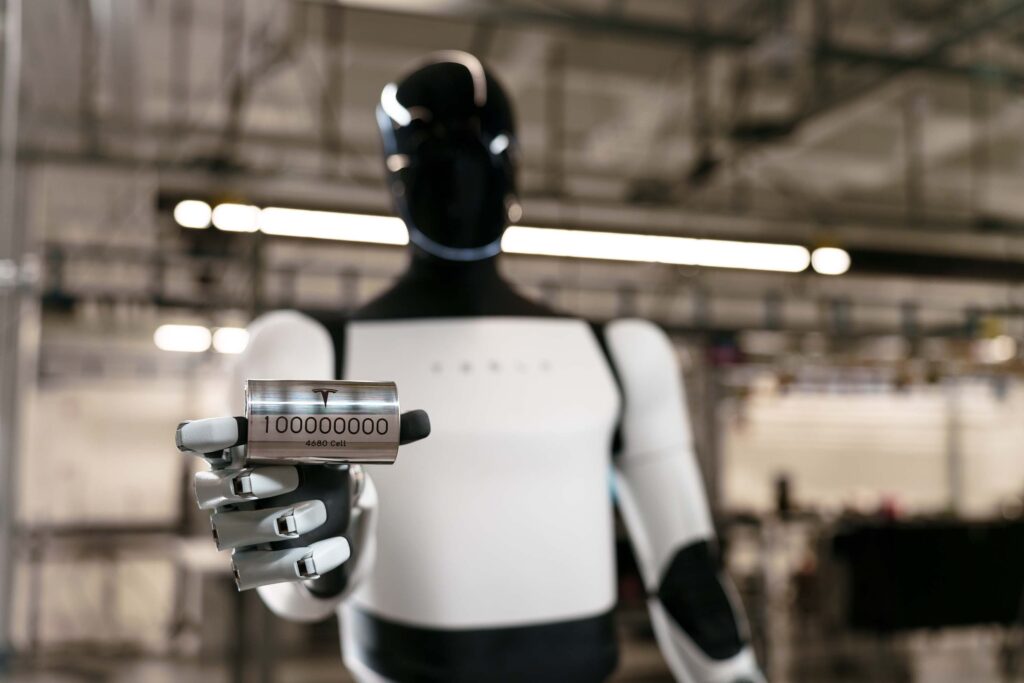
Tesla is once again putting Optimus at the center of its technological narrative. The company has continued to present itself as more than just an electric car manufacturer, but the leap from a humanoid robot prototype to full-scale industrial production requires a supply chain still taking shape. This is where Taiwan enters the picture.
According to reports published by the Taiwanese newspaper Economic Daily News and picked up by specialized media, several local suppliers are preparing to provide key components for the future Optimus 3. Among them are Mirle Automation and Asia Optical, two companies that could play a significant role in harmonic reducers, joint modules, and optical systems for the robot’s vision. Tesla has not officially confirmed these agreements, so this news should be seen as a signal about the supply chain, not as a finalized corporate announcement.
Reducers, joints, and lenses: the robot starts with its small parts
The interest in this information isn’t just that Tesla aims to build robots. That was already known. The relevant part is that the auxiliary industry is beginning to move around specific components. In humanoid robotics, headlines often focus on AI, natural language, or video demonstrations, but industrial success depends on much more tangible parts: actuators, reducers, sensors, cameras, hands, batteries, wiring, and control systems.
According to information from Taiwan, Mirle Automation has started supplying harmonic reducers and joint modules for Optimus 3. These components are critical because they enable precise movement in load-bearing joints, especially in arms, legs, and hands. A humanoid robot cannot just move; it must do so with stability, repeatability, and enough force without excessive energy consumption or cost.
The Taiwanese firm also participates in a joint venture in Thailand alongside Kedali and another company linked to the group, with an investment close to 1.667 billion Taiwanese dollars. The new company would be located in Rayong, a Thai industrial hub with established automation and advanced manufacturing sectors. The goal is to expand production of components like harmonic reducers, actuators, and other precision parts.
Asia Optical, in turn, is identified as a potential supplier for Optimus’s “eyes.” The company works with spherical and aspherical lenses, high-resolution cameras, and optical components for machine vision. Its president, Lai I-jen, has indicated that a humanoid robot may need at least seven or eight lenses for vision, perception, and hand sensors. If Optimus aims to operate in factories and later in domestic or service environments, vision won’t be an accessory; it will be a basic layer of safety and autonomy.
| Quoted Supplier | Associated Component | Function in a Humanoid Robot | Current Status |
|---|---|---|---|
| Mirle Automation | Harmonic reducers and joint modules | Precise movement in joints, arms, legs, and hands | Supply chain information; no specific clients disclosed |
| Asia Optical | Lenses and optical components | Artificial vision, environment perception, hand sensors | Samples or prototypes; production expected between 2026 and 2027 |
| Kedali and partners | Production in Thailand | Industrial capacity for precision components | Joint venture linked to supply expansion |
| Tesla | Optimus 3 | Humanoid robot aimed at manufacturing and large-scale future production | Production plans announced by Musk, pending implementation |
Fremont, Texas, and the promise of scaling Optimus
Elon Musk has raised expectations for Optimus over recent months. During Tesla’s 2025 annual shareholders meeting, he talked about an initial production line in Fremont with a target capacity of one million units annually and a second line in Texas that, in a later phase, could aim for 10 million robots per year. These figures are enormous—even for a company with industrial production experience—and should be viewed as ambitious goals rather than current capacities.
Reports in the United States indicated that Tesla was preparing to produce Optimus in Fremont between late July and August 2026, with a second facility in Austin, Texas, planned for 2027. The Optimus 3 version would be the closest to a production-ready model after several generations of prototypes and public demonstrations.
The challenge differs from car manufacturing. Tesla knows how to produce vehicles at volume, but a humanoid robot involves a more diverse and demanding supply chain: compact actuators, dexterous hands, vision systems, sensors, power electronics, batteries, motor control software, and AI models capable of operating in unpredictable environments. Manufacturing millions of units would require a combination of automation, stable supply, and cost reduction that is yet to be demonstrated.
Musk has stated multiple times that Optimus could become Tesla’s most important product. This vision explains why the company wants to shift part of its narrative from electric vehicles to robotics and physical AI. However, the market will need to differentiate potential from execution. Humanoid robotics has promised an industrial and domestic revolution for decades, but costs, safety, autonomy, and reliability have kept mass adoption at bay.
Taiwan’s growing role in Tesla’s new humanoid robotics supply chain
The potential involvement of Mirle Automation and Asia Optical aligns with a broader trend: humanoid robotics is creating its own supply chain, closely linked to the electric vehicle, semiconductor, and industrial automation sectors. Taiwan not only supplies electronics but also optics, industrial control, precision components, and manufacturing expertise for major global clients.
Mentioning a “not-red supply chain“, according to Taiwanese sources, introduces a geopolitical perspective. Tesla and other Western manufacturers seek to reduce risks associated with over-reliance on China for critical components. Thailand emerges as a reasonable alternative to expand capacity in Asia without concentrating everything in China, though the supply chain will remain regional and complex.
For Taiwanese suppliers, Optimus could open a huge market if Tesla manages to scale. A humanoid robot requires multiple joints, lenses, sensors, and control systems. Producing hundreds of thousands or millions of units would turn each component into a high-volume business. That’s why initial signals—tests, prototypes, or small-scale production—generate significant stock market and industry attention.
There are also risks. Tesla is known for pressuring costs, rapidly changing designs, and rethinking schedules. Early entrants can gain a competitive edge but also face investments before there’s real demand. Additionally, the humanoid market won’t rely solely on Tesla: Figure AI, Agility Robotics, Apptronik, Unitree, Fourier Intelligence, and other companies are competing in industrial, logistics, and service applications.
Optimus remains a bet. It could transform automation if it achieves useful autonomy, reasonable costs, and stable production. It might also take longer than expected if hands, locomotion, safety, or software don’t mature as promised. The involvement of suppliers like Mirle and Asia Optical doesn’t resolve all uncertainties but indicates Tesla is moving from demos to a more industrial phase.
Humanoid robotics are no longer measured only by viral videos. Progress is now also assessed by factory contracts, component supply, production capacity, and delivery timelines. If Optimus 3 reaches production in late 2026, the question will no longer be whether Tesla can build a flashy prototype but whether it can produce functional, repeatable, and affordable robots capable of opening a real market.
Frequently Asked Questions
Has Tesla officially confirmed these suppliers for Optimus 3?
No. The information comes from the Taiwanese supply chain and specialized media. Tesla has not publicly confirmed specific agreements with Mirle Automation or Asia Optical for Optimus 3.
What are harmonic reducers and why are they important?
They are precision mechanical components that enable controlled, high-torque movements in robotic joints. They’re vital for arms, legs, and hands of a humanoid robot.
When might production of Optimus 3 begin?
Based on published information, Tesla is preparing for an initial production phase in Fremont between late July and August 2026, with a second line in Texas planned for 2027. These plans are subject to change.
Why is Taiwan relevant to Tesla’s robotics efforts?
Taiwan hosts suppliers with expertise in optics, automation, electronics, and precision components. If Optimus scales, these suppliers could become key parts of the supply chain.
via: money.udn
