
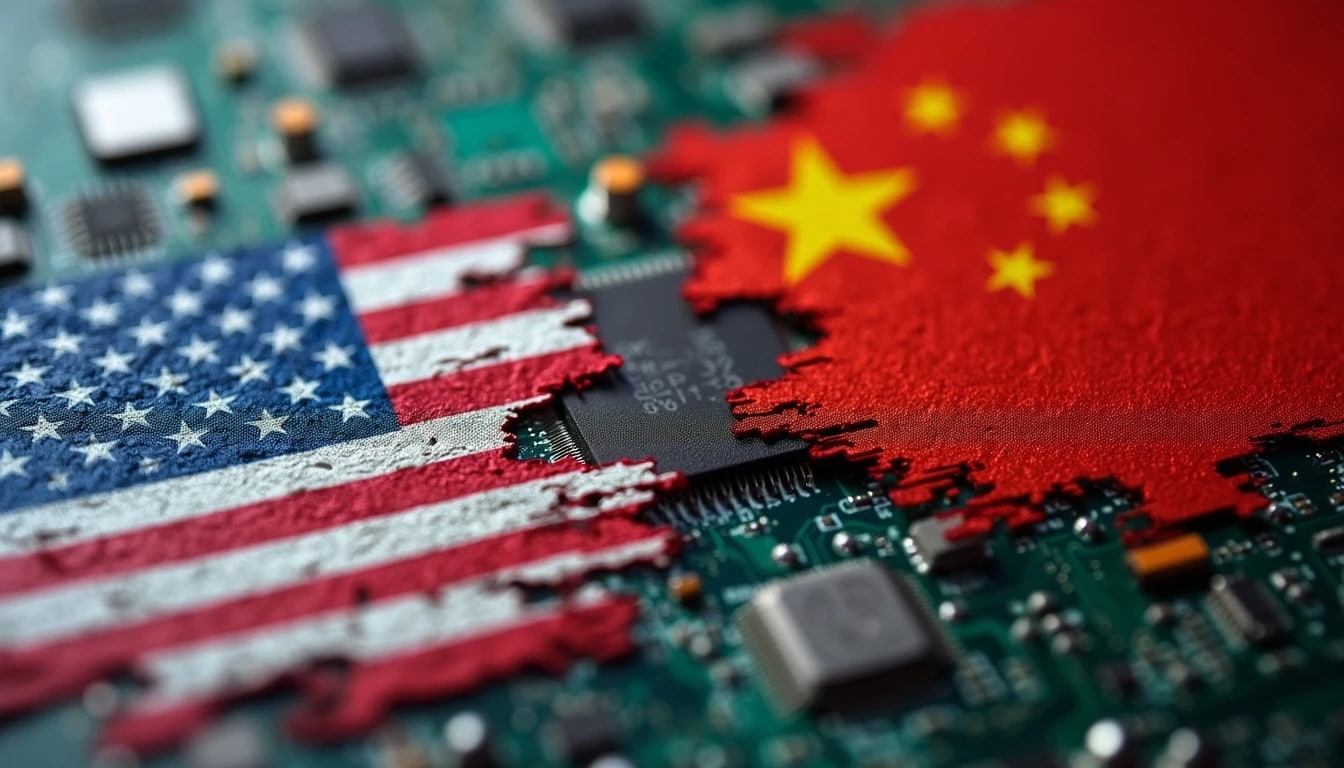
China has imposed new trade restrictions against U.S. companies linked to defense, drones, advanced electronics, and rare earths. The measure comes in response to the latest update of the U.S. Department of Defense’s list 1260H, which identifies Chinese companies considered by Washington to be connected to China’s military or industrial complex.
The move adds another layer to the technological standoff between the two largest economies in the world. It is no longer just about advanced chips, artificial intelligence, or electric vehicles. The dispute extends to critical minerals, dual-use components, public procurement, drones, aerospace systems, and supply chains that can have both civilian and military applications.
Ten companies under export control
China’s Ministry of Commerce has added 10 U.S. entities to its export control list. From now on, these companies will be restricted from receiving dual-use products from China, meaning goods, technologies, or components that can serve both civilian and military purposes.
Among the affected companies are MP Materials and USA Rare Earth, two key players in the U.S. rare earths supply chain. Also included are manufacturers or suppliers related to drones and defense, such as Teal Drones, Jaia Robotics, Aveox, Ball Aerospace & Technologies, and Oshkosh Defense, among others.
| Chinese measure | Scope |
|---|---|
| Inclusion of 10 entities on the export control list | Prohibition of exporting dual-use goods from China to these companies |
| Restrictions on rare earths and defense | Affects companies involved in mining, drones, aerospace, and military equipment |
| Exclusion of 46 companies from government procurement | Chinese public entities cannot contract with these companies |
| Exemption for locally funded subsidiaries | Local entities affiliated with these firms are excluded from the restrictions |
Meanwhile, China’s Ministry of Finance has excluded 46 American companies, mostly defense contractors, from participating in public procurement projects in China. The direct impact for some of these companies may be limited, as many do not depend heavily on the Chinese public market. However, the political message is clear: Beijing is willing to respond with its own lists when Washington broadens theirs.
Response to Washington’s list 1260H
The immediate trigger is in the United States. The Pentagon updated its list 1260H this month, which includes Chinese companies believed by Washington to operate in the U.S. and have links to the People’s Liberation Army or China’s military-civil fusion strategy.
The update includes names of significant industrial and technological weight, such as Alibaba, Baidu, BYD, NIO, CXMT, YMTC, Unitree, RoboSense, WuXi AppTec, BOE, and TP-Link, among others. Inclusion does not automatically mean full financial sanctions, but it does have consequences. It limits direct contracts with the Department of Defense and can cause reputational, compliance, and partner withdrawal effects.
| U.S. list 1260H | Main effect |
| Identifies Chinese companies linked to the military sector | Does not impose automatic financial sanctions |
| Affects technology, industrial, automotive, chip, and robotics firms | May limit contracts with the Pentagon |
| Has reputational impact | Banks, partners, and clients may review exposure |
| Allows delisting requests | Some companies have previously challenged similar designations |
China views these lists as a form of economic discrimination under the guise of national security. Conversely, the U.S. argues that it cannot allow companies with direct or indirect ties to China’s military to access sensitive technologies, markets, or contracts without restrictions.
The tension isn’t new, but the scope of sectors included is noteworthy. Washington no longer focuses solely on semiconductor manufacturers or state-run military companies. It now also encompasses digital platforms, electric vehicle producers, biotechnology, robotics, sensors, displays, energy, and components. This indicates how much the definition of strategic technology has expanded.
Rare earths, drones, and dual use: why they matter
Including companies like MP Materials and USA Rare Earth isn’t incidental. Rare earths are essential for permanent magnets, electric motors, defense, electronics, EVs, turbines, sensors, and many industrial applications. The U.S. aims to reduce its reliance on China in this supply chain, but Beijing still retains strong control over processing, separation, and refining of these materials.
Listing U.S. rare earth companies on a control list carries symbolic weight. China is signaling one of the areas where it still possesses leverage. Although the immediate impact might be limited if these companies have little direct exposure to Chinese imports, the message is aimed at the entire industrial chain: critical minerals are also a geopolitical tool.
| Impacted sector | Why it’s sensitive |
| Rare earths | Magnets, defense, EVs, electronics, energy transition |
| Drones | Civil use, surveillance, defense, military applications |
| Aerospace | Critical systems, satellites, sensors, communications |
| Motors & advanced electronics | Components with potential dual-use applications |
| Land defense | Military equipment and public contracts |
The case of drones is similar. Companies like Teal Drones and others included in Chinese measures operate in a rapidly growing segment. Drones are no longer niche technology; they’re used in agriculture, industrial inspection, emergencies, logistics, security, and defense. The Ukraine war has also demonstrated how unmanned systems can disrupt military balance.
Hence, dual-use controls have become one of the favorite tools in the technological rivalry. They allow restrictions without necessarily branding products as weapons. The challenge is that many modern technologies have mixed uses: a chip, sensor, thermal camera, motor, battery, or communication module can end up in either civilian or military systems.
More symbolic than an immediate economic blow
Several analysts view China’s response as more symbolic than disruptive. The reason is simple: many affected U.S. companies have limited direct trade activity in China or already operate in sectors where access to the Chinese market was politically and security-wise restricted.
That doesn’t mean the measure is insignificant. In the list war, the main damage isn’t always direct. The key is to create uncertainty, increase compliance costs, warn third parties, and demonstrate the capacity to respond. A company on a Chinese list might need to review suppliers, contracts, logistics, subsidiaries, insurers, banks, and relationships with international partners.
| Potential impact | Interpretation |
| Low direct commercial impact | Many affected firms have minimal exposure to China |
| High reputational effect | Inclusion on lists heightens caution among partners and suppliers |
| Risk for third parties | Distributors or subsidiaries must verify if they can transfer Chinese goods |
| Supply chain pressure | Especially for dual-use components and critical minerals | Political signal | China shows it will respond to each U.S. expansion |
The broader risk lies in the normalization of retaliations. Each new U.S. list provokes a Chinese response; each Chinese reply reinforces in Washington the need to decouple supply chains. The result is a more fragmented tech economy with increased controls, costs, and unpredictability.
Technology is no longer separate from national security
The U.S.-China conflict has scaled up. Years ago, the focus was on tariffs, trade deficits, and market access. Now, the center of gravity has shifted to who controls the technologies underpinning artificial intelligence, defense, communications, automotive, energy, robotics, and biotechnology.
The U.S. has used export controls to limit China’s access to advanced chips, semiconductor manufacturing equipment, and sensitive technologies. China has responded with restrictions on critical materials, export controls, and measures against companies linked to defense. Both governments justify their actions as matters of national security. Meanwhile, companies are forced to reorganize their supply chains in a more politicized environment.
For tech firms, the lesson is clear: geopolitical risk is now part of product design. It’s not enough to choose the cheapest supplier or the most efficient component. They must know the origin of each part, the jurisdiction that controls it, whether it is dual-use, and what could happen if a new list appears tomorrow.
China’s new response doesn’t break the economic relationship with the U.S. by itself, but it confirms a difficult-to-reverse trend. Strategic technology is fragmenting into trust blocks. More companies, even those producing seemingly civilian products, could become caught between rival definitions of national security.
Frequently Asked Questions
What exactly has China done?
China has added 10 U.S. entities to its export control list and restricted the shipment of dual-use products from China to these companies.
Which companies are affected?
Among those listed are MP Materials, USA Rare Earth, Teal Drones, Jaia Robotics, Aveox, Ball Aerospace & Technologies, and Oshkosh Defense, among others.
Why is China responding now?
The measure follows the U.S. Department of Defense’s update to list 1260H with new Chinese companies accused of links to Beijing’s military apparatus.
Is there an immediate economic impact?
In many cases, impact may be limited, as several affected firms have little direct exposure to China. However, the geopolitical, reputational, and compliance effects could be significant.
