
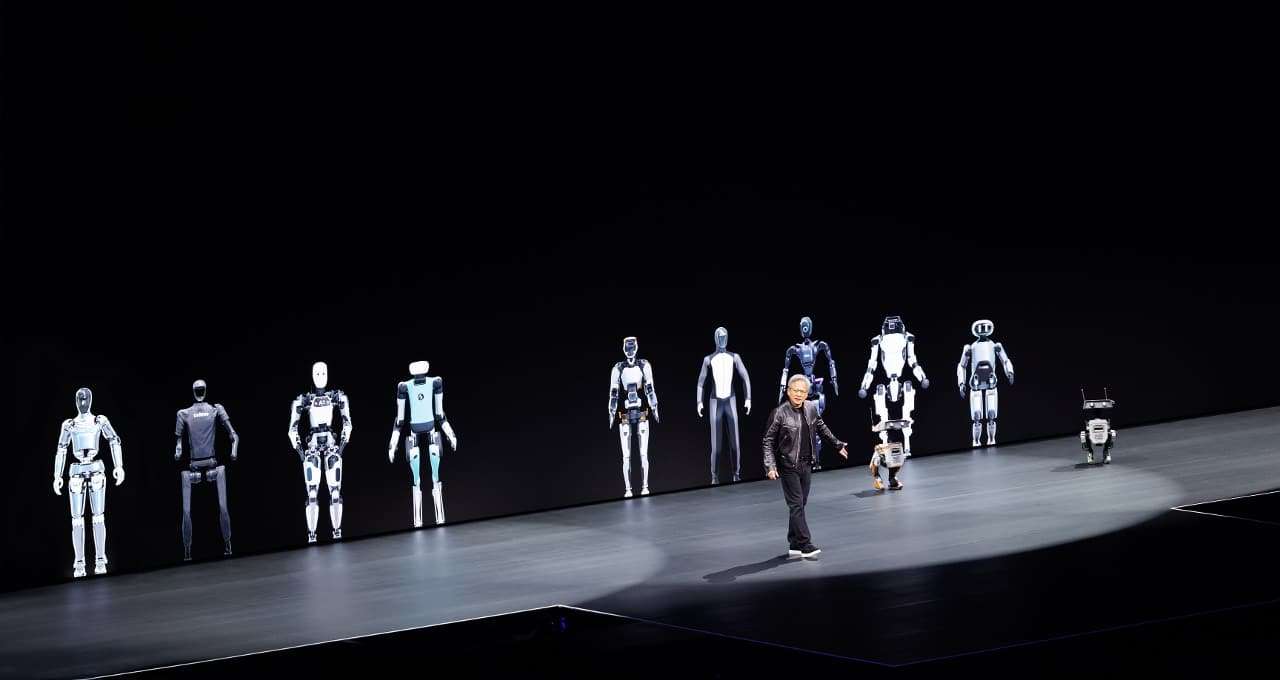
Humanoid robots are no longer just spectacular videos on social media. By 2026, there are pilots operating in factories, agreements with logistics operators, industrial orders, billions in funding, and an increasingly clear competition between the United States, China, and Europe. The question is no longer whether these robots will reach real-world environments, but at what speed, at what cost, and in which jobs they will be economically viable.
The public image of the sector remains dominated by striking demonstrations: robots walking, folding clothes, handling objects, working on assembly lines, or learning tasks by imitation. But the business side is more complex. A humanoid robot doesn’t compete solely to look human; it competes to justify its cost against traditional automation, robotic arms, AMRs, cobots, software, outsourcing, and human workers.
The market is moving quickly. Goldman Sachs raised its forecast for the global humanoid market to $38 billion by 2035, with 1.4 million units, after revising its expectations upward due to falling costs and advances in artificial intelligence. Morgan Stanley went much further, estimating that the humanoid and related services market could reach $5 trillion by 2050, with over 1 billion units in use. These are ambitious predictions, based on many assumptions, but they help explain why capital is flowing so strongly into the sector.
From viral videos to industrial pilots
The first commercial wave seems to be happening not in households, but in factories, warehouses, and logistics. This is logical. Industrial environments are more controlled, tasks are more repetitive, schedules are more predictable, and return on investment can be measured more clearly. A humanoid robot moving parts, classifying packages, feeding lines, or performing inspections doesn’t need to solve all the complexities of a home. It needs to be reliable, safe, and useful for a specific task.
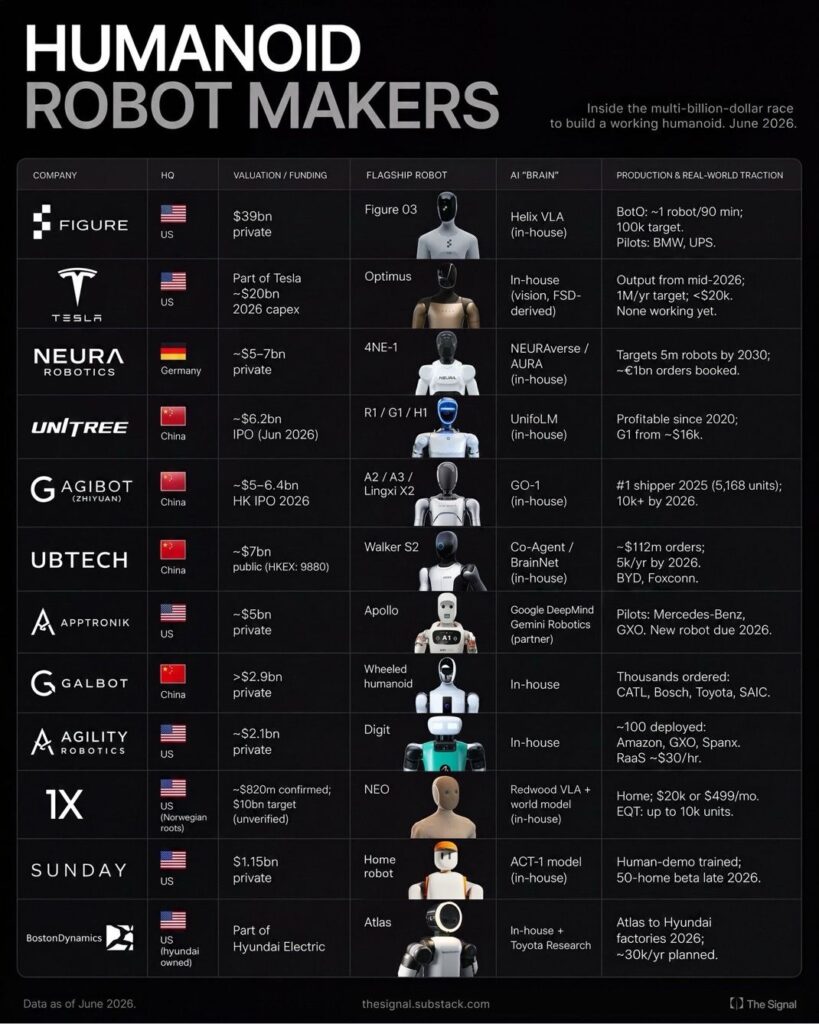
Figure AI is one of the most visible names. In 2025, the company announced a funding round of over $1 billion, with a post-money valuation of $39 billion. Its narrative combines two fronts: robots for physical work in companies and, in the longer term, assistance in the home. Its Figure 03 robot is presented as a more production-ready platform, while its Helix system aims to add a layer of visual and linguistic intelligence to manipulate objects and operate in variable environments.
Tesla remains the most closely watched player for its industrial capacity. Optimus still needs to demonstrate mass production, cost, and utility at scale, but the company has an advantage few competitors have: vertical manufacturing, expertise in computer vision, supply chain, batteries, motors, electronics, and a brand capable of attracting talent and capital. Elon Musk has spoken for years about millions of units at prices close to a small car, though 2026 remains a phase of initial testing and validation, not mass adoption.
China is approaching with a different strategy: volume, speed, and cost. Companies like Unitree, AgiBot, and UBTECH have gained visibility because they are putting units on the market at prices and manufacturing rates that are difficult for many Western startups to match. Unitree is on its way to an IPO in Shanghai, and data published about its listing shows humanoids accounted for more than half of its revenue in the first nine months of 2025. AgiBot claims to have surpassed 10,000 units, and sector reports rank it among the largest manufacturers by volume. UBTECH, already listed in Hong Kong, has deployed its Walker robots in industrial pilots with companies like BYD and Foxconn.
| Company | Country | Highlighted Robot | Main Focus | Most Visible in 2026 |
|---|---|---|---|---|
| Figure AI | USA | Figure 03 | General-purpose humanoid for business and home | High funding, pilots, and initial production |
| Tesla | USA | Optimus | Mass production integrated with Tesla ecosystem | Advanced development, scaling still pending |
| Unitree | China | G1 / R1 / H1 | Low cost, volume, education, industry | IPO preparations, strong unit sales |
| AgiBot | China | A2 / A3 / Lingxi X2 | Humanoids and data for embodied AI | High declared volume and commercial expansion |
| UBTECH | China | Walker S2 | Industry, factories, services | Hong Kong-listed, pilots with major manufacturers |
| Apptronik | USA | Apollo | Manufacturing and logistics | Partnerships with Mercedes-Benz, GXO, Jabil, Google DeepMind |
| Agility Robotics | USA | Digit | Logistics and warehouses | Deployments with GXO, Amazon |
| 1X | Norway / USA | NEO | Domestic robot | Pre-orders and initial deliveries planned |
| Sunday Robotics | USA | Memo | Home | Domestic beta expected by late 2026 |
| Boston Dynamics | USA / Hyundai | Atlas | Advanced industry | Transition from prototype to industrial product |
AI now weighs as much as hardware
For years, humanoid robotics was limited by motors, batteries, actuators, balance, cost, and safety. These issues have not disappeared. But the most recent change is in artificial intelligence. Vision-language-action models, learning by demonstration, simulation, synthetic data, and teleoperation are accelerating the training of physical robots.
Apptronik exemplifies this convergence. Its Apollo robot targets manufacturing and logistics, but its partnership with Google DeepMind connects hardware with Gemini Robotics, a family of models designed to bring multimodal capabilities into the physical world. Google DeepMind describes Gemini Robotics as a model capable of adapting to different robotic bodies and executing manipulation tasks from open instructions. The key isn’t just in robots seeing and moving, but in understanding goals, context, and objects in three dimensions.
Boston Dynamics, traditionally known for mechanical excellence, is also moving into this territory. Atlas, now electric, aims to serve Hyundai factories in the coming years. Its challenge isn’t just to make an impressive demonstration—a skill the company has long mastered—but to turn that performance into a repeatable, maintainable, and economically justifiable industrial product.
The problem is that a humanoid robot needs to be much more reliable than a demo. In a factory, failing once every few hours can be unacceptable. In a home, an error might mean breaking objects, getting stuck on simple tasks, or raising safety concerns. That’s why the next two or three years will be less about spectacular feats and more about business metrics: availability, hourly cost, maintenance, safety, learning new tasks, and real ROI.
United States, China, and Europe: three distinct strategies
The race has a geopolitical dimension. The US leads in private funding, AI models, software, and some high-profile startups. Tesla, Figure, Apptronik, Agility Robotics, Boston Dynamics, and Sunday Robotics reflect different bets: from vertical manufacturing to home robots, logistics, and factories.
China has an advantage in manufacturing capacity, supply chain, public support, and speed to market. The country has already made industrial robotics a strategic priority and is replicating that pattern in humanoids. Companies like Unitree, AgiBot, UBTECH, and Galbot are progressing with aggressive pricing, volume, and industrial pilots. This doesn’t guarantee that all will win, but China is building an internal market where robots can be tested, produced, and made cheaper at high speed.
Europe appears more fragmented. NEURA Robotics, from Germany, is one of the most visible bets in cognitive and humanoid robotics. Its 4NE-1 is designed for serial production, and the company is working on an ecosystem of robotic applications. Still, Europe must prove whether it can scale physical robotics companies as fast as the US and China, or if it will mainly contribute components, sensors, actuators, industrial software, and regulated use cases rather than complete platforms.
| Region | Main Strength | Main Risk |
| USA | Capital, AI, startups, software, talent, and major platforms | High costs and difficulty scaling manufacturing |
| China | Manufacturing, volume, supply chain, speed | Margin pressure and doubts about real utility in some cases |
| Europe | Industrial engineering, safety, regulation, specialized robotics | Fragmentation and lower funding velocity |
Employment: transformation before total substitution
The employment debate often swings between promises of abundance and fears of mass replacement. The reality will be more uneven. Humanoids won’t suddenly replace millions of jobs because they’re still expensive, imperfect, and hard to integrate. But they can automate specific tasks in sectors facing labor shortages, high turnover, physical risks, or repetitive work.
Initial scenarios include logistics, automotive, electronics manufacturing, warehouses, industrial inspection, and some auxiliary services. Homes will come later, except in high-income niches or subscription models. Homes are much more chaotic environments than factories: changing objects, children, pets, furniture, liquids, stairs, privacy, and very high expectations.
For companies, the immediate impact won’t be just “owning humanoid robots” as futuristic symbols, but redesigning processes to make their use meaningful. A humanoid doesn’t add value if it only does a worse job than a cheap robotic arm. It adds value when it can operate in human-designed spaces, use existing tools, move between tasks, and reduce the need for full plant redesigns.
That’s why the humanoid format remains attractive—not necessarily because it’s always the most efficient design, but because the physical world is built for humans: doors, shelves, carts, tools, stairs, boxes, knobs, and tables. If a robot can work in that environment without redesigning every square meter, the economic case improves.
Likely timeline: less science fiction, more gradual deployment
From 2026–2027, we’ll see expanded pilots, initial industrial fleets, limited home testing, and a natural selection process. Some companies will disappear or be acquired; others will become component, software, or data providers. Cheaper robots will gain volume in education, research, and demos; more robust ones will focus on industry and logistics.
Between 2028 and 2030, clearer adoption in industrial environments should emerge if costs decline and reliability improves. It won’t be an invasion of humanoids, but deployment based on use cases: moving totes, feeding lines, inspecting, classifying, loading, unloading, or supporting repetitive tasks. Reaching millions of units will depend on three factors: price, true autonomy, and maintenance.
After 2030, the market could scale significantly if robots can operate many hours with minimal human intervention and learn new tasks without costly reprogramming. That’s the real frontier. Walking isn’t enough. Manipulating objects in a video isn’t enough. A truly useful robot will be one that can generate value week after week, with safety, support, and predictable costs.
The humanoid revolution isn’t guaranteed to unfold at the pace some optimistic narratives suggest. But it can no longer be dismissed as fantasy. Capital, industrial pilots, advancements in physical AI, and demographic pressures are aligning forces previously moving separately. The phase now beginning isn’t about spectacular robots—it’s about robots working in real environments.
Frequently Asked Questions
When will humanoid robots arrive in companies?
They are already arriving in the form of pilots and limited deployments in factories, logistics, and warehouses. Broader adoption will depend on cost, reliability, and return on investment.
Will humanoid robots replace workers?
They will automate specific tasks—especially repetitive, dangerous, or hard-to-fill jobs—and will also create demand for maintenance, integration, supervision, data handling, and robotic operation profiles.
Which companies are leading the humanoid race?
Among the most visible are Figure AI, Tesla, Unitree, AgiBot, UBTECH, Apptronik, Agility Robotics, 1X, Sunday Robotics, NEURA Robotics, and Boston Dynamics.
Why build robots with a human form?
Because many factories, warehouses, and homes are designed for human bodies. A humanoid robot can use existing spaces and tools without redesigning everything, although it’s not always the most efficient option.
Infographic via LinkedIn
