
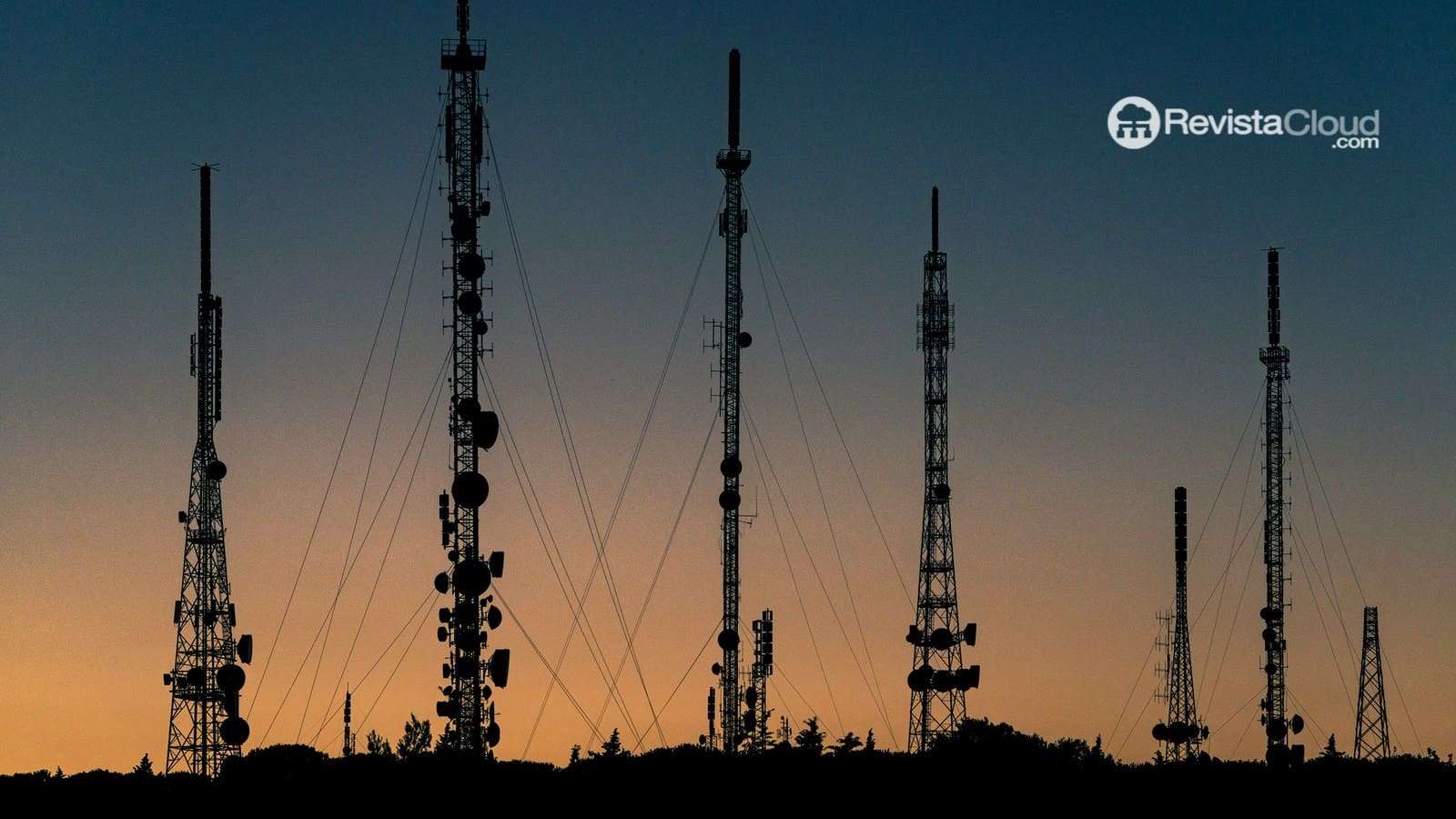
An antenna does not “broadcast internet” into the air without context. Behind every Wi-Fi connection, microwave link, 5G cell, or IoT network, there is an engineering decision: where to send the energy, with what power, at what frequency, with what gain, what obstacles are around, and what level of interference can be tolerated. The wireless signal may seem simple when it works, but it is a mix of physics, radio-electrical design, and planning.
Most users only consider whether there is coverage or not. Engineers, on the other hand, analyze radiation patterns, signal-to-noise ratio, gain, polarization, line of sight, effective radiated power, available spectrum, and environmental geometry. The difference between an omnidirectional, sector, or parabolic antenna is not just in its shape: it’s in how it distributes energy.
Understanding antenna types helps better interpret almost any telecommunications deployment. A home router, a mobile base station, a link between two buildings, a backhaul network, or an urban small cell address different problems. That’s why they use different types of antennas.
Omnidirectional, sectorial, and directional: not all cover the same
The omnidirectional antenna is the most familiar. It radiates in a 360-degree circle around its horizontal axis, allowing it to cover a wide area without targeting a specific point. Commonly found in Wi-Fi routers, access points, IoT networks, sensors, industrial gateways, and spaces where even signal distribution is important.
Its advantage is general coverage. Its limitation is that, by dispersing energy in all directions, it doesn’t reach as far as a more directive antenna. Indoors, walls, ceilings, furniture, glass, metal, and other wireless networks can significantly alter its performance.
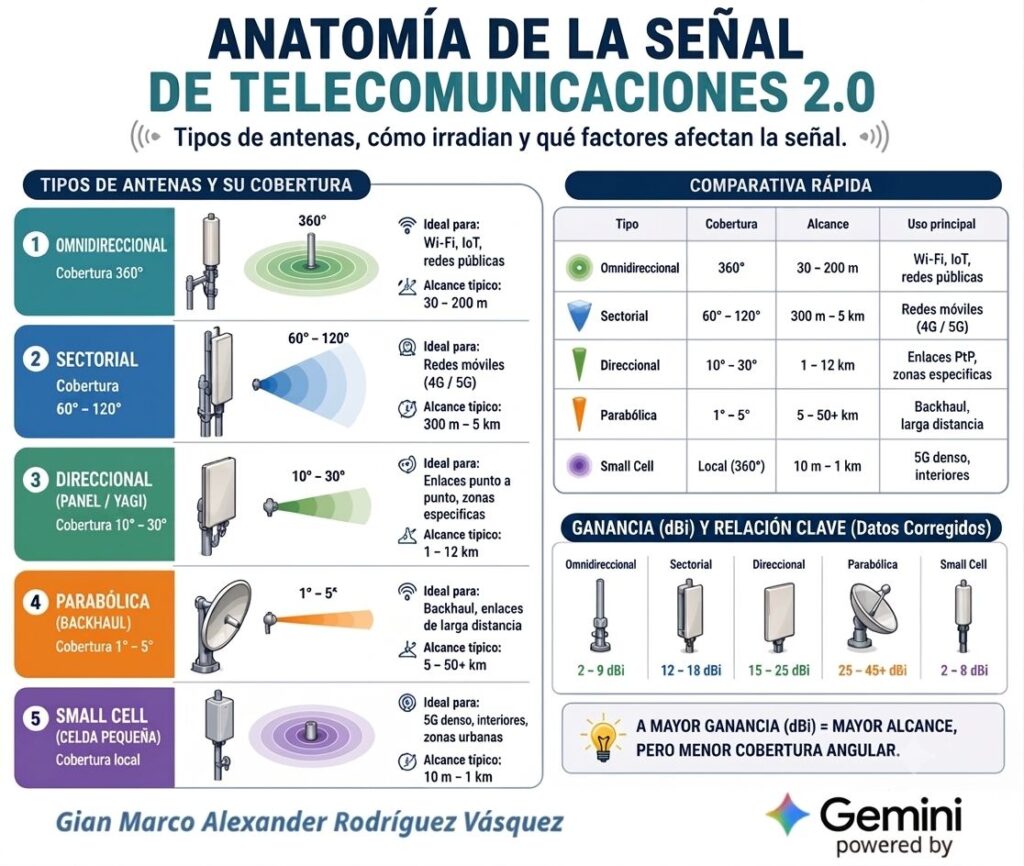
A sectorial antenna operates differently. Instead of covering 360 degrees, it concentrates the signal into a sector, typically between 60 and 120 degrees. This transmission method became essential in mobile networks, where a tower is divided into multiple sectors to reuse frequencies, organize traffic, and improve capacity. In 4G and 5G, sectorization allows targeting specific zones without wasting energy toward areas without users or where interference would occur.
Directional antennas, such as panels or Yagi antennas, narrow the beam even more. Their goal is to focus energy very precisely in one direction. They are used in point-to-point links, site-to-site connections, remote cameras, rural areas, WISP deployments, and situations where longer reach with less dispersion is needed.
| Type of antenna | Typical coverage | Common use | Main advantage |
|---|---|---|---|
| Omnidirectional | 360 degrees | Wi-Fi, IoT, local networks | Coverage around the emission point |
| Sectorial | 60-120 degrees | Mobile networks, WISP | Divides coverage into controlled zones |
| Directional | 10-30 degrees | Point-to-point links | Greater reach and less lateral interference |
| Parabolic | 1-5 degrees | Backhaul, satellite, long-distance | Very narrow beam with high gain |
| Small cell | Local coverage | Dense 5G, indoor, stadiums | Capacity close to the user |
The general idea is simple: the more focused the signal, the farther it can reach in that direction, but the narrower the angular coverage. An antenna covering all around cannot concentrate as much energy as one designed for a specific target.
The parabolic antenna and the role of backhaul
Parabolic antennas are easily recognized by their dish reflector. Their geometry allows them to concentrate signals into a very narrow beam, making them suitable for long-distance links, microwave communications, satellites, teleports, and backbone networks. In telecom, “backhaul” refers to the transport of data from access nodes back to the core network. Without backhaul, an access antenna can provide local coverage but lacks the pathway to the internet or the primary network.
A parabolic antenna isn’t aiming to cover a broad area—it’s meant to connect two specific points accurately. This requires precise alignment, line of sight, and stability. Even small misalignments can degrade the link, especially at high frequencies or over long distances.
This type of antenna clearly illustrates the difference between coverage and transport capacity. A mobile network might use sector antennas to communicate with phones but will rely on microwave links, fiber, or other backhaul solutions to connect base stations to the rest of the network.
Small cells represent the opposite end of the spectrum in terms of reach but are equally important. They are low-power base stations with limited coverage, designed to bring the network closer to users, especially in malls, stadiums, busy streets, stations, offices, hospitals, or areas where macro cells cannot meet all demand.
In 5G, small cells help densify the network. Reducing the distance between user and antenna improves signal quality, lowers latency, and increases capacity. The challenges go beyond technical considerations, including permitting, power, fiber deployment, urban aesthetics, maintenance, and coordination with the overall network.
Gain in dBi: more reach doesn’t mean better coverage
Antenna gain is usually expressed in dBi, decibels relative to an ideal isotropic antenna. Although such an isotropic antenna doesn’t physically exist, it serves as a theoretical reference: it would radiate equally in all directions. When an antenna has a higher dBi, it concentrates energy more effectively in its main direction.
This should not be confused with “more power” in a simple sense. A high-gain antenna doesn’t generate energy out of nowhere. It redistributes energy, focusing it in specific directions and reducing emission elsewhere. This is why a parabolic can have high gain but a very narrow coverage angle.
| Type of antenna | Typical gain | Practical interpretation |
| Omnidirectional | 2-9 dBi | Wide coverage, less focus |
| Sectorial | 12-18 dBi | Good zone coverage |
| Directional | 15-25 dBi | Specific links with longer reach |
| Parabolic | 25-45+ dBi | Long-distance, very narrow beam |
| Small cell | 2-8 dBi | Local, controlled coverage |
These values are approximate. Actual performance depends on frequency, permitted power, height, obstacles, cable losses, connector quality, polarization, weather, interference, and regulations. Two antennas with the same gain can perform very differently if installed poorly.
Remember that greater reach isn’t always desirable. In Wi-Fi, for example, a poorly chosen antenna can cause more interference, worse roaming, or dead zones. In mobile networks, overly broad coverage can lead to unwanted overlaps. In radio links, a very narrow beam requires more precise alignment.
The history of antennas is also the history of radio
Modern antennas are heirs of over a century of experimentation. Heinrich Hertz proved the existence of electromagnetic waves in the late 19th century, and Guglielmo Marconi brought wireless telegraphy into practical use, transforming maritime, military, and commercial communications. Since then, the evolution of radio has been about controlling more precisely how energy is emitted, received, and directed.
The Yagi-Uda antenna, developed in Japan in the 1920s by Shintaro Uda and Hidetsugu Yagi, marked a significant advancement in directive antennas. Used for decades in television, amateur radio, links, and radar applications, its simple yet effective design with one driven element and multiple parasitic elements allows for focused signals at a relatively low complexity.
Cellular sectorization emerged much later, with the expansion of mobile networks. Dividing a base station into sectors boosts capacity and allows frequency reuse. Today, with 4G and 5G, this principle is combined with MIMO, beamforming, active antennas, and smart radio management software for better environmental adaptation.
Small cells are a logical continuation: no longer is a high tower covering a large area enough. In dense urban zones, many small, coordinated, and user-close cells are necessary. The network becomes more distributed, smarter, and increasingly reliant on fiber, power sources, and urban planning.
Choosing an antenna is choosing the problem you want to solve
The right antenna isn’t necessarily the most powerful or the most expensive. It’s the one suited to the specific challenge. To cover an industrial warehouse with sensors, a well-placed omnidirectional might suffice. To connect two separated buildings, a directional antenna is more practical. To serve an urban area from a tower, a sector antenna makes sense. For capacity in a stadium, small cells are required. For a long-distance backbone link, a parabolic antenna could be the answer.
| Need | Common antenna choice |
| General Wi-Fi coverage | Omnidirectional or panel depending on design |
| Urban mobile network | Sectorial and active antennas |
| Building-to-building link | Directional or parabolic |
| Long-distance backhaul | Microwave parabolic |
| Indoor 5G coverage | Small cells |
| Distributed IoT network | Omnidirectional or sectorial |
| Specific rural zone | High-gain directional |
Radio planning remains a hands-on discipline. Formulas, simulations, and tools are helpful, but field measurements are essential. Materials, height, humidity, trees, terrain, or new buildings can all affect what seemed perfect on a plan.
The next generation of telecom won’t eliminate antennas—in fact, it will rely on them even more. Advanced 5G, 6G, low-earth orbit satellites, private industrial networks, massive IoT, connected vehicles, and smart cities will require more precise signal design.
Antennas are the visible part of an invisible network. They are on rooftops, lampposts, routers, towers, facades, satellites, and devices. Often overlooked, they determine if a connection arrives, if it’s clean, and if it has enough capacity. In telecom, the signal starts long before the screen lights up—it begins with how it is designed to radiate.
Frequently Asked Questions
What is an omnidirectional antenna?
It radiates signals in 360 degrees around its horizontal axis. Used in Wi-Fi, IoT, access points, and networks where coverage around the device is needed.
What’s the difference between a sector and a directional antenna?
A sector antenna covers a broad fan-shaped area, typically between 60 and 120 degrees. A directional antenna focuses signals in a specific direction, with a narrower beam and longer effective range.
What does dBi mean for an antenna?
dBi indicates the gain of an antenna relative to an ideal isotropic antenna. Higher dBi means more focused energy in the main radiation direction.
Why isn’t a higher-gain antenna always better?
Because higher gain usually means narrower coverage angle. It can increase the reach in one direction but reduce coverage on others or require more precise aiming.
What role do small cells play in 5G?
Small cells bring the network closer to users in high-density, indoor, or capacity-demanding areas. They improve signal quality, lower latency, and increase total capacity, though also involving challenges like permits and urban planning.
Image and reference: LinkedIN
