
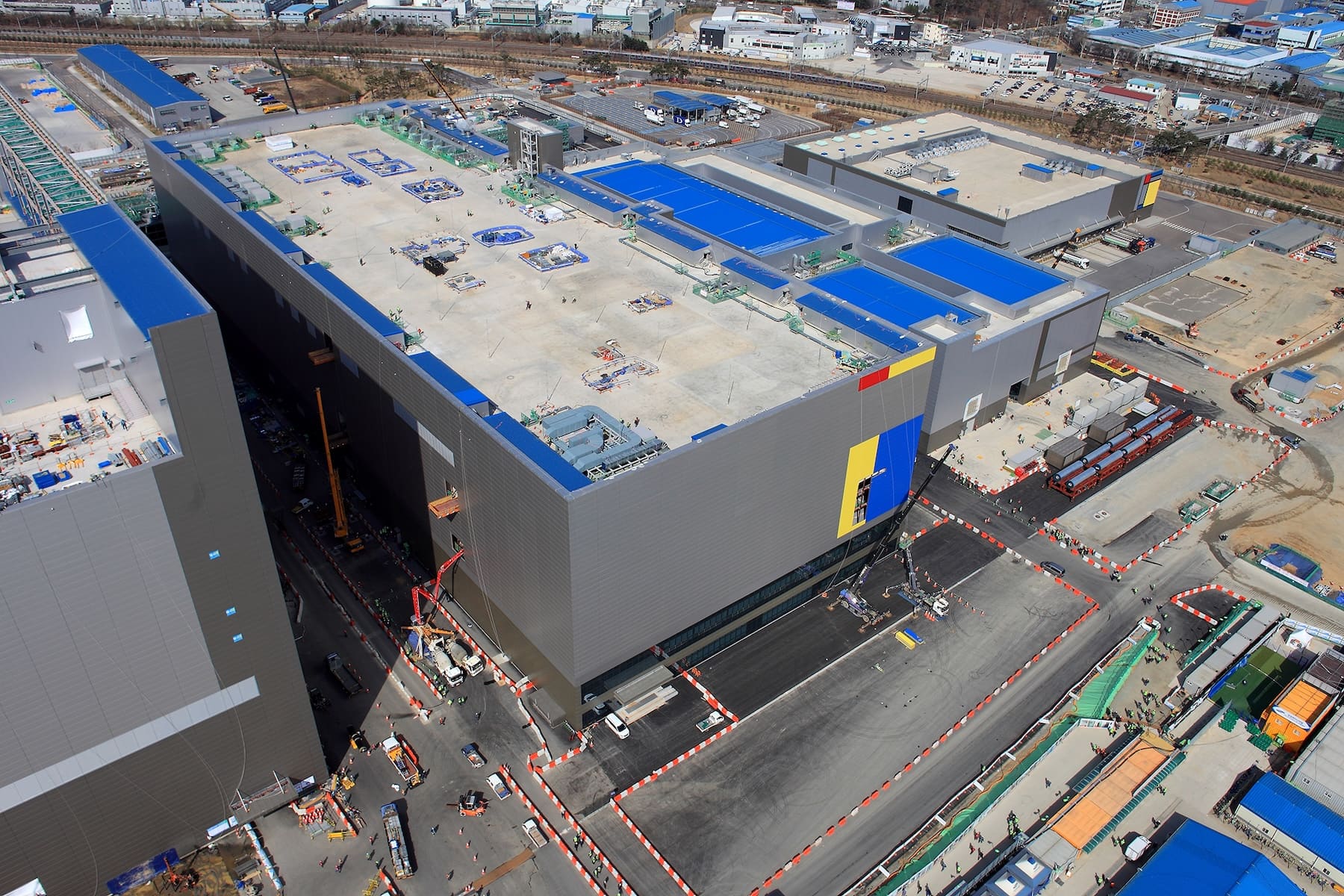
Samsung Electronics is laying the groundwork for the production of its next-generation 10nm-class DRAM, known as 1d DRAM. According to industry sources, the company is working with several equipment partners to introduce mass production machinery in the second or third quarter of next year, aiming to begin initial manufacturing phases by the end of 2027 if the schedule proceeds without delays.
This information has not been officially confirmed by Samsung, but it aligns with market pressure in the memory sector. Artificial intelligence has turned advanced DRAM and HBM memory into critical components for data centers, GPUs, accelerators, and servers. In this context, each node jump counts: higher density, lower power consumption, better performance, and greater capacity to support future generations of high-bandwidth memory.
The key point is that 1d DRAM wouldn’t just be another memory chip in the catalog. It could become the foundation for chips aimed at future HBM generations, including HBM5E by the end of the decade. For Samsung, which has been striving to regain momentum against SK hynix and Micron in AI memory, stabilizing this technology will be a top-tier industrial test.
What is 1d DRAM and why does it matter
DRAM naming conventions can be confusing. When terms like 1a, 1b, 1c, or 1d are used, they don’t follow a commercially visible scale like the logical nodes of 3nm or 2nm. Instead, they represent successive generations within the 10nm DRAM family. Each letter indicates further reductions and improvements in process, density, and efficiency.
The 1d DRAM is positioned as the seventh generation of 10nm-class DRAM, with industry sources suggesting line widths around 10 to 11 nanometers. The 1c generation, already used in recent products, operates approximately in the 11 to 12 nanometers range. The difference seems small but can be decisive in memory manufacturing, especially when producing millions of chips and stacking multiple layers in HBM packages.
| DRAM Generation | Technological Position | Expected Role |
|---|---|---|
| 1b | Fifth generation of 10nm class | Preceding advanced DRAM |
| 1c | Sixth generation of 10nm class | Base for HBM4 and HBM4E |
| 1d | Seventh generation of 10nm class | Candidate for future HBM5E memory |
| 10a / sub-10 nm | Next more aggressive jump | To be produced later, still in development |
| 3D DRAM | Future architecture | Potential path for next decade |
Reducing cell size in DRAM allows more memory to be fabricated per wafer, improves energy efficiency, and increases capacity. However, each generation becomes more challenging. DRAM relies on extremely small structures, complex capacitors, advanced lithography, precise materials, and strict defect control. Designing the process isn’t enough; manufacturing with high yield and volume is crucial.
This explains why some forecasts for 1d DRAM production within this year seem optimistic. If key equipment remains in development and validation, mass production can hardly commence before completing testing, installation, qualification, and yield stabilization.
AI shifts memory priorities
The rise of AI has placed memory at the center of the value chain. For years, focus was on GPUs, CPUs, and logical nodes. Now, the bottleneck is also bandwidth, capacity, and efficiency of the memory powering these accelerators.
HBM has become the most desired memory for advanced training and inference. It stacks vertically, connects via interposers or advanced packaging technologies, and offers bandwidth far surpassing conventional memories. But manufacturing competitive HBM requires cutting-edge DRAM, effective stacking, TSVs, advanced packaging, thermal management, and production capacity.
| Memory Type | Main Use | Relevance for AI |
| DDR5 | General servers and PCs | Balanced capacity and cost |
| LPDDR | Mobile devices and efficient systems | Low power consumption |
| GDDR | Graphics and some inference accelerators | High bandwidth, lower cost than HBM |
| HBM3E | Current GPUs and accelerators | Key memory for advanced AI |
| HBM4 / HBM4E | Next generation for AI | More bandwidth and efficiency |
| HBM5 / HBM5E | End of decade | Greater integration and technological demands |
Samsung has already begun shipping samples of 12-layer HBM4E, with speeds up to 16 Gbps and improvements in efficiency and thermal behavior. This generation builds on the experience of HBM4 and the 1c DRAM process. The next step will be to sustain a roadmap capable of competing in HBM5 and HBM5E, where 1d DRAM could play a significant role.
The battle with SK hynix and Micron is decided by yield
Samsung doesn’t compete alone. SK hynix has led much of the HBM market associated with AI GPUs, while Micron has gained visibility with HBM3E and data center products. In this market, speed to market isn’t always enough. Major clients, especially accelerators designers, demand capacity, power efficiency, performance, thermal stability, reliable packaging, and steady delivery.
Yield will be a critical factor. Advanced technology might look promising in samples, but if it produces too many defective or unstable chips, the actual cost skyrockets. In memory, where volumes are enormous and margins fluctuate, the difference between a mature process and a problematic one can determine entire contracts.
| Competitive Factor | Impact on HBM |
| DRAM Yield | Determines cost and actual volume |
| Stacking Capability | Enables more layers and capacity |
| Thermal Control | Prevents degradation in AI accelerators | Energy Efficiency | Reduces power consumption per server |
| Customer Validation | Decides adoption in GPUs and ASICs |
| Production Schedule | Indicates advantage in product cycles |
Samsung has a unique advantage: it can integrate memory, logic, foundry, and packaging within the same group. This integration could help in generations like HBM5, where the logic die, stacking, and DRAM need closer coordination. But this advantage only becomes a business advantage if industrial execution aligns.
Equipment and partners: the less visible part of the leap
Industry sources indicate that Samsung is developing 1d DRAM production equipment with several partners. This detail is more important than it appears. Memory jumps heavily depend on lithography, deposition, etching, metrology, inspection, and process control tools.
If a critical machine isn’t ready yet, the entire schedule shifts. First, the equipment must be developed. Then installed. Next, the process must be validated. Later, samples are produced, performance is measured, defects are corrected, yield is improved, and customers are qualified. That’s why commercial rollout often lags behind technological announcements.
| Stage | What Happens |
| Equipment Development | Adjustment of machinery with suppliers |
| Installation | Introduction of tools into production line |
| Initial Samples | Process and performance validation |
| Qualification | Internal and customer testing |
| Initial Production | Limited volumes |
| Mass Production | Scaling with stable yield |
Industry sources mentioned in the original report suggest equipment introduction in the second or third quarter of next year. With that schedule, starting initial production by the end of 2027 appears more realistic than mass production in 2026.
HBM5E: the strategic fundamental reason
The true strategic significance of 1d DRAM lies in the future HBM generations. Industry reports indicate Samsung might use 1d as the central die in HBM5E, expected around 2029. Before that, HBM5 is anticipated by some South Korean media around 2028, with developments in 12, 16, and even 20 layers.
HBM5E will not be just “more memory.” It must support AI accelerators with more parameters, higher bandwidth, more power consumption, and greater density per rack. It will also need to integrate with new packaging techniques and advanced base dies, possibly fabricated on very competitive logic nodes.
| HBM Generation | Approximate Status |
| HBM3E | Current industrial deployment in AI |
| HBM4 | Entering production and initial shipments in 2026 |
| HBM4E | Samples and customer validation |
| HBM5 | Preparation for end of the decade |
| HBM5E | Possible use of 1d DRAM as core memory |
For Samsung, 1d DRAM could be key to enhancing density and efficiency in this transition. However, it also increases complexity. The more advanced the DRAM, the more demanding the process control. The more layers in HBM, the more complex stacking and thermal management become.
A schedule with margin for uncertainty
Memory industry cycles are rapid but not magical. Having initial samples or internal progress doesn’t mean commercial production is assured. Timelines can shift due to equipment issues, yield problems, customer validation, actual demand, or capacity prioritization toward more profitable products.
There’s also tension between 1c and 1d. If demand for 1c-based HBM4 and HBM4E is very strong, Samsung might prioritize expanding and maturing 1c rather than rushing into 1d. This has happened before: a more stable technology can be more profitable in the short term than a more advanced yet immature one.
| Scenario | Implication |
| 1d progresses on schedule | Initial production by late 2027 |
| Equipment delay | Start pushed to 2028 |
| High demand for 1c | Samsung prioritizes HBM4/HBM4E |
| Better yield for 1d | Accelerates adoption for HBM5E |
| Slow customer validation | Commercial production takes longer |
Caution is warranted because Samsung has not officially announced a firm schedule for mass production of 1d DRAM. Still, the technological direction seems clear: the company needs a new DRAM generation to support its ambitions in AI memory.
Memory returns to the center of tech geopolitics
The advancement of 1d DRAM also has geopolitical implications. South Korea, the U.S., Taiwan, Japan, and China are all trying to secure positions along different parts of the semiconductor supply chain. Memory, long treated as a cyclical and volume market, is regaining huge strategic value due to AI.
Samsung plays a central role for South Korea. It not only manufactures DRAM and NAND but also develops foundry, logic, packaging, and electronics. In an industry where AI is absorbing capacity and capital, maintaining leadership in memory is vital to avoid dependence on rivals for a critical data center component.
The pressure isn’t only from SK hynix and Micron. Major clients like NVIDIA, AMD, Google, Amazon, Microsoft, and other accelerator designers require multiple suppliers capable of delivering advanced HBM. A strong Samsung enhances supply chain resilience, but only if it can meet or exceed performance and quality demands.
A race won with factories, not just announcements
The news about 1d DRAM indicates Samsung is preparing its next leap, but the real test will be in the factory. Advanced memory isn’t won by promising samples or internal timelines; it’s won through installed equipment, stable production, high yields, and customer adoption into AI platforms.
If Samsung manages to start initial 1d DRAM production by late 2027, it will build a stronger footing to compete in HBM5E. Delays could lead it to rely on 1c for HBM4E, but it would lose ground in the next generation.
The AI race has reaffirmed an old hardware truth: models may grab headlines, but without sufficient memory, they don’t scale. Each improvement in DRAM, HBM, and packaging determines how much data an accelerator can handle, how much energy it consumes, and how many servers a data center can deploy without escalating costs.
Samsung is aware of this. That’s why 1d DRAM isn’t just another memory node; it’s a strategic move to regain ground in the most profitable and critical segment: memory for artificial intelligence.
Frequently Asked Questions
What is Samsung’s 1d DRAM?
1d DRAM is Samsung’s seventh-generation 10nm-class DRAM, expected to reduce line size compared to 1c and improve density, performance, and energy efficiency.
When might production start?
Industry sources suggest Samsung is preparing equipment for launch in 2027. Initial production could begin towards the end of that year, though schedules may shift.
Why is it important for AI?
Because 1d DRAM could serve as the foundation for future HBM generations, especially HBM5E, which are essential for AI accelerators and servers.
How does it relate to HBM4E?
Samsung is already shipping HBM4E samples based on its 1c DRAM process. 1d DRAM would be the next step for subsequent generations, offering higher density and efficiency.
via: Zdnet
