
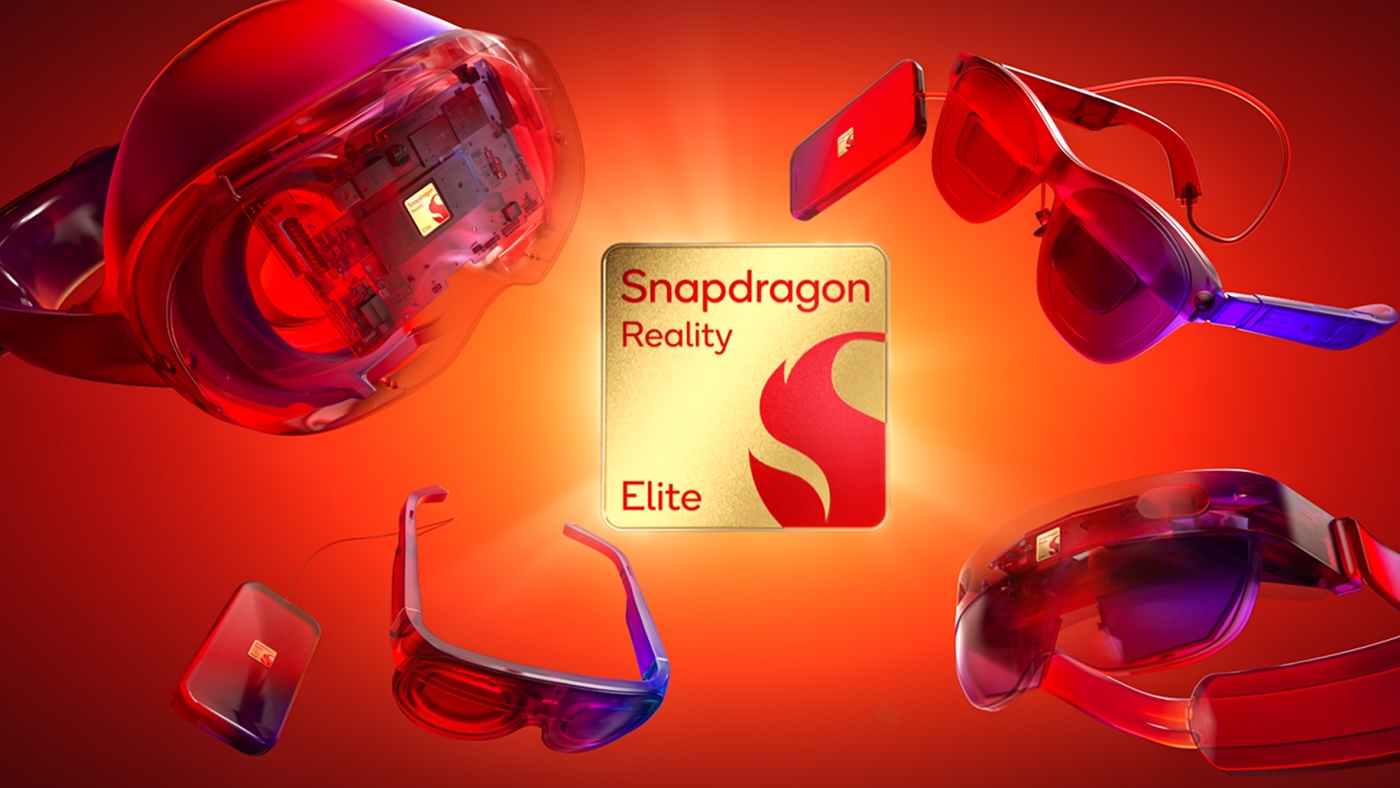
Qualcomm aims for the next generation of XR glasses and headsets to depend less solely on screens, sensors, and graphics. The company has introduced Snapdragon Reality Elite, a new platform designed to bring generative artificial intelligence directly to the device and address some of the longstanding issues hindering extended reality adoption: short battery life, heat generation, weight, latency, and a lack of genuinely useful applications.
The announcement was made at Augmented World Expo 2026 amid renewed interest in spatial computing. Apple has shifted the conversation toward premium experiences with Vision Pro, Meta continues pushing Quest and Ray-Ban Meta, Google is working towards a common foundation with Android XR, and various manufacturers are exploring lighter glasses that can be worn longer without feeling like a lab helmet. Qualcomm aspires to position itself at the center of this transition with a chip built from the ground up for XR and on-device AI.
Snapdragon Reality Elite is not aimed at a single format. The platform can power standalone mixed reality headsets with video passthrough as well as lightweight glasses with transparent optics connected to an external module. This flexibility is important because the market has yet to settle on a winning format: powerful headsets, lightweight glasses, hybrid devices, or a combination depending on use case.
AI on the device to help glasses understand their environment
The key innovation lies not just in enhanced graphics power but in integrated AI capability. Qualcomm states that Snapdragon Reality Elite can deliver up to 48 TOPS of AI processing and run large language and vision models directly on the device. The promise is that glasses will do more than just display content—they will understand space, recognize objects, interpret gestures, assist the user, and generate digital elements in real time.
This approach could redefine the usefulness of extended reality. Until now, many XR experiences relied on visual demos, games, or highly controlled applications. With local vision and language models, the device can gain context: what’s in front, where the hands are, what object is being manipulated, what information the user needs, and how to overlay digital content onto the physical world.
| Capacities of Snapdragon Reality Elite | What it can provide |
|---|---|
| Up to 48 TOPS of AI | Local execution of language and vision models |
| LLM and LVM models on device | Reduced reliance on the cloud |
| Head and hand tracking | More natural interaction |
| Real-time object generation | Contextual digital content |
| Photorealistic avatars | Immersive communication and collaboration |
| Contextual AI | More useful responses based on environment |
Local processing also offers advantages in privacy and latency. For glasses that capture the environment through cameras and sensors, sending all data to the cloud isn’t always practical or acceptable. Processing some information on the device can reduce delays, protect sensitive data, and enable smoother experiences.
Higher performance, less heat
Qualcomm compares Reality Elite with Snapdragon XR2+ Gen 2, highlighting significant improvements: up to 60% more GPU performance, 30% more CPU, and 160% more NPU performance. The NPU enhancement is especially important for spatial AI, but gains in CPU and GPU matter too. XR applications demand rendering, spatial perception, tracking, image composition, and immediate response.
The chip supports images of up to 4.4K per eye at 90 frames per second. On paper, this translates to sharper visuals, smoother motion, and higher fidelity. In practice, image quality isn’t a luxury—if resolution is low, latency high, or motion jittery, the experience becomes uncomfortable.
| Declared improvements over XR2+ Gen 2 | Expected impact |
| 60% more GPU performance | Richer graphics and more complex scenes |
| 30% more CPU performance | More capacity for logic, apps, and multitasking |
| 160% more NPU performance | More capable local AI |
| Up to 20% more battery life | Extended usage |
| Up to 12°C lower under load | More comfortable devices |
| 4.4K per eye at 90 fps | Sharper and smoother images |
Thermal management is a critical factor. A hot smartphone can be annoying; glasses that heat up on the face are much worse. Qualcomm guarantees the platform can operate up to 12°C cooler under load and offer up to 20% more battery life for the same workload. If these improvements translate well into commercial products, they could enable thinner, lighter, and longer-lasting devices.
Video passthrough and transparent optics: two paths for XR
Snapdragon Reality Elite targets two main categories: video-see-through headsets and optical-see-through glasses. The former use cameras to display the real world on a screen and blend it with digital content. The latter allow users to see the environment directly through optics with digital overlays.
Both approaches have strengths and limitations. Video passthrough offers greater control over the image and digital integration but introduces dependency on cameras, screens, and latency. Transparent optics may feel more natural and lightweight but require complex solutions for visualization, brightness, field of view, and alignment.
| Format | Main advantage | Challenge |
| Video-see-through | Greater control over mixed reality | Latency, cameras, weight |
| Optical-see-through | Lightweight glasses and direct vision | Field of view, brightness, optics complexity |
| Stand-alone headset | More integrated power | Weight and battery life |
| Tethered glasses | Less weight on head | Dependence on external module |
| Enterprise XR | Clear use cases | Cost and deployment |
| Consumer XR | Broader market potential | Applications and comfort |
Qualcomm is pursuing both paths because the market remains open. Meta has shown that headsets can succeed if pricing and content are right. Apple has demonstrated the potential of premium experiences, albeit at a high cost. XREAL, Google, and other manufacturers are betting on lighter, connected glasses, a direction that could make more sense for everyday use.
XREAL Aura, Android XR, and the effort to build an ecosystem
Snapdragon Reality Elite will first appear in Android XR devices like XREAL Project Aura, which the company has announced as transparent optical glasses with Android XR and AI features. XREAL confirmed Aura will launch in fall and be powered by Qualcomm’s new platform.
This combination is significant because Android XR aims to be a common foundation for headset and glasses manufacturers, similar to Android’s role in smartphones. Google provides the operating system, services, Gemini AI, and app ecosystem; Qualcomm offers silicon, connectivity, and technical reference; manufacturers like XREAL develop hardware and product design.
| Part of the ecosystem | Role |
| Android XR | Operating system and app platform |
| Snapdragon Reality Elite | Processing, AI, graphics, perception |
| XREAL Aura | First transparent optical devices |
| Google Gemini | Multimodal AI and services |
| Developers | Spatial applications | OEMs | Form factors, pricing, user experience |
The augmented reality space is filled with platforms that promised much but never achieved critical mass. Now, advances in displays, chips, sensors, AI models, and development tools have matured the ecosystem. Still, the challenge remains: having enough applications to justify wearing a device on the face.
Developers: the real bottleneck
While Qualcomm can improve performance, efficiency, and AI capabilities, XR’s success ultimately depends on developers. Without useful applications, even the most advanced hardware remains limited to demos, immersive videos, and niche uses.
Qualcomm has also introduced initiatives to facilitate smart glasses and AI-enabled devices, including reference designs and kits aimed at accelerating development. This is crucial because the XR market needs diversity: consumer glasses, professional headsets, industrial devices, education, healthcare, training, design, remote assistance, and entertainment.
| Use case | XR potential with AI |
| Technical assistance | Visual guides on real machinery |
| Training | Immersive simulations and contextual feedback |
| Healthcare | Visualization, procedural support, education |
| Industrial design | Prototyping and spatial review |
| Education | Interactive content and multimodal tutoring |
| Gaming | Mixed worlds with natural interaction |
| Workplace | Virtual screens and collaboration |
| Everyday consumption | Contextual info and translation |
AI might be the key element that makes glasses truly useful. Showing floating windows isn’t enough—the device must understand the context and assist seamlessly, without forcing users to navigate complex menus. When contextual AI functions well, XR can evolve from a “secondary display” to an ambient interface.
Qualcomm aims to defend its position in a strategic category
Qualcomm has maintained a strong presence in XR for years. Its platforms have powered many of the most significant headsets—from Meta devices to enterprise projects. With Reality Elite, the goal is to preserve that leadership as competition shifts focus from rendering to local AI, thermal efficiency, and ecosystem compatibility.
This strategy also aligns with Qualcomm’s broader vision. The company wants to bring AI to PCs, smartphones, cars, wearables, IoT, and personal devices. XR fits into this because it combines perception, interaction, connectivity, and local processing. If smart glasses succeed, Qualcomm’s position as the chip provider could become highly advantageous.
However, risks remain. The XR market has experienced cycles of hype and disappointment. Many companies have tested devices, but mass deployment remains limited. In consumer markets, price, comfort, battery life, and content continue to hinder adoption. Qualcomm provides a vital component but doesn’t guarantee success.
XR enters a more realistic phase
Snapdragon Reality Elite doesn’t solve all extended reality issues, but sets a more pragmatic course. Devices require more local AI, less heat, longer battery life, better tracking, and more portable formats. The announcement targets these points directly.
The next phase won’t hinge solely on a single specification. Numbers like 48 TOPS, 4.4K per eye, or 90 fps won’t be enough. Success will depend on how these specs translate into glasses that people want to wear: lightweight, comfortable, useful, with practical applications and without feeling like a tech demo.
Qualcomm has established a solid technical foundation for this transition. Now, manufacturers, Google, and developers must take it further. If Android XR consolidates an ecosystem and products like XREAL Aura gain traction outside trade shows, spatial computing could become significantly more practical.
Extended reality has been searching for its moment. AI may not be the full answer, but it might be the missing piece that shifts XR from just a face-mounted screen to an interactive interface capable of understanding the world around the user.
Frequently Asked Questions
What is Snapdragon Reality Elite?
Snapdragon Reality Elite is Qualcomm’s new platform for premium XR devices, designed for mixed reality headsets and transparent optical glasses with integrated AI on the device.
How much AI power does it offer?
Qualcomm claims up to 48 TOPS of AI processing, capable of running large language and vision models directly on the device.
Which devices will use Snapdragon Reality Elite?
It will first be used in Android XR devices like XREAL Project Aura. Qualcomm also mentions future products from Play for Dream and other manufacturers.
What improvements does it offer over Snapdragon XR2+ Gen 2?
Qualcomm states up to 60% more GPU performance, 30% more CPU, 160% more NPU, up to 20% longer battery life, and operation up to 12°C cooler under load.
