
Innoscience has achieved a significant victory in China within its long-standing patent dispute with Infineon over gallium nitride (GaN) technology. The Supreme People’s Court of China has upheld an order preventing Infineon from selling, offering for sale, or importing certain GaN products into the Chinese market after a Suzhou court found that those products infringed on an Innoscience patent.
This decision marks the definitive closure of this particular front in China and comes just weeks after another setback for Infineon in the country: the Beijing Intellectual Property Court confirmed the validity of two key Innoscience patents related to GaN and rejected invalidation requests filed by the German company.
The case should not be viewed as a sweeping victory for either side. The battle between Innoscience and Infineon plays out across multiple countries with varying outcomes. For example, in May, Infineon secured a favorable decision from the U.S. International Trade Commission (ITC), which ordered restrictions on the import and sale of certain Innoscience products for infringing a GaN patent. The company has also made progress in Germany. The overall picture is of an international IP war over a technology that is beginning to become strategically critical.
What the Chinese judiciary has decided
According to Innoscience’s statement reported by specialized media, the Supreme People’s Court of China confirmed an earlier ruling from the Intermediate People’s Court of Suzhou, dated May 27. That court had concluded that certain Infineon GaN products infringed an Innoscience patent and ordered the cessation of sale, offer for sale, and import of the affected products in China.
The ruling also includes a compensation of 10 million yuan, approximately $1.38 million, in favor of Innoscience. Beyond the monetary amount, the key aspect is the commercial ban order, as China is one of the world’s largest markets for power semiconductors, consumer electronics, electric vehicles, data centers, and industrial systems.
| Case Element in China | Main Data |
|---|---|
| Plaintiff | Innoscience |
| Defendant | Infineon Technologies |
| Technology | Gallium Nitride (GaN) |
| Initial Court | Intermediate People’s Court of Suzhou |
| Date of Initial Ruling | May 27, 2026 |
| Appeal Court | Supreme People’s Court of China |
| Confirmed Measure | Prohibition of sale, offer for sale, and importation |
| Compensation | 10 million yuan |
| Scope | Specific GaN products in China |
This decision follows the April 24, 2026, ruling by the Beijing Patent Tribunal, which upheld the validity of two Innoscience invention patents. The company emphasizes that these patents are the same ones invoked in its national litigation against Infineon.
This detail matters because a common defense in patent litigation is to seek invalidation of the patent either prior to or during infringement proceedings. If the patent is invalidated, the case loses its strength. In this front, Infineon failed to invalidate the patents before the Chinese authorities or the specialized court in Beijing.
Small technology, big strategic value
GaN is a semiconductor material that enables the production of more efficient, faster, and smaller power devices compared to many traditional silicon solutions. It is used in fast chargers, industrial electronics, telecommunications, automotive applications, renewable energy systems, and increasingly in power supplies for data centers and artificial intelligence.
Its appeal lies in faster switching, lower energy loss, higher power density, and more compact designs. In a world where every watt counts—from electric cars to AI racks—this efficiency has direct economic value.
| GaN Applications | Why it Matters |
| Fast Chargers | Smaller, more efficient devices |
| Electric Vehicles | Power conversion efficiency and reduced losses |
| Renewable Energy | More efficient power electronics |
| Telecommunications | Power supplies and RF components |
| Data Centers | High-density, energy-efficient conversion |
| Artificial Intelligence | Lower losses in demanding power systems |
The dispute between Innoscience and Infineon occurs at a time when the GaN market is becoming more competitive. TrendForce forecasts Innoscience as the global leader in GaN power devices in 2024 with a 29.9% market share. Infineon ranks fourth with 10.3%, though it maintains a much broader position in power semiconductors and possesses an extensive IP portfolio.
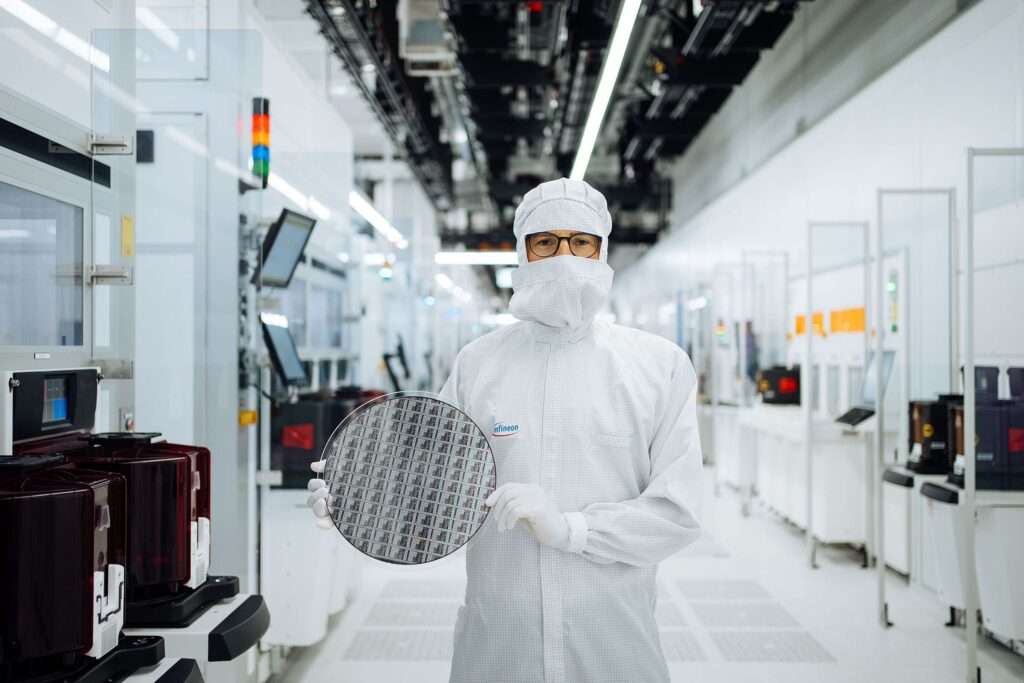
Additionally, Infineon has publicly defended its ability to manufacture GaN on 300 mm wafers, a technology it claims can lower costs by enabling more chips per wafer compared to 200 mm processes. Innoscience, meanwhile, has established itself as a leading Chinese player in GaN-on-silicon with 8-inch wafer production.
The battle is not limited to China
Innoscience’s victory in China does not erase favorable decisions for Infineon in other markets. In May 2026, the U.S. International Trade Commission (ITC) confirmed an earlier decision that Innoscience infringed an Infineon GaN patent. The ITC ordered import and sale bans on certain Innoscience products, though subject to a 60-day presidential review period.
Infineon views this ruling as a confirmation of the strength of its IP portfolio. It states it holds around 450 patent families related to GaN and will actively defend its technologies.
In contrast, Innoscience argues that its redesigned current products do not infringe the U.S. patent in question and that its shipments to the U.S. market are unaffected. This variance in interpretations illustrates why these litigations are so complex: a victory may impact specific products, older generations, redesigned models, or particular markets.
| Jurisdiction | Key Outcome |
| China | Innoscience maintains patents and secures a ban on certain Infineon products |
| United States | ITC rules in favor of Infineon in a related case |
| Germany | Infineon wins favorable rulings against Innoscience in litigation |
| Global Market | Legal disputes continue across multiple fronts and regions |
In Germany, Infineon has also claimed wins in Munich courts in cases related to multiple patents and a utility model. This confirms that the fight over GaN is not isolated but part of a global competition over a technology with high growth potential.
China bolsters its local champion
The Chinese Supreme Court’s ruling also carries an industrial message. Innoscience is among China’s most visible companies in compound semiconductors and has become a strategic asset for the country’s technological ambitions. Amid tensions between China, the U.S., and Europe over chips, materials, and supply chains, a judicial victory against a European leader like Infineon strengthens its domestic position.
According to Asian media, Innoscience’s shares surged significantly after the ruling, and other Chinese companies involved in compound semiconductors also reported gains. The market interpreted the decision as a positive sign for China’s autonomy in power technologies.
It’s important not to overstate. Infineon remains a leading global player in power semiconductors, with a strong position in silicon, silicon carbide, and GaN. However, the setback in China could impact its commercial margins in a key market, especially if the affected products are in high-demand applications.
The structure of the market itself explains the tension. GaN is not an entirely mature or closed technology. There is still room to contest processes, architectures, patents, packaging, costs, and applications. In this phase, safeguarding IP can be as crucial as securing new customers.
AI, data centers, and power electronics intensify the pressure
Interest in GaN is growing due to the energy demands of artificial intelligence and high-density data centers. New power architectures for AI racks aim to reduce losses, handle more power, and improve efficiency in every conversion stage. Technologies like GaN and SiC are central to these developments, each with its specific application niches.
NVIDIA has indicated moving toward higher voltage power architectures for future AI racks, and several semiconductor suppliers—such as Infineon, Innoscience, Texas Instruments, Navitas, onsemi—are competing to position themselves in this transition. The landscape features ongoing innovations in power supply solutions for AI infrastructure.
In this context, patents become a tool for direct competition. If a provider faces restrictions in a market due to a court order, its customers may need to redesign, seek alternatives, or regionalize supply chains. Conversely, if a company blocks a rival in another jurisdiction, it gains leverage and negotiating power.
| Pressures Impacting GaN | Implications |
| The rise of AI | Increased demand for efficient power supplies |
| High-density data centers | Need for lower losses and higher density |
| Electric Vehicles | More compact power electronics |
| Renewables | Efficient energy conversion |
| Geopolitical tensions | Growing interest in local suppliers |
| Patent disputes | Risk of market blockages due to legal actions |
The clear takeaway for industrial clients is that IP risk is now a variable in purchasing decisions. Price, efficiency, and availability are no longer enough—it’s essential to consider whether a product can be sold in all relevant markets, whether it faces legal challenges, and whether suitable alternatives exist.
Patent wars foreshadow market maturity
Patent battles often emerge when a technology shifts from experimental to mainstream commercial use. GaN has moved beyond niche applications in fast chargers and is aiming to expand into automotive, infrastructure, industry, and data centers. As volume increases, disputes become more likely.
Innoscience secured an important victory locally, while Infineon achieved wins in the U.S. and Germany. Both sides can present compelling cases to their clients and investors. The conflict is unlikely to resolve with a single ruling but will involve a mix of redesigns, appeals, licensing, and new lawsuits.
From Europe’s perspective, the case reflects a broader strategic view. Infineon remains a major European semiconductor firm, critical to electrification, automotive, and industrial sectors. For China, Innoscience exemplifies the capacity to compete in a technology that can reduce dependence on external sources. The clash is not just legal; it signifies the emerging industrial competition over energy layers in the digital sphere.
While the Chinese ruling doesn’t alter the global balance of GaN, it sends a potent message: Chinese providers will not only compete on price or capacity but will also actively defend their patent portfolios in courts. In an industry increasingly defined by technological sovereignty, energy efficiency, and AI, legal capability is part of the broader industrial strategy.
Frequently Asked Questions
What has the Supreme People’s Court of China decided?
It confirmed an order that prevents Infineon from selling, offering for sale, or importing certain GaN products into China due to patent infringement by Innoscience.
How much must Infineon pay?
The earlier Suzhou court ruling awarded Innoscience 10 million yuan, and the Chinese Supreme Court upheld the ban order.
Does this mean Innoscience has won the entire global dispute?
Not entirely. Innoscience scored a major victory in China, but Infineon has secured favorable rulings in the U.S. and Germany in other patent cases related to GaN.
Why is GaN so important?
Because it enables more efficient, compact, and faster power devices, crucial for chargers, electric vehicles, renewables, telecommunications, data centers, and AI infrastructure.
via: innoscience
